
Mapa mental
Psychology: Observations
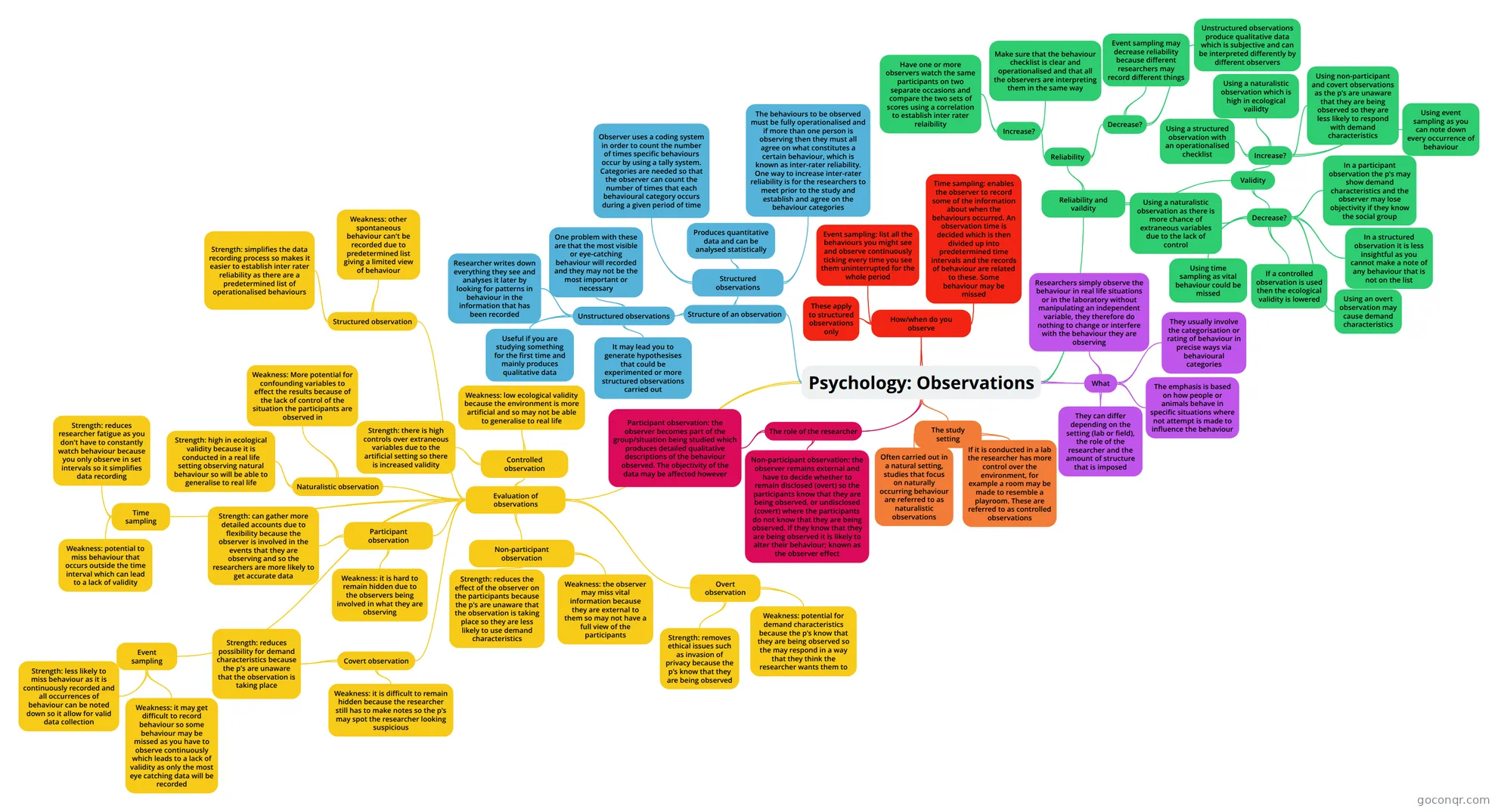
Mind map: Psychology observations
Conteúdo do mapa
Psychology: Observations
What
- Researchers simply observe the behaviour in real life situations or in the laboratory without manipulating an independent variable, they therefore do nothing to change or interfere with the behaviour they are observing
- They usually involve the categorisation or rating of behaviour in precise ways via behavioural categories
- The emphasis is based on how people or animals behave in specific situations where not attempt is made to influence the behaviour
- They can differ depending on the setting (lab or field), the role of the researcher and the amount of structure that is imposed
The study setting
- Often carried out in a natural setting, studies that focus on naturally occurring behaviour are referred to as naturalistic observations
- If it is conducted in a lab the researcher has more control over the environment, for example a room may be made to resemble a playroom. These are referred to as controlled observations
The role of the researcher
- Participant observation: the observer becomes part of the group/situation being studied which produces detailed qualitative descriptions of the behaviour observed. The objectivity of the data may be affected however
- Non-participant observation: the observer remains external and have to decide whether to remain disclosed (overt) so the participants know that they are being observed, or undisclosed (covert) where the participants do not know that they are being observed. If they know that they are being observed it is likely to alter their behaviour; known as the observer effect
Structure of an observation
- Unstructured observations
- Researcher writes down everything they see and analyses it later by looking for patterns in behaviour in the information that has been recorded
- Useful if you are studying something for the first time and mainly produces qualitative data
- It may lead you to generate hypothesises that could be experimented or more structured observations carried out
- One problem with these are that the most visible or eye-catching behaviour will recorded and they may not be the most important or necessary
- Structured observations
- Observer uses a coding system in order to count the number of times specific behaviours occur by using a tally system. Categories are needed so that the observer can count the number of times that each behavioural category occurs during a given period of time
- Produces quantitative data and can be analysed statistically
- The behaviours to be observed must be fully operationalised and if more than one person is observing then they must all agree on what constitutes a certain behaviour, which is known as inter-rater reliability. One way to increase inter-rater reliability is for the researchers to meet prior to the study and establish and agree on the behaviour categories
- Unstructured observations
How/when do you observe
- These apply to structured observations only
- Event sampling: list all the behaviours you might see and observe continuously ticking every time you see them uninterrupted for the whole period
- Time sampling: enables the observer to record some of the information about when the behaviours occurred. An observation time is decided which is then divided up into predetermined time intervals and the records of behaviour are related to these. Some behaviour may be missed
Reliability and vaildity
- Reliability
- Increase?
- Have one or more observers watch the same participants on two separate occasions and compare the two sets of scores using a correlation to establish inter rater relaibility
- Make sure that the behaviour checklist is clear and operationalised and that all the observers are interpreting them in the same way
- Decrease?
- Unstructured observations produce qualitative data which is subjective and can be interpreted differently by different observers
- Event sampling may decrease reliability because different researchers may record different things
- Increase?
- Validity
- Increase?
- Using a structured observation with an operationalised checklist
- Using a naturalistic observation which is high in ecological vailidty
- Using non-participant and covert observations as the p's are unaware that they are being observed so they are less likely to respond with demand characteristics
- Using event sampling as you can note down every occurrence of behaviour
- Decrease?
- Using a naturalistic observation as there is more chance of extraneous variables due to the lack of control
- Using time sampling as vital behaviour could be missed
- If a controlled observation is used then the ecological validity is lowered
- Using an overt observation may cause demand characteristics
- In a participant observation the p's may show demand characteristics and the observer may lose objectivity if they know the social group
- In a structured observation it is less insightful as you cannot make a note of any behaviour that is not on the list
- Increase?
- Reliability
Evaluation of observations
- Controlled observation
- Strength: there is high controls over extraneous variables due to the artificial setting so there is increased validity
- Weakness: low ecological validity because the environment is more artificial and so may not be able to generalise to real life
- Naturalistic observation
- Strength: high in ecological validity because it is conducted in a real life setting observing natural behaviour so will be able to generalise to real life
- Weakness: More potential for confounding variables to effect the results because of the lack of control of the situation the participants are observed in
- Participant observation
- Strength: can gather more detailed accounts due to flexibility because the observer is involved in the events that they are observing and so the researchers are more likely to get accurate data
- Weakness: it is hard to remain hidden due to the observers being involved in what they are observing
- Non-participant observation
- Strength: reduces the effect of the observer on the participants because the p's are unaware that the observation is taking place so they are less likely to use demand characteristics
- Weakness: the observer may miss vital information because they are external to them so may not have a full view of the participants
- Covert observation
- Strength: reduces possibility for demand characteristics because the p's are unaware that the observation is taking place
- Weakness: it is difficult to remain hidden because the researcher still has to make notes so the p's may spot the researcher looking suspicious
- Overt observation
- Strength: removes ethical issues such as invasion of privacy because the p's know that they are being observed
- Weakness: potential for demand characteristics because the p's know that they are being observed so the may respond in a way that they think the researcher wants them to
- Structured observation
- Strength: simplifies the data recording process so makes it easier to establish inter rater reliability as there are a predetermined list of operationalised behaviours
- Weakness: other spontaneous behaviour can't be recorded due to predetermined list giving a limited view of behaviour
- Time sampling
- Strength: reduces researcher fatigue as you don't have to constantly watch behaviour because you only observe in set intervals so it simplifies data recording
- Weakness: potential to miss behaviour that occurs outside the time interval which can lead to a lack of validity
- Event sampling
- Strength: less likely to miss behaviour as it is continuously recorded and all occurrences of behaviour can be noted down so it allow for valid data collection
- Weakness: it may get difficult to record behaviour so some behaviour may be missed as you have to observe continuously which leads to a lack of validity as only the most eye catching data will be recorded
- Controlled observation
Informações
- Descrição
- Mapa Mental sobre Psychology: Observations, criado por millymoo83 em 03-05-2015.
- Criado por
- millymoo83
- Visualizações
- 3
- Avaliação