
Mapa mental
The Victorian Age (1837-1901)
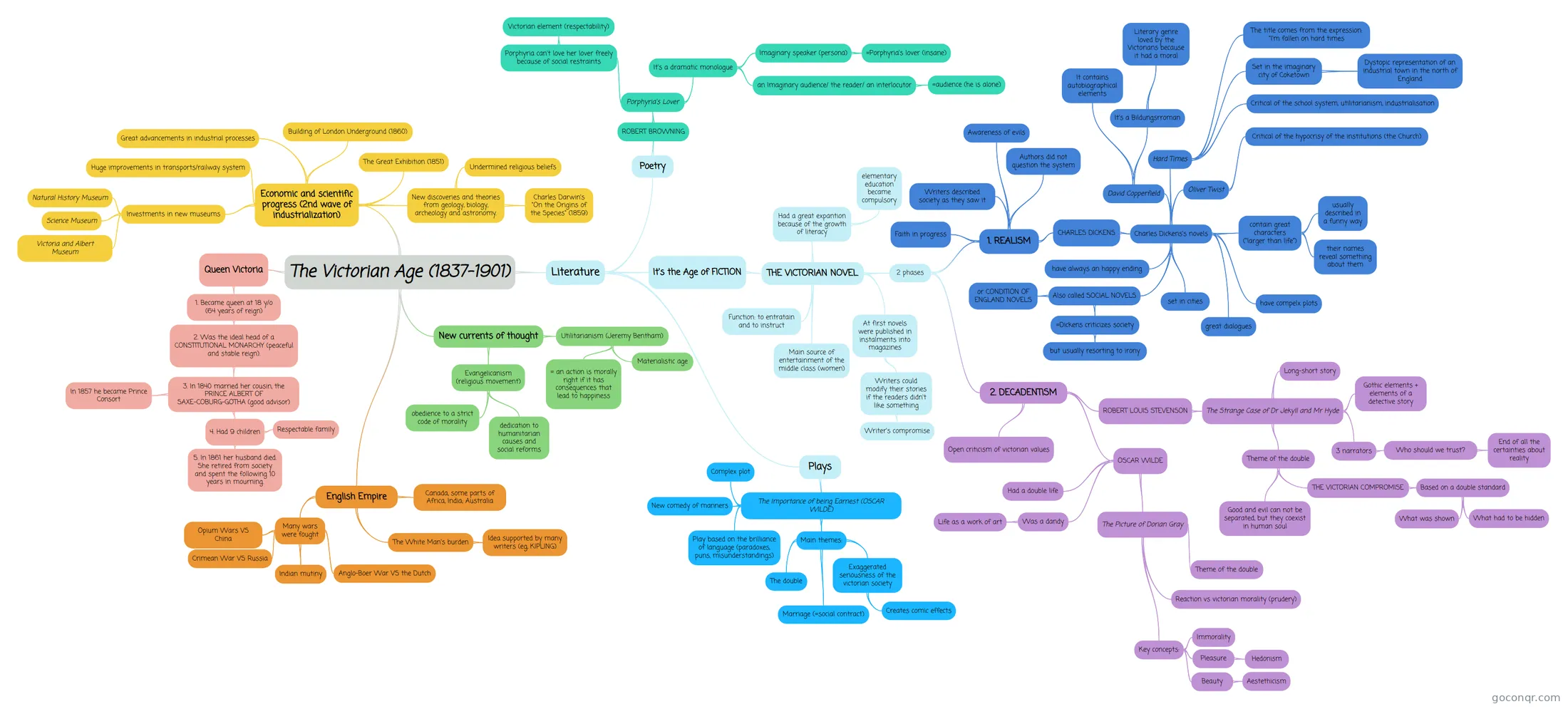
Mind map: The Victorian Age (1837-1901)
Conteúdo do mapa
The Victorian Age (1837-1901)
Queen Victoria
- 1. Became queen at 18 y/o (64 years of reign)
- 2. Was the ideal head of a CONSTITUTIONAL MONARCHY (peaceful and stable reign).
- 3. In 1840 married her cousin, the PRINCE ALBERT OF SAXE-COBURG-GOTHA (good advisor)
- In 1857 he became Prince Consort
- 4. Had 9 children
- Respectable family
- 5. In 1861 her husband died. She retired from society and spent the following 10 years in mourning.
- 3. In 1840 married her cousin, the PRINCE ALBERT OF SAXE-COBURG-GOTHA (good advisor)
- 2. Was the ideal head of a CONSTITUTIONAL MONARCHY (peaceful and stable reign).
- 1. Became queen at 18 y/o (64 years of reign)
Literature
- Poetry
- ROBERT BROWNING
- Porphyria's Lover
- It's a dramatic monologue
- Imaginary speaker (persona)
- =Porphyria's lover (insane)
- an Imaginary audience/ the reader/ an interlocutor
- =audience (he is alone)
- Imaginary speaker (persona)
- Porphyria can't love her lover freely because of social restraints
- Victorian element (respectability)
- It's a dramatic monologue
- Porphyria's Lover
- ROBERT BROWNING
- It's the Age of FICTION
- THE ViCTORIAN NOVEL
- Function: to entratain and to instruct
- Had a great expantion because of the growth of literacy
- elementary education became compulsory
- Main source of entertainment of the middle class (women)
- At first novels were published in instalments into magazines
- Writers could modify their stories if the readers didn't like something
- Writer's compromise
- Writers could modify their stories if the readers didn't like something
- 2 phases
- 1. REALISM
- CHARLES DICKENS
- Charles Dickens's novels
- David Copperfield
- It's a Bildungsrroman
- Literary genre loved by the Victorians because it had a moral
- It contains autobiographical elements
- It's a Bildungsrroman
- Hard Times
- The title comes from the expression: "I'm fallen on hard times
- Set in the imaginary city of Coketown
- Dystopic representation of an industrial town in the north of England
- Critical of the school system, utilitarianism, industrialisation
- Oliver Twist
- Critical of the hypocrisy of the institutions (the Church)
- have always an happy ending
- set in cities
- contain great characters ("larger than life")
- usually described in a funny way
- their names reveal something about them
- Also called SOCIAL NOVELS
- =Dickens criticizes society
- but usually resorting to irony
- or CONDITION OF ENGLAND NOVELS
- =Dickens criticizes society
- have compelx plots
- great dialogues
- David Copperfield
- Charles Dickens's novels
- Writers described society as they saw it
- Faith in progress
- Awareness of evils
- Authors did not question the system
- CHARLES DICKENS
- 2. DECADENTiSM
- ROBERT LOUIS STEVENSON
- The Strange Case of Dr Jekyll and Mr Hyde
- Long-short story
- Gothic elements + elements of a detective story
- 3 narrators
- Who should we trust?
- End of all the certainties about reality
- Who should we trust?
- Theme of the double
- THE VICTORIAN COMPROMISE
- Based on a double standard
- What was shown
- What had to be hidden
- Based on a double standard
- Good and evil can not be separated, but they coexist in human soul
- THE VICTORIAN COMPROMISE
- The Strange Case of Dr Jekyll and Mr Hyde
- OSCAR WILDE
- The Picture of Dorian Gray
- Reaction vs victorian morality (prudery)
- Theme of the double
- Key concepts:
- Immorality
- Pleasure
- Hedonism
- Beauty
- Aestethicism
- Had a double life
- Was a dandy
- Life as a work of art
- The Picture of Dorian Gray
- Open criticism of victorian values
- ROBERT LOUIS STEVENSON
- 1. REALISM
- THE ViCTORIAN NOVEL
- Plays
- The Importance of being Earnest (OSCAR WILDE)
- New comedy of manners
- Main themes:
- The double
- Marriage (=social contract)
- Exaggerated seriousness of the victorian society
- Creates comic effects
- Play based on the brilliance of language (paradoxes, puns, misunderstandings)
- Complex plot
- The Importance of being Earnest (OSCAR WILDE)
- Poetry
Economic and scientific progress (2nd wave of industrialization)
- The Great Exhibition (1851)
- Building of London Underground (1860)
- Great advancements in industrial processes
- Huge improvements in transports/railway system
- Investments in new museums
- Natural History Museum
- Science Museum
- Victoria and Albert Museum
- New discoveries and theories from geology, biology, archeology and astronomy.
- Charles Darwin's "On the Origins of the Species" (1859)
- Undermined religious beliefs
New currents of thought
- Evangelicanism (religious movement)
- obedience to a strict code of morality
- dedication to humanitarian causes and social reforms
- Utilitarianism (Jeremy Bentham)
- = an action is morally right if it has consequences that lead to happiness
- Materialistic age
- Evangelicanism (religious movement)
English Empire
- Canada, some parts of Africa, India; Australia
- The White Man's burden
- Idea supported by many writers (eg, KIPLING)
- Many wars were fought
- Opium Wars VS China
- Crimean War VS Russia
- Indian mutiny
- Anglo-Boer War VS the Dutch
Informações
- Descrição
- Mapa Mental sobre The Victorian Age (1837-1901), criado por Letizia S em 04-01-2021.
- Criado por
- Letizia S
- Visualizações
- 54
- Avaliação