
Mapa mental
The Scarlet Letter: Chapter 11
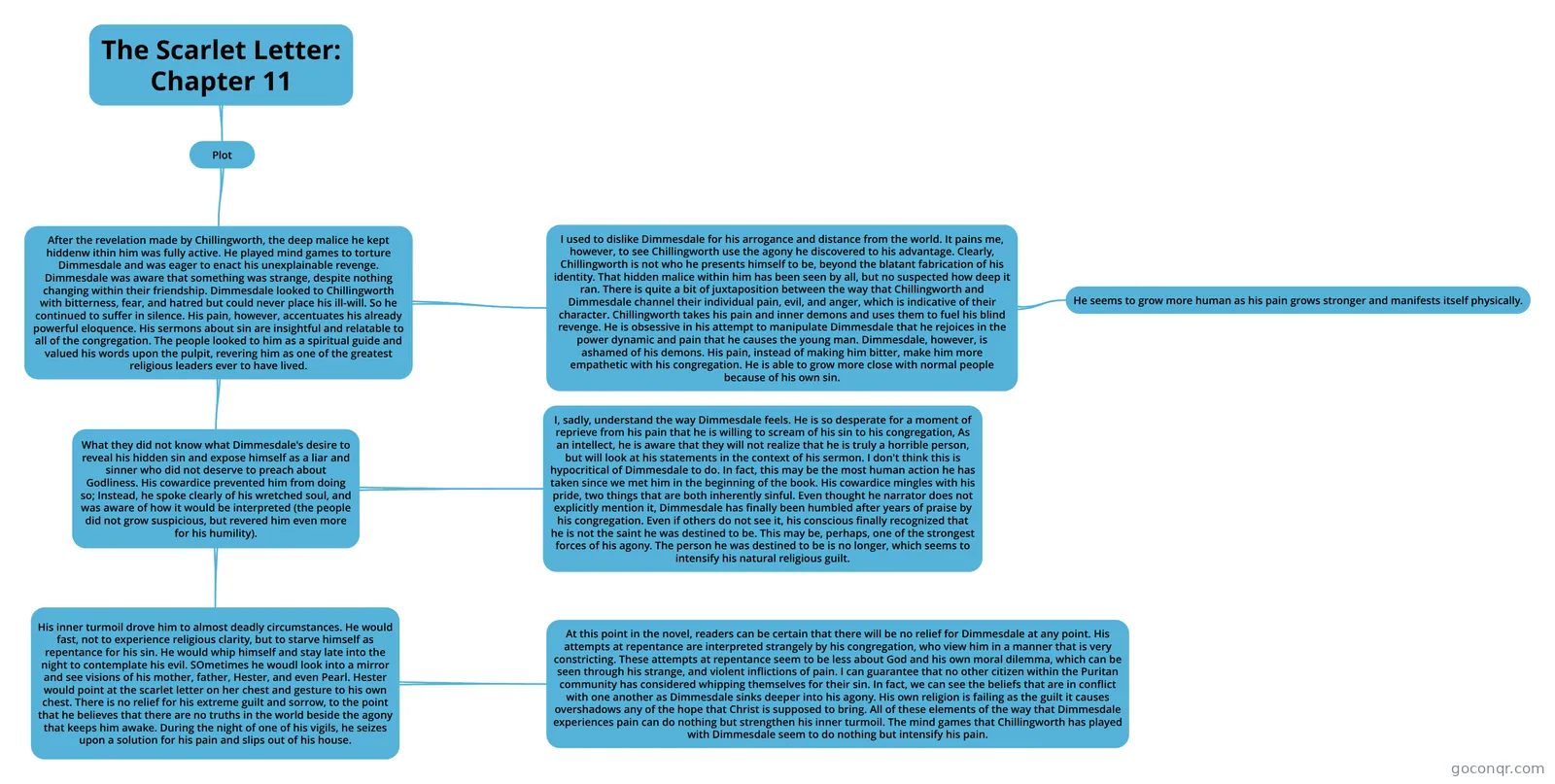
Mind map: The Scarlet Letter chapter 11
Conteúdo do mapa
The Scarlet Letter: Chapter 11
Plot
- After the revelation made by Chillingworth, the deep malice he kept hiddenw ithin him was fully active. He played mind games to torture Dimmesdale and was eager to enact his unexplainable revenge. Dimmesdale was aware that something was strange, despite nothing changing within their friendship. Dimmesdale looked to Chillingworth with bitterness, fear, and hatred but could never place his ill-will. So he continued to suffer in silence. His pain, however, accentuates his already powerful eloquence. His sermons about sin are insightful and relatable to all of the congregation. The people looked to him as a spiritual guide and valued his words upon the pulpit, revering him as one of the greatest religious leaders ever to have lived.
- What they did not know what Dimmesdale's desire to reveal his hidden sin and expose himself as a liar and sinner who did not deserve to preach about Godliness. His cowardice prevented him from doing so; Instead, he spoke clearly of his wretched soul, and was aware of how it would be interpreted (the people did not grow suspicious, but revered him even more for his humility).
- His inner turmoil drove him to almost deadly circumstances. He would fast, not to experience religious clarity, but to starve himself as repentance for his sin. He would whip himself and stay late into the night to contemplate his evil. SOmetimes he woudl look into a mirror and see visions of his mother, father, Hester, and even Pearl. Hester would point at the scarlet letter on her chest and gesture to his own chest. There is no relief for his extreme guilt and sorrow, to the point that he believes that there are no truths in the world beside the agony that keeps him awake. During the night of one of his vigils, he seizes upon a solution for his pain and slips out of his house.
- At this point in the novel, readers can be certain that there will be no relief for Dimmesdale at any point. His attempts at repentance are interpreted strangely by his congregation, who view him in a manner that is very constricting. These attempts at repentance seem to be less about God and his own moral dilemma, which can be seen through his strange, and violent inflictions of pain. I can guarantee that no other citizen within the Puritan community has considered whipping themselves for their sin. In fact, we can see the beliefs that are in conflict with one another as Dimmesdale sinks deeper into his agony. His own religion is failing as the guilt it causes overshadows any of the hope that Christ is supposed to bring. All of these elements of the way that Dimmesdale experiences pain can do nothing but strengthen his inner turmoil. The mind games that Chillingworth has played with Dimmesdale seem to do nothing but intensify his pain.
- I, sadly, understand the way Dimmesdale feels. He is so desperate for a moment of reprieve from his pain that he is willing to scream of his sin to his congregation, As an intellect, he is aware that they will not realize that he is truly a horrible person, but will look at his statements in the context of his sermon. I don't think this is hypocritical of Dimmesdale to do. In fact, this may be the most human action he has taken since we met him in the beginning of the book. His cowardice mingles with his pride, two things that are both inherently sinful. Even thought he narrator does not explicitly mention it, Dimmesdale has finally been humbled after years of praise by his congregation. Even if others do not see it, his conscious finally recognized that he is not the saint he was destined to be. This may be, perhaps, one of the strongest forces of his agony. The person he was destined to be is no longer, which seems to intensify his natural religious guilt.
- His inner turmoil drove him to almost deadly circumstances. He would fast, not to experience religious clarity, but to starve himself as repentance for his sin. He would whip himself and stay late into the night to contemplate his evil. SOmetimes he woudl look into a mirror and see visions of his mother, father, Hester, and even Pearl. Hester would point at the scarlet letter on her chest and gesture to his own chest. There is no relief for his extreme guilt and sorrow, to the point that he believes that there are no truths in the world beside the agony that keeps him awake. During the night of one of his vigils, he seizes upon a solution for his pain and slips out of his house.
- I used to dislike Dimmesdale for his arrogance and distance from the world. It pains me, however, to see Chillingworth use the agony he discovered to his advantage. Clearly, Chillingworth is not who he presents himself to be, beyond the blatant fabrication of his identity. That hidden malice within him has been seen by all, but no suspected how deep it ran. There is quite a bit of juxtaposition between the way that Chillingworth and Dimmesdale channel their individual pain, evil, and anger, which is indicative of their character. Chillingworth takes his pain and inner demons and uses them to fuel his blind revenge. He is obsessive in his attempt to manipulate Dimmesdale that he rejoices in the power dynamic and pain that he causes the young man. Dimmesdale, however, is ashamed of his demons. His pain, instead of making him bitter, make him more empathetic with his congregation. He is able to grow more close with normal people because of his own sin.
- He seems to grow more human as his pain grows stronger and manifests itself physically.
- What they did not know what Dimmesdale's desire to reveal his hidden sin and expose himself as a liar and sinner who did not deserve to preach about Godliness. His cowardice prevented him from doing so; Instead, he spoke clearly of his wretched soul, and was aware of how it would be interpreted (the people did not grow suspicious, but revered him even more for his humility).
- After the revelation made by Chillingworth, the deep malice he kept hiddenw ithin him was fully active. He played mind games to torture Dimmesdale and was eager to enact his unexplainable revenge. Dimmesdale was aware that something was strange, despite nothing changing within their friendship. Dimmesdale looked to Chillingworth with bitterness, fear, and hatred but could never place his ill-will. So he continued to suffer in silence. His pain, however, accentuates his already powerful eloquence. His sermons about sin are insightful and relatable to all of the congregation. The people looked to him as a spiritual guide and valued his words upon the pulpit, revering him as one of the greatest religious leaders ever to have lived.
Informações
- Descrição
- Mapa Mental sobre The Scarlet Letter: Chapter 11, criado por Alyssia Ouhocine em 19-02-2021.
- Criado por
- Alyssia Ouhocine
- Visualizações
- 0
- Avaliação