
Mapa mental
Physics
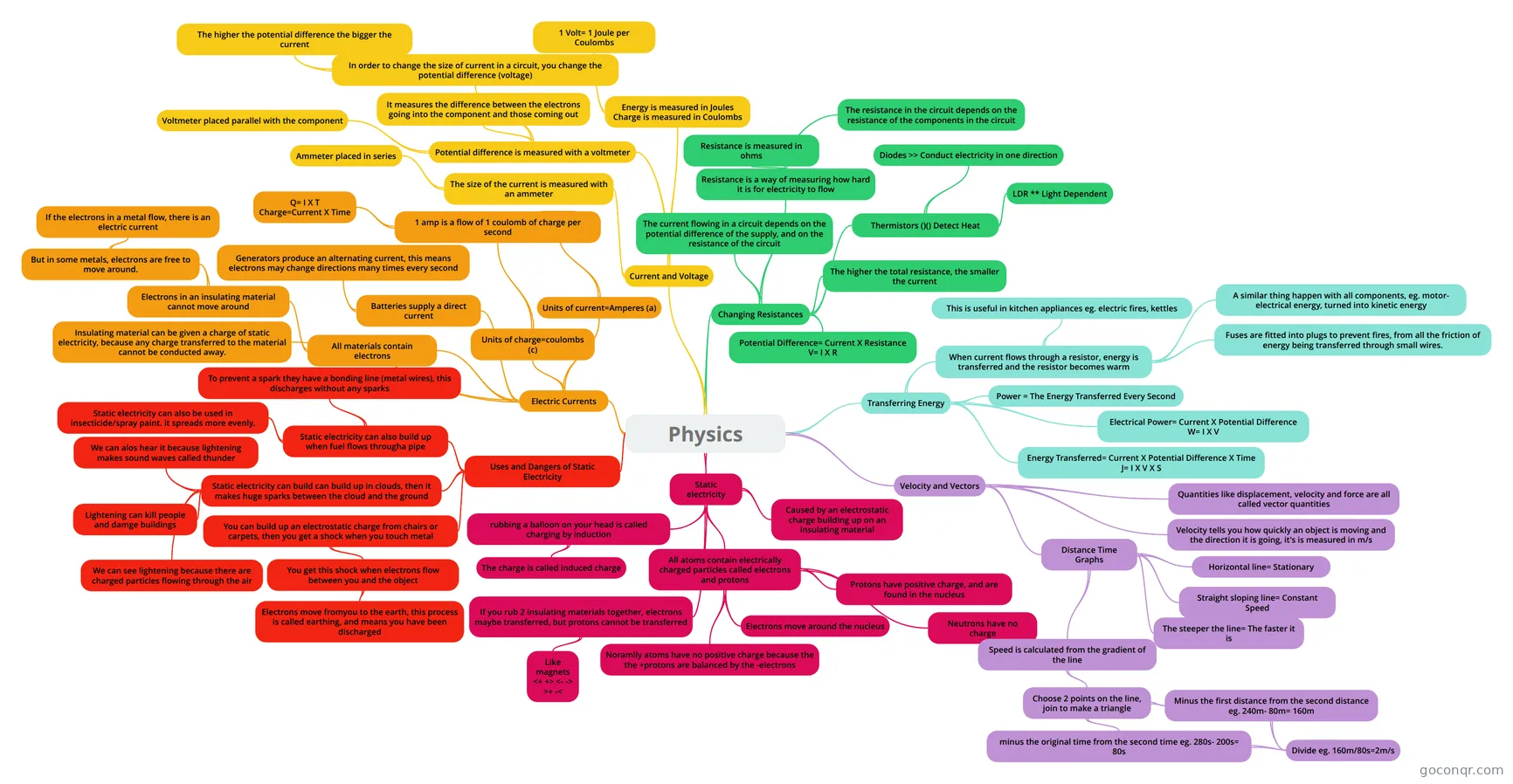
Mind map: Physics electricity and circuits
Conteúdo do mapa
Physics
Static electricity
- Caused by an electrostatic charge building up on an insulating material
- All atoms contain electrically charged particles called electrons and protons
- Protons have positive charge, and are found in the nucleus
- Electrons move around the nucleus
- Noramlly atoms have no positive charge because the the +protons are balanced by the -electrons
- Neutrons have no charge
- If you rub 2 insulating materials together, electrons maybe transferred, but protons cannot be transferred
- Like magnets <+ +> <- -> >+ -<
- rubbing a balloon on your head is called charging by induction
- The charge is called induced charge
Uses and Dangers of Static Electricity
- You can build up an electrostatic charge from chairs or carpets, then you get a shock when you touch metal
- You get this shock when electrons flow between you and the object
- Electrons move fromyou to the earth, this process is called earthing, and means you have been discharged
- You get this shock when electrons flow between you and the object
- Static electricity can build can build up in clouds, then it makes huge sparks between the cloud and the ground
- We can see lightening because there are charged particles flowing through the air
- We can alos hear it because lightening makes sound waves called thunder
- Lightening can kill people and damge buildings
- Static electricity can also build up when fuel flows througha pipe
- To prevent a spark they have a bonding line (metal wires), this discharges without any sparks
- Static electricity can also be used in insecticide/spray paint. it spreads more evenly.
- You can build up an electrostatic charge from chairs or carpets, then you get a shock when you touch metal
Current and Voltage
- The size of the current is measured with an ammeter
- Ammeter placed in series
- Potential difference is measured with a voltmeter
- Voltmeter placed parallel with the component
- In order to change the size of current in a circuit, you change the potential difference (voltage)
- The higher the potential difference the bigger the current
- It measures the difference between the electrons going into the component and those coming out
- Energy is measured in Joules Charge is measured in Coulombs
- 1 Volt= 1 Joule per Coulombs
- The size of the current is measured with an ammeter
Electric Currents
- Insulating material can be given a charge of static electricity, because any charge transferred to the material cannot be conducted away.
- All materials contain electrons
- Electrons in an insulating material cannot move around
- But in some metals, electrons are free to move around.
- If the electrons in a metal flow, there is an electric current
- But in some metals, electrons are free to move around.
- Electrons in an insulating material cannot move around
- Batteries supply a direct current
- Generators produce an alternating current, this means electrons may change directions many times every second
- Units of charge=coulombs (c)
- 1 amp is a flow of 1 coulomb of charge per second
- Q= I X T Charge=Current X Time
- 1 amp is a flow of 1 coulomb of charge per second
- Units of current=Amperes (a)
Changing Resistances
- The current flowing in a circuit depends on the potential difference of the supply, and on the resistance of the circuit
- Resistance is a way of measuring how hard it is for electricity to flow
- Resistance is measured in ohms
- The resistance in the circuit depends on the resistance of the components in the circuit
- The higher the total resistance, the smaller the current
- Potential Difference= Current X Resistance V= I X R
- Thermistors ()() Detect Heat
- LDR ** Light Dependent
- Diodes >> Conduct electricity in one direction
Velocity and Vectors
- Quantities like displacement, velocity and force are all called vector quantities
- Velocity tells you how quickly an object is moving and the direction it is going, it's is measured in m/s
- Distance Time Graphs
- Horizontal line= Stationary
- Straight sloping line= Constant Speed
- The steeper the line= The faster it is
- Speed is calculated from the gradient of the line
- Choose 2 points on the line, join to make a triangle
- Minus the first distance from the second distance eg. 240m- 80m= 160m
- Divide eg. 160m/80s=2m/s
- minus the original time from the second time eg. 280s- 200s= 80s
- Minus the first distance from the second distance eg. 240m- 80m= 160m
- Choose 2 points on the line, join to make a triangle
Transferring Energy
- When current flows through a resistor, energy is transferred and the resistor becomes warm
- This is useful in kitchen appliances eg. electric fires, kettles
- A similar thing happen with all components, eg. motor- electrical energy, turned into kinetic energy
- Fuses are fitted into plugs to prevent fires, from all the friction of energy being transferred through small wires.
- Power = The Energy Transferred Every Second
- Electrical Power= Current X Potential Difference W= I X V
- Energy Transferred= Current X Potential Difference X Time J= I X V X S
- When current flows through a resistor, energy is transferred and the resistor becomes warm
Informações
- Descrição
- Static Electricity Uses and Dangers of Static Electricity Electric Currents Current and Voltage Changing Resistances Transferring Energy Vectors and Velocity
- Criado por
- Alicia Tamlyn
- Visualizações
- 10
- Avaliação