
Mapa mental
Stroke (summarized) Period 8
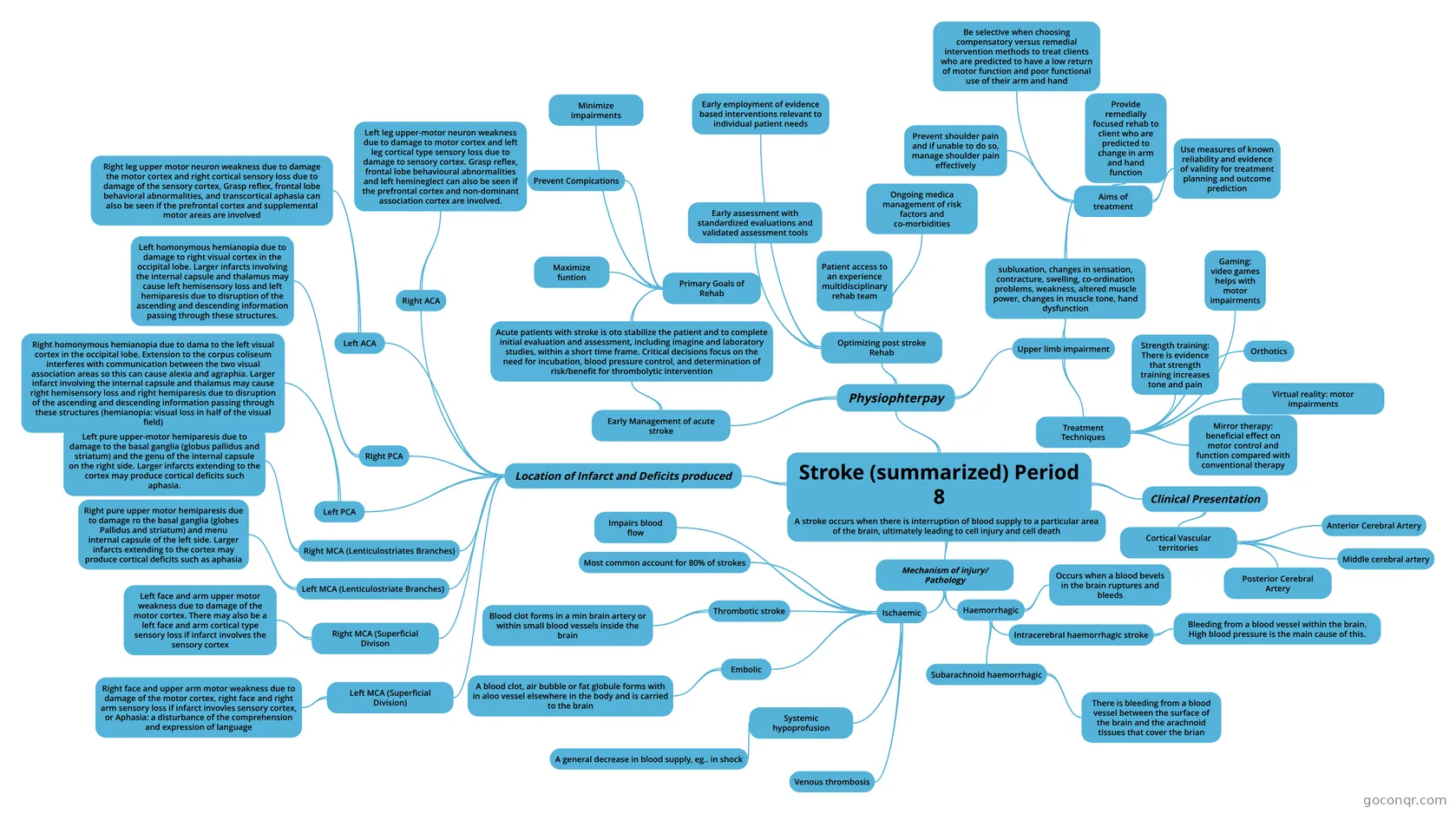
Mind map: Stroke (summarized)
Conteúdo do mapa
Stroke (summarized) Period 8
A stroke occurs when there is interruption of blood supply to a particular area of the brain, ultimately leading to cell injury and cell death
- Mechanism of injury/ Pathology
- Ischaemic
- Most common account for 80% of strokes
- Thrombotic stroke
- Blood clot forms in a min brain artery or within small blood vessels inside the brain
- Embolic
- A blood clot, air bubble or fat globule forms with in aloo vessel elsewhere in the body and is carried to the brain
- Systemic hypoprofusion
- A general decrease in blood supply, eg.. in shock
- Venous thrombosis
- Impairs blood flow
- Haemorrhagic
- Occurs when a blood bevels in the brain ruptures and bleeds
- Intracerebral haemorrhagic stroke
- Bleeding from a blood vessel within the brain. High blood pressure is the main cause of this.
- Subarachnoid haemorrhagic
- There is bleeding from a blood vessel between the surface of the brain and the arachnoid tissues that cover the brian
- Ischaemic
- Mechanism of injury/ Pathology
Clinical Presentation
- Cortical Vascular territories
- Anterior Cerebral Artery
- Middle cerebral artery
- Posterior Cerebral Artery
- Cortical Vascular territories
Location of Infarct and Deficits produced
- Left MCA (Superficial Division)
- Right face and upper arm motor weakness due to damage of the motor cortex, right face and right arm sensory loss if infarct invovles sensory cortex, or Aphasia: a disturbance of the comprehension and expression of language
- Right MCA (Superficial Divison
- Left face and arm upper motor weakness due to damage of the motor cortex. There may also be a left face and arm cortical type sensory loss if infarct involves the sensory cortex
- Left MCA (Lenticulostriate Branches)
- Right pure upper motor hemiparesis due to damage ro the basal ganglia (globes Pallidus and striatum) and menu internal capsule of the left side. Larger infarcts extending to the cortex may produce cortical deficits such as aphasia
- Right MCA (Lenticulostriates Branches)
- Left pure upper-motor hemiparesis due to damage to the basal ganglia (globus pallidus and striatum) and the genu of the internal capsule on the right side. Larger infarcts extending to the cortex may produce cortical deficits such aphasia.
- Left PCA
- Right homonymous hemianopia due to dama to the left visual cortex in the occipital lobe. Extension to the corpus coliseum interferes with communication between the two visual association areas so this can cause alexia and agraphia. Larger infarct involving the internal capsule and thalamus may cause right hemisensory loss and right hemiparesis due to disruption of the ascending and descending information passing through these structures (hemianopia: visual loss in half of the visual field)
- RIght PCA
- Left homonymous hemianopia due to damage to right visual cortex in the occipital lobe. Larger infarcts involving the internal capsule and thalamus may cause left hemisensory loss and left hemiparesis due to disruption of the ascending and descending information passing through these structures.
- Left ACA
- Right leg upper motor neuron weakness due to damage the motor cortex and right cortical sensory loss due to damage of the sensory cortex, Grasp reflex, frontal lobe behavioral abnormalities, and transcortical aphasia can also be seen if the prefrontal cortex and supplemental motor areas are involved
- Right ACA
- Left leg upper-motor neuron weakness due to damage to motor cortex and left leg cortical type sensory loss due to damage to sensory cortex. Grasp reflex, frontal lobe behavioural abnormalities and left hemineglect can also be seen if the prefrontal cortex and non-dominant association cortex are involved.
- Left MCA (Superficial Division)
Physiophterpay
- Early Management of acute stroke
- Acute patients with stroke is oto stabilize the patient and to complete initial evaluation and assessment, including imagine and laboratory studies, within a short time frame. Critical decisions focus on the need for incubation, blood pressure control, and determination of risk/benefit for thrombolytic intervention
- Primary Goals of Rehab
- Prevent Compications
- Minimize impairments
- Maximize funtion
- Primary Goals of Rehab
- Acute patients with stroke is oto stabilize the patient and to complete initial evaluation and assessment, including imagine and laboratory studies, within a short time frame. Critical decisions focus on the need for incubation, blood pressure control, and determination of risk/benefit for thrombolytic intervention
- Optimizing post stroke Rehab
- Early assessment with standardized evaluations and validated assessment tools
- Early employment of evidence based interventions relevant to individual patient needs
- Patient access to an experience multidisciplinary rehab team
- Ongoing medica management of risk factors and co-morbidities
- Upper limb impairment
- subluxation, changes in sensation, contracture, swelling, co-ordination problems, weakness, altered muscle power, changes in muscle tone, hand dysfunction
- Aims of treatment
- Prevent shoulder pain and if unable to do so, manage shoulder pain effectively
- Be selective when choosing compensatory versus remedial intervention methods to treat clients who are predicted to have a low return of motor function and poor functional use of their arm and hand
- Provide remedially focused rehab to client who are predicted to change in arm and hand function
- Use measures of known reliability and evidence of validity for treatment planning and outcome prediction
- Aims of treatment
- Treatment Techniques
- Strength training: There is evidence that strength training increases tone and pain
- Orthotics
- Gaming: video games helps with motor impairments
- Virtual reality: motor impairments
- Mirror therapy: beneficial effect on motor control and function compared with conventional therapy
- subluxation, changes in sensation, contracture, swelling, co-ordination problems, weakness, altered muscle power, changes in muscle tone, hand dysfunction
- Early Management of acute stroke
Informações
- Descrição
- Mapa Mental sobre Stroke (summarized) Period 8, criado por Emilio Lanza em 13-06-2015.
- Criado por
- Emilio Lanza
- Visualizações
- 2
- Avaliação