
Mapa mental
Study Guide BCE 513- Theories
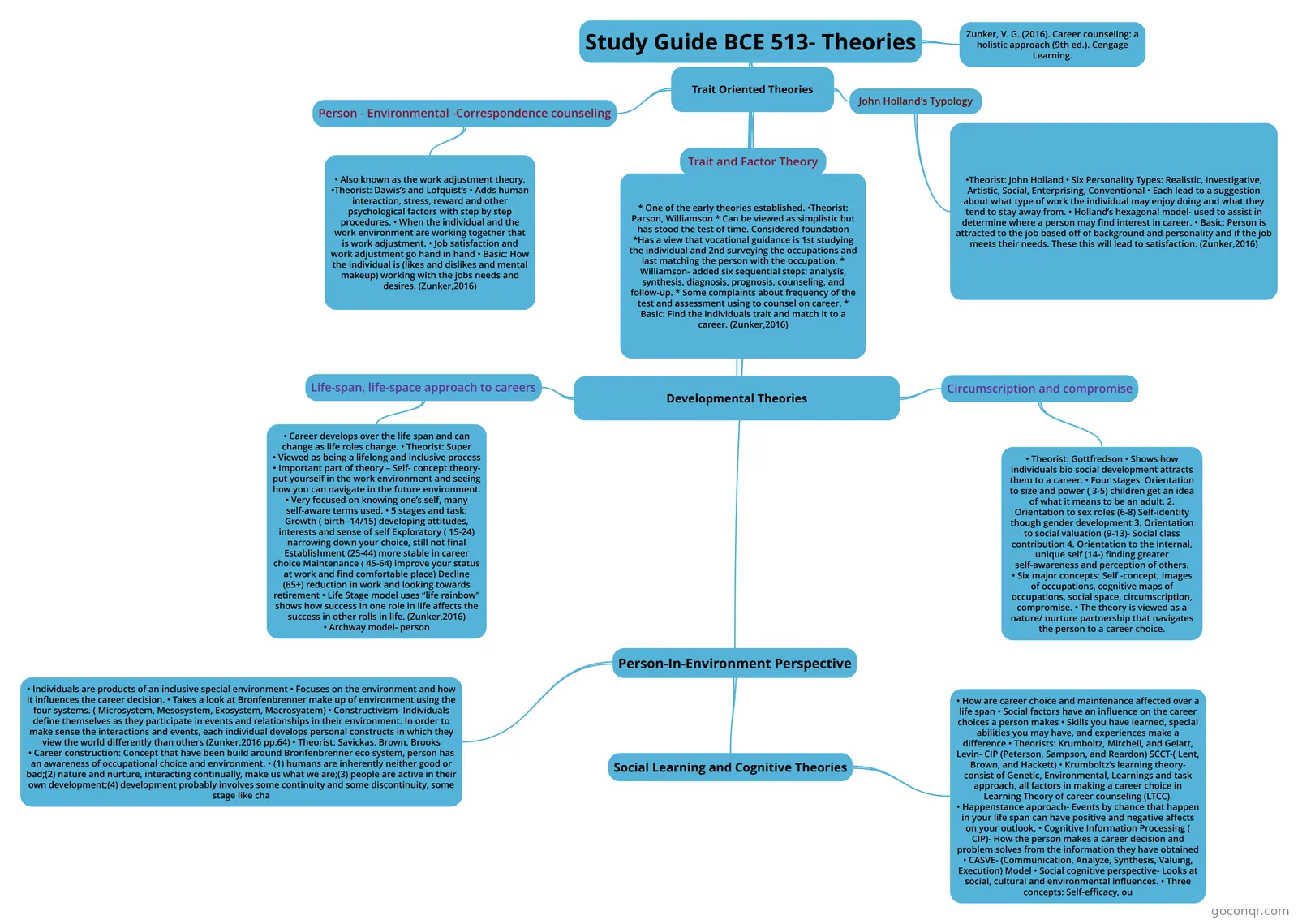
Mind map: BCE 513 theories
Conteúdo do mapa
Study Guide BCE 513- Theories
Trait Oriented Theories
- Trait and Factor Theory
- * One of the early theories established. •Theorist: Parson, Williamson * Can be viewed as simplistic but has stood the test of time. Considered foundation *Has a view that vocational guidance is 1st studying the individual and 2nd surveying the occupations and last matching the person with the occupation. * Williamson- added six sequential steps: analysis, synthesis, diagnosis, prognosis, counseling, and follow-up. * Some complaints about frequency of the test and assessment using to counsel on career. * Basic: Find the individuals trait and match it to a career. (Zunker,2016)
- Person - Environmental -Correspondence counseling
- • Also known as the work adjustment theory. •Theorist: Dawis’s and Lofquist’s • Adds human interaction, stress, reward and other psychological factors with step by step procedures. • When the individual and the work environment are working together that is work adjustment. • Job satisfaction and work adjustment go hand in hand • Basic: How the individual is (likes and dislikes and mental makeup) working with the jobs needs and desires. (Zunker,2016)
- John Holland's Typology
- •Theorist: John Holland • Six Personality Types: Realistic, Investigative, Artistic, Social, Enterprising, Conventional • Each lead to a suggestion about what type of work the individual may enjoy doing and what they tend to stay away from. • Holland’s hexagonal model- used to assist in determine where a person may find interest in career. • Basic: Person is attracted to the job based off of background and personality and if the job meets their needs. These this will lead to satisfaction. (Zunker,2016)
- Trait and Factor Theory
Developmental Theories
- Life-span, life-space approach to careers
- • Career develops over the life span and can change as life roles change. • Theorist: Super • Viewed as being a lifelong and inclusive process • Important part of theory – Self- concept theory- put yourself in the work environment and seeing how you can navigate in the future environment. • Very focused on knowing one’s self, many self-aware terms used. • 5 stages and task: Growth ( birth -14/15) developing attitudes, interests and sense of self Exploratory ( 15-24) narrowing down your choice, still not final Establishment (25-44) more stable in career choice Maintenance ( 45-64) improve your status at work and find comfortable place) Decline (65+) reduction in work and looking towards retirement • Life Stage model uses “life rainbow” shows how success In one role in life affects the success in other rolls in life. (Zunker,2016) • Archway model- person
- Circumscription and compromise
- • Theorist: Gottfredson • Shows how individuals bio social development attracts them to a career. • Four stages: Orientation to size and power ( 3-5) children get an idea of what it means to be an adult. 2. Orientation to sex roles (6-8) Self-identity though gender development 3. Orientation to social valuation (9-13)- Social class contribution 4. Orientation to the internal, unique self (14-) finding greater self-awareness and perception of others. • Six major concepts: Self -concept, Images of occupations, cognitive maps of occupations, social space, circumscription, compromise. • The theory is viewed as a nature/ nurture partnership that navigates the person to a career choice.
- Life-span, life-space approach to careers
Person-In-Environment Perspective
- Social Learning and Cognitive Theories
- • How are career choice and maintenance affected over a life span • Social factors have an influence on the career choices a person makes • Skills you have learned, special abilities you may have, and experiences make a difference • Theorists: Krumboltz, Mitchell, and Gelatt, Levin- CIP (Peterson, Sampson, and Reardon) SCCT-( Lent, Brown, and Hackett) • Krumboltz’s learning theory- consist of Genetic, Environmental, Learnings and task approach, all factors in making a career choice in Learning Theory of career counseling (LTCC). • Happenstance approach- Events by chance that happen in your life span can have positive and negative affects on your outlook. • Cognitive Information Processing ( CIP)- How the person makes a career decision and problem solves from the information they have obtained • CASVE- (Communication, Analyze, Synthesis, Valuing, Execution) Model • Social cognitive perspective- Looks at social, cultural and environmental influences. • Three concepts: Self-efficacy, ou
- • Individuals are products of an inclusive special environment • Focuses on the environment and how it influences the career decision. • Takes a look at Bronfenbrenner make up of environment using the four systems. ( Microsystem, Mesosystem, Exosystem, Macrosyatem) • Constructivism- Individuals define themselves as they participate in events and relationships in their environment. In order to make sense the interactions and events, each individual develops personal constructs in which they view the world differently than others (Zunker,2016 pp.64) • Theorist: Savickas, Brown, Brooks • Career construction: Concept that have been build around Bronfenbrenner eco system, person has an awareness of occupational choice and environment. • (1) humans are inherently neither good or bad;(2) nature and nurture, interacting continually, make us what we are;(3) people are active in their own development;(4) development probably involves some continuity and some discontinuity, some stage like cha
- Social Learning and Cognitive Theories
Zunker, V. G. (2016). Career counseling: a holistic approach (9th ed.). Cengage Learning.
Informações
- Descrição
- Mapa Mental sobre Study Guide BCE 513- Theories, criado por Shonte Johnson em 11-06-2021.
- Criado por
- Shonte Johnson
- Visualizações
- 0
- Avaliação
Mais sobre Career Development Theories