
Mapa mental
CGEIT
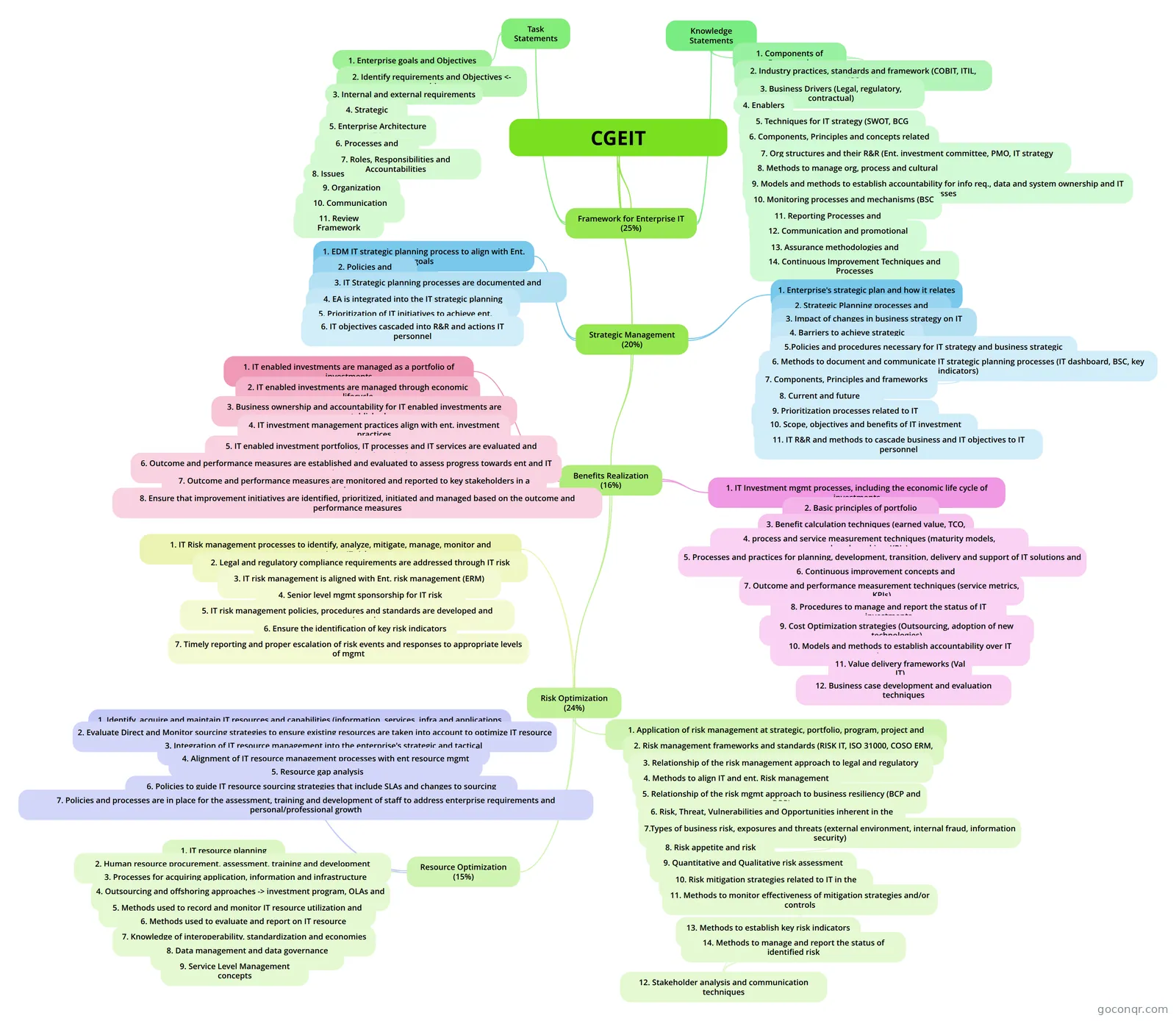
Mind map: CGEIT
Conteúdo do mapa
CGEIT
Strategic Management (20%)
- Benefits Realization (16%)
- Risk Optimization (24%)
- Resource Optimization (15%)
- 1. Identify, acquire and maintain IT resources and capabilities (information, services, infra and applications and people
- 2. Evaluate Direct and Monitor sourcing strategies to ensure existing resources are taken into account to optimize IT resource utilization
- 3. Integration of IT resource management into the enterprise's strategic and tactical planning
- 4. Alignment of IT resource management processes with ent resource mgmt processes
- 5. Resource gap analysis process
- 6. Policies to guide IT resource sourcing strategies that include SLAs and changes to sourcing strategies
- 7. Policies and processes are in place for the assessment, training and development of staff to address enterprise requirements and personal/professional growth
- 6. Policies to guide IT resource sourcing strategies that include SLAs and changes to sourcing strategies
- 5. Resource gap analysis process
- 4. Alignment of IT resource management processes with ent resource mgmt processes
- 3. Integration of IT resource management into the enterprise's strategic and tactical planning
- 2. Evaluate Direct and Monitor sourcing strategies to ensure existing resources are taken into account to optimize IT resource utilization
- 1. IT resource planning methods
- 2. Human resource procurement, assessment, training and development methodologies
- 3. Processes for acquiring application, information and infrastructure resources
- 4. Outsourcing and offshoring approaches -> investment program, OLAs and SLAs
- 5. Methods used to record and monitor IT resource utilization and availability
- 6. Methods used to evaluate and report on IT resource performance
- 7. Knowledge of interoperability, standardization and economies of scale
- 8. Data management and data governance concepts
- 9. Service Level Management concepts
- 8. Data management and data governance concepts
- 7. Knowledge of interoperability, standardization and economies of scale
- 6. Methods used to evaluate and report on IT resource performance
- 5. Methods used to record and monitor IT resource utilization and availability
- 4. Outsourcing and offshoring approaches -> investment program, OLAs and SLAs
- 3. Processes for acquiring application, information and infrastructure resources
- 2. Human resource procurement, assessment, training and development methodologies
- 1. Identify, acquire and maintain IT resources and capabilities (information, services, infra and applications and people
- 1. IT Risk management processes to identify, analyze, mitigate, manage, monitor and communicate IT risk
- 2. Legal and regulatory compliance requirements are addressed through IT risk management
- 3. IT risk management is aligned with Ent. risk management (ERM) framework
- 4. Senior level mgmt sponsorship for IT risk management
- 5. IT risk management policies, procedures and standards are developed and communicated
- 6. Ensure the identification of key risk indicators (KRIs)
- 7. Timely reporting and proper escalation of risk events and responses to appropriate levels of mgmt
- 6. Ensure the identification of key risk indicators (KRIs)
- 5. IT risk management policies, procedures and standards are developed and communicated
- 4. Senior level mgmt sponsorship for IT risk management
- 3. IT risk management is aligned with Ent. risk management (ERM) framework
- 2. Legal and regulatory compliance requirements are addressed through IT risk management
- 1. Application of risk management at strategic, portfolio, program, project and operations levels
- 2. Risk management frameworks and standards (RISK IT, ISO 31000, COSO ERM, etc.
- 3. Relationship of the risk management approach to legal and regulatory compliance
- 4. Methods to align IT and ent. Risk management (ERM)
- 5. Relationship of the risk mgmt approach to business resiliency (BCP and DRP)
- 6. Risk, Threat, Vulnerabilities and Opportunities inherent in the use of IT
- 7.Types of business risk, exposures and threats (external environment, internal fraud, information security)
- 8. Risk appetite and risk tolerance
- 9. Quantitative and Qualitative risk assessment methods
- 10. Risk mitigation strategies related to IT in the enterprise
- 11. Methods to monitor effectiveness of mitigation strategies and/or controls
- 12. Stakeholder analysis and communication techniques
- 13. Methods to establish key risk indicators (KRIs)
- 14. Methods to manage and report the status of identified risk
- 13. Methods to establish key risk indicators (KRIs)
- 12. Stakeholder analysis and communication techniques
- 11. Methods to monitor effectiveness of mitigation strategies and/or controls
- 10. Risk mitigation strategies related to IT in the enterprise
- 9. Quantitative and Qualitative risk assessment methods
- 8. Risk appetite and risk tolerance
- 7.Types of business risk, exposures and threats (external environment, internal fraud, information security)
- 6. Risk, Threat, Vulnerabilities and Opportunities inherent in the use of IT
- 5. Relationship of the risk mgmt approach to business resiliency (BCP and DRP)
- 4. Methods to align IT and ent. Risk management (ERM)
- 3. Relationship of the risk management approach to legal and regulatory compliance
- 2. Risk management frameworks and standards (RISK IT, ISO 31000, COSO ERM, etc.
- Resource Optimization (15%)
- 1. IT enabled investments are managed as a portfolio of investments
- 2. IT enabled investments are managed through economic lifecycle
- 3. Business ownership and accountability for IT enabled investments are established
- 4. IT investment management practices align with ent. investment practices
- 5. IT enabled investment portfolios, IT processes and IT services are evaluated and benchmarked
- 6. Outcome and performance measures are established and evaluated to assess progress towards ent and IT objectives
- 7. Outcome and performance measures are monitored and reported to key stakeholders in a timely manner
- 8. Ensure that improvement initiatives are identified, prioritized, initiated and managed based on the outcome and performance measures
- 7. Outcome and performance measures are monitored and reported to key stakeholders in a timely manner
- 6. Outcome and performance measures are established and evaluated to assess progress towards ent and IT objectives
- 5. IT enabled investment portfolios, IT processes and IT services are evaluated and benchmarked
- 4. IT investment management practices align with ent. investment practices
- 3. Business ownership and accountability for IT enabled investments are established
- 2. IT enabled investments are managed through economic lifecycle
- 1. IT Investment mgmt processes, including the economic life cycle of investments
- 2. Basic principles of portfolio managment
- 3. Benefit calculation techniques (earned value, TCO, ROI)
- 4. process and service measurement techniques (maturity models, benchmarking, KPIs)
- 5. Processes and practices for planning, development, transition, delivery and support of IT solutions and services
- 6. Continuous improvement concepts and principles
- 7. Outcome and performance measurement techniques (service metrics, KPIs)
- 8. Procedures to manage and report the status of IT investments
- 9. Cost Optimization strategies (Outsourcing, adoption of new technologies)
- 10. Models and methods to establish accountability over IT investments
- 11. Value delivery frameworks (Val IT)
- 12. Business case development and evaluation techniques
- 11. Value delivery frameworks (Val IT)
- 10. Models and methods to establish accountability over IT investments
- 9. Cost Optimization strategies (Outsourcing, adoption of new technologies)
- 8. Procedures to manage and report the status of IT investments
- 7. Outcome and performance measurement techniques (service metrics, KPIs)
- 6. Continuous improvement concepts and principles
- 5. Processes and practices for planning, development, transition, delivery and support of IT solutions and services
- 4. process and service measurement techniques (maturity models, benchmarking, KPIs)
- 3. Benefit calculation techniques (earned value, TCO, ROI)
- 2. Basic principles of portfolio managment
- Risk Optimization (24%)
- 1. EDM IT strategic planning process to align with Ent. goals
- 2. Policies and procedures
- 3. IT Strategic planning processes are documented and communicated
- 4. EA is integrated into the IT strategic planning processes
- 5. Prioritization of IT initiatives to achieve ent. objectives
- 6. IT objectives cascaded into R&R and actions IT personnel
- 5. Prioritization of IT initiatives to achieve ent. objectives
- 4. EA is integrated into the IT strategic planning processes
- 3. IT Strategic planning processes are documented and communicated
- 2. Policies and procedures
- 1. Enterprise's strategic plan and how it relates to IT
- 2. Strategic Planning processes and Techniques
- 3. Impact of changes in business strategy on IT strategy
- 4. Barriers to achieve strategic alignment
- 5.Policies and procedures necessary for IT strategy and business strategic alignment
- 6. Methods to document and communicate IT strategic planning processes (IT dashboard, BSC, key indicators)
- 7. Components, Principles and frameworks of EA
- 8. Current and future technologies
- 9. Prioritization processes related to IT initiatives
- 10. Scope, objectives and benefits of IT investment programs
- 11. IT R&R and methods to cascade business and IT objectives to IT personnel
- 10. Scope, objectives and benefits of IT investment programs
- 9. Prioritization processes related to IT initiatives
- 8. Current and future technologies
- 7. Components, Principles and frameworks of EA
- 6. Methods to document and communicate IT strategic planning processes (IT dashboard, BSC, key indicators)
- 5.Policies and procedures necessary for IT strategy and business strategic alignment
- 4. Barriers to achieve strategic alignment
- 3. Impact of changes in business strategy on IT strategy
- 2. Strategic Planning processes and Techniques
- Benefits Realization (16%)
Framework for Enterprise IT (25%)
- Task Statements
- 1. Enterprise goals and Objectives
- 2. Identify requirements and Objectives <- enablers
- 3. Internal and external requirements
- 4. Strategic planning
- 5. Enterprise Architecture (EA)
- 6. Processes and Activities
- 7. Roles, Responsibilities and Accountabilities
- 8. Issues
- 9. Organization Structure
- 10. Communication Channel
- 11. Review Framework
- 10. Communication Channel
- 9. Organization Structure
- 8. Issues
- 7. Roles, Responsibilities and Accountabilities
- 6. Processes and Activities
- 5. Enterprise Architecture (EA)
- 4. Strategic planning
- 3. Internal and external requirements
- 2. Identify requirements and Objectives <- enablers
- 1. Enterprise goals and Objectives
- Knowledge Statements
- 1. Components of Framework
- 2. Industry practices, standards and framework (COBIT, ITIL, ISO,etc.)
- 3. Business Drivers (Legal, regulatory, contractual)
- 4. Enablers
- 5. Techniques for IT strategy (SWOT, BCG Matrix)
- 6. Components, Principles and concepts related to EA
- 7. Org structures and their R&R (Ent. investment committee, PMO, IT strategy committee..)
- 8. Methods to manage org, process and cultural changes
- 9. Models and methods to establish accountability for info req., data and system ownership and IT processes
- 10. Monitoring processes and mechanisms (BSC etc)
- 11. Reporting Processes and Mechanisms
- 12. Communication and promotional techniques
- 13. Assurance methodologies and techniques
- 14. Continuous Improvement Techniques and Processes
- 13. Assurance methodologies and techniques
- 12. Communication and promotional techniques
- 11. Reporting Processes and Mechanisms
- 10. Monitoring processes and mechanisms (BSC etc)
- 9. Models and methods to establish accountability for info req., data and system ownership and IT processes
- 8. Methods to manage org, process and cultural changes
- 7. Org structures and their R&R (Ent. investment committee, PMO, IT strategy committee..)
- 6. Components, Principles and concepts related to EA
- 5. Techniques for IT strategy (SWOT, BCG Matrix)
- 4. Enablers
- 3. Business Drivers (Legal, regulatory, contractual)
- 2. Industry practices, standards and framework (COBIT, ITIL, ISO,etc.)
- 1. Components of Framework
- Task Statements
Informações
- Descrição
- Mapa Mental sobre CGEIT, criado por sathyababutn em 03-11-2013.
- Criado por
- sathyababutn
- Visualizações
- 287
- Avaliação