
Mapa mental
Levels of language
Conteúdo do mapa
Levels of language
Phonetics
- Study of human sounds in general.
- Studies speech as a physical process.
- It can be divided in:
- Articulatory phonetics
- Emission of sounds
- Acoustic phonetics
- Transmission of sounds
- Auditive phonetics
- Reception of sounds
- Articulatory phonetics
- Basic units
- Allophones
- The realisation of a phone.
- Phones
- [p], [i:], [t].
- Allophones
Phonology
- Studies the systems of linguistics sound structures.
- Gives a functional classification of the sounds in a particular language.
- And explains how the subset used in a particular language is utilised.
- Studies the sounds according thier distinctive function.
- And what distinctions in meaning can be made on the basis of what sounds.
- Basic unit
- Phoneme
- /k/, /u:/, /l/
- Phoneme
Morphology
- Studies the words
- Especially
- Their internal structure.
- The changes they need to form new words.
- Especially
- Can be divided into:
- Inflectional
- Ending of words
- Derivational
- Formation of new words
- Inflectional
- Basic unit
- Morphemes
- Smallest meaningful unit of the language.
- Divisions
- According to their status:
- Free morpheme
- Can stand alone as a word.
- Bound morpheme
- Requires a base word to stand as word.
- Free morpheme
- According to their function:
- Lexical morpheme
- Has a specifiable independent meaning.
- Grammatical morphemes
- Carries meaning
- Gives us grammatical information such as time or gender.
- Lexical morpheme
- According to their status:
- Morphemes
- Studies the words
Syntax
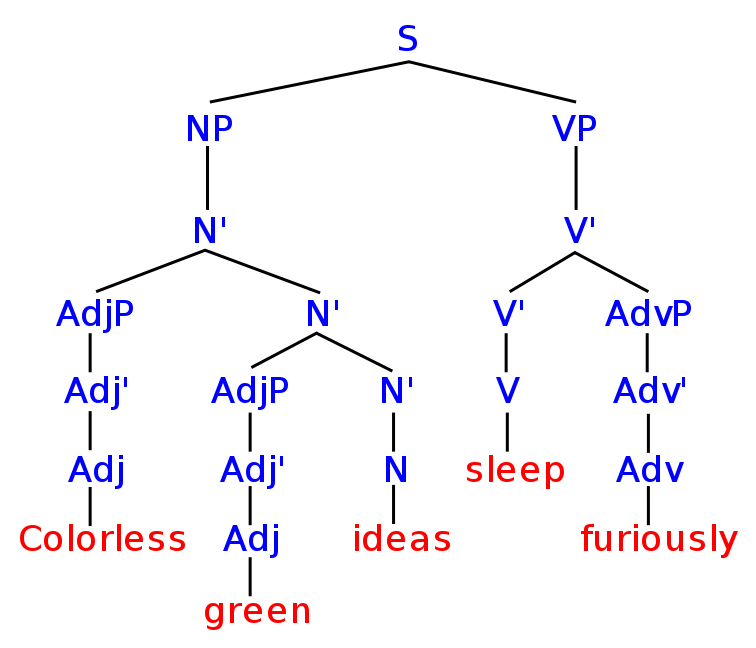
- Is concerned with the structure of sentences.
- Describes:
- Process and rules of
- The combination of words form sentences.
- The difference in meaning if we change the order of them.
- Process and rules of
Semantics
- Study of the meaning in language.
- There are four types of meaning:
- Lexical meaning
- The meaning of an individual word.
- Grammatical meaning
- Related to inflectional morphology.
- Sentence meaning
- The meaning of a sentence depending on the order of the words.
- Utterance meaning
- Related to pragmatics
- Lexical meaning
Pragmatics
- Studies the use of language in specific situations.
- Describes:
- The performance of the language in itself.
- The effects of the language use on participants.
- Three subgroups
- Pragmalinguistics
- Language structure according to the context.
- Sociopragmatics
- Social factors that determine the usage of the language.
- Applied pragmatics
- Problems of interaction.
- Pragmalinguistics
Imagens e arquivos do mapa




Informações
- Descrição
- A01_ JMPA Mind Map – 6 Levels of Language
- Criado por
- Jessica Mariana Pablo
- Visualizações
- 8
- Avaliação