
Mapa mental
Neurodevelopmental Treatment
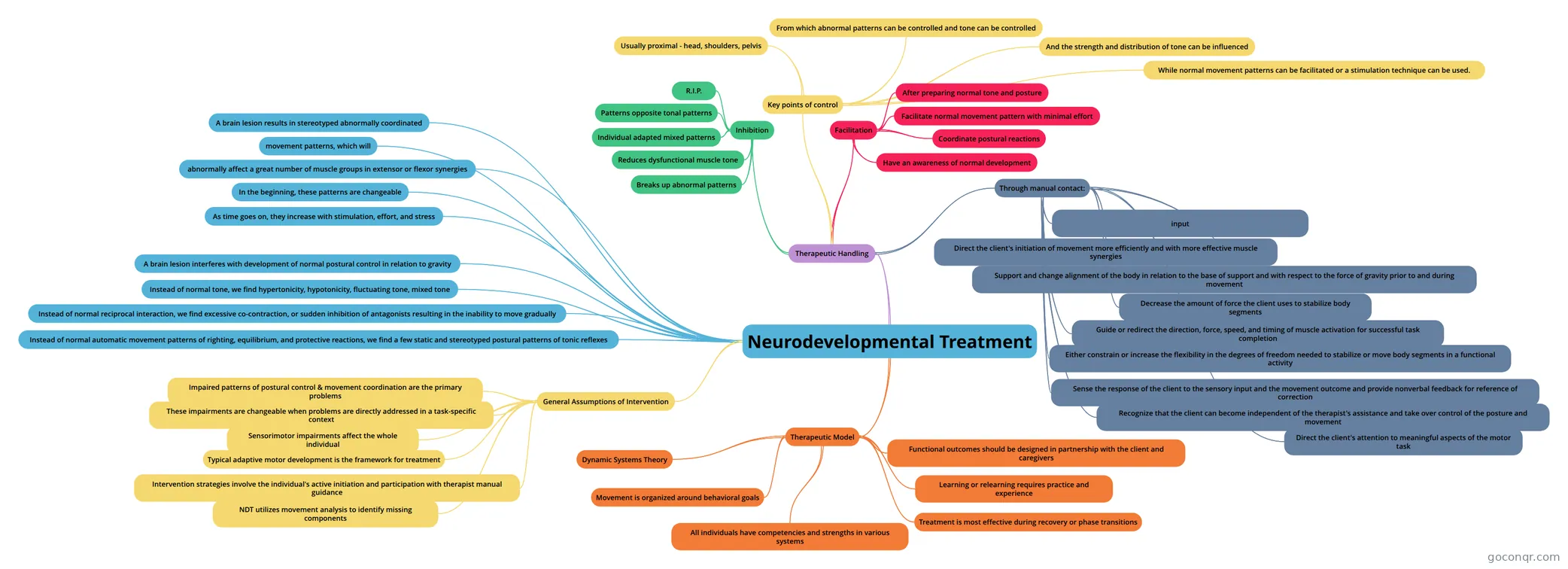
Mind map: Neurodevelopmental Treatment
Conteúdo do mapa
Neurodevelopmental Treatment
General Assumptions of Intervention
- Impaired patterns of postural control & movement coordination are the primary problems
- These impairments are changeable when problems are directly addressed in a task-specific context
- Sensorimotor impairments affect the whole individual
- Typical adaptive motor development is the framework for treatment
- Intervention strategies involve the individual's active initiation and participation with therapist manual guidance
- NDT utilizes movement analysis to identify missing components
Therapeutic Model
- Dynamic Systems Theory
- Movement is organized around behavioral goals
- All individuals have competencies and strengths in various systems
- Functional outcomes should be designed in partnership with the client and caregivers
- Learning or relearning requires practice and experience
- Treatment is most effective during recovery or phase transitions
Therapeutic Handling
- Through manual contact:
- input
- Direct the client's initiation of movement more efficiently and with more effective muscle synergies
- Support and change alignment of the body in relation to the base of support and with respect to the force of gravity prior to and during movement
- Decrease the amount of force the client uses to stabilize body segments
- Guide or redirect the direction, force, speed, and timing of muscle activation for successful task completion
- Either constrain or increase the flexibility in the degrees of freedom needed to stabilize or move body segments in a functional activity
- Sense the response of the client to the sensory input and the movement outcome and provide nonverbal feedback for reference of correction
- Recognize that the client can become independent of the therapist's assistance and take over control of the posture and movement
- Direct the client's attention to meaningful aspects of the motor task
- Key points of control
- Usually proximal - head, shoulders, pelvis
- From which abnormal patterns can be controlled and tone can be controlled
- And the strength and distribution of tone can be influenced
- While normal movement patterns can be facilitated or a stimulation technique can be used.
- Facilitation
- After preparing normal tone and posture
- Facilitate normal movement pattern with minimal effort
- Coordinate postural reactions
- Have an awareness of normal development
- Inhibition
- R.I.P.
- Patterns opposite tonal patterns
- Individual adapted mixed patterns
- Reduces dysfunctional muscle tone
- Breaks up abnormal patterns
- Through manual contact:
A brain lesion results in stereotyped abnormally coordinated
movement patterns, which will
abnormally affect a great number of muscle groups in extensor or flexor synergies
In the beginning, these patterns are changeable
As time goes on, they increase with stimulation, effort, and stress
A brain lesion interferes with development of normal postural control in relation to gravity
Instead of normal tone, we find hypertonicity, hypotonicity, fluctuating tone, mixed tone
Instead of normal reciprocal interaction, we find excessive co-contraction, or sudden inhibition of antagonists resulting in the inability to move gradually
Instead of normal automatic movement patterns of righting, equilibrium, and protective reactions, we find a few static and stereotyped postural patterns of tonic reflexes
Informações
- Descrição
- Basic treatment principles of NDT.
- Criado por
- Laurie Schroder
- Visualizações
- 138
- Tags
- Avaliação