
Mapa mental
P1
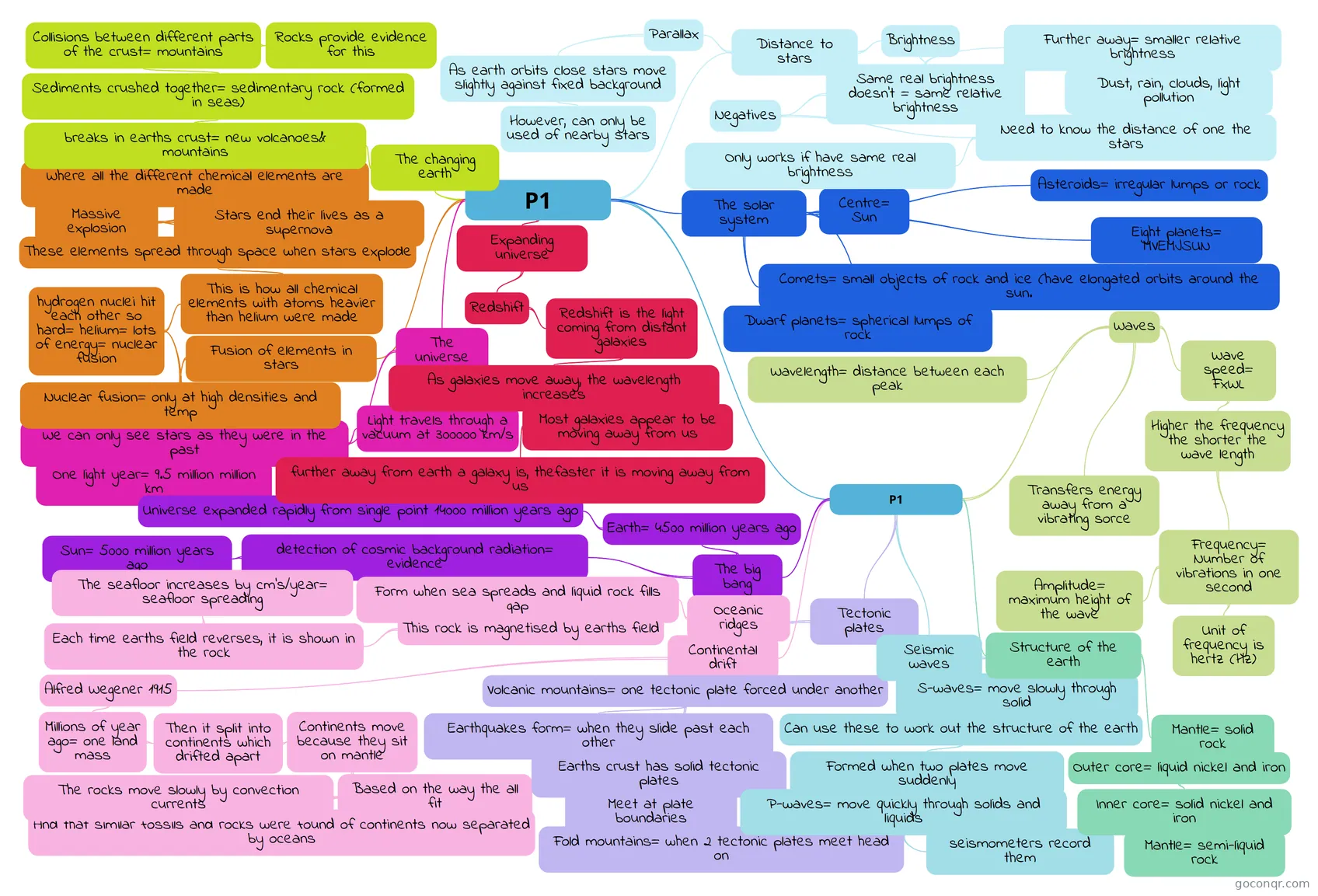
Mind map: the solar system and universe
Conteúdo do mapa
P1
The solar system
- Centre= Sun
- Eight planets= MVEMJSUN
- Asteroids= irregular lumps or rock
- Comets= small objects of rock and ice (have elongated orbits around the sun.
- Dwarf planets= spherical lumps of rock
The universe
- We can only see stars as they were in the past
- One light year= 9.5 million million km
- Light travels through a vacuum at 300000 km/s
- We can only see stars as they were in the past
Distance to stars
- Brightness
- Same real brightness doesn't = same relative brightness
- Further away= smaller relative brightness
- Negatives
- Need to know the distance of one the stars
- Only works if have same real brightness
- Dust, rain, clouds, light pollution
- Need to know the distance of one the stars
- Same real brightness doesn't = same relative brightness
- Parallax
- As earth orbits close stars move slightly against fixed background
- However, can only be used of nearby stars
- As earth orbits close stars move slightly against fixed background
- Brightness
Expanding universe
- Redshift
- Redshift is the light coming from distant galaxies
- As galaxies move away, the wavelength increases
- Most galaxies appear to be moving away from us
- further away from earth a galaxy is, thefaster it is moving away from us
- Most galaxies appear to be moving away from us
- As galaxies move away, the wavelength increases
- Redshift is the light coming from distant galaxies
- Redshift
Fusion of elements in stars
- Nuclear fusion= only at high densities and temp
- hydrogen nuclei hit each other so hard= helium= lots of energy= nuclear fusion
- This is how all chemical elements with atoms heavier than helium were made
- These elements spread through space when stars explode
- Stars end their lives as a supernova
- Massive explosion
- Where all the different chemical elements are made
- Massive explosion
- Stars end their lives as a supernova
- These elements spread through space when stars explode
- This is how all chemical elements with atoms heavier than helium were made
- hydrogen nuclei hit each other so hard= helium= lots of energy= nuclear fusion
- Nuclear fusion= only at high densities and temp
The changing earth
- breaks in earths crust= new volcanoes& mountains
- Sediments crushed together= sedimentary rock (formed in seas)
- Collisions between different parts of the crust= mountains
- Rocks provide evidence for this
- Collisions between different parts of the crust= mountains
- Sediments crushed together= sedimentary rock (formed in seas)
- breaks in earths crust= new volcanoes& mountains
P1
- The big bang
- detection of cosmic background radiation= evidence
- Sun= 5000 million years ago
- Earth= 4500 million years ago
- Universe expanded rapidly from single point 14000 million years ago
- detection of cosmic background radiation= evidence
- Continental drift
- Alfred Wegener 1915
- Millions of year ago= one land mass
- Then it split into continents which drifted apart
- Continents move because they sit on mantle
- The rocks move slowly by convection currents
- Based on the way the all fit
- And that similar fossils and rocks were found of continents now separated by oceans
- Based on the way the all fit
- The rocks move slowly by convection currents
- Continents move because they sit on mantle
- Then it split into continents which drifted apart
- Millions of year ago= one land mass
- Oceanic ridges
- Form when sea spreads and liquid rock fills gap
- This rock is magnetised by earths field
- Each time earths field reverses, it is shown in the rock
- The seafloor increases by cm's/year= seafloor spreading
- Each time earths field reverses, it is shown in the rock
- This rock is magnetised by earths field
- Form when sea spreads and liquid rock fills gap
- Alfred Wegener 1915
- Tectonic plates
- Volcanic mountains= one tectonic plate forced under another
- Earths crust has solid tectonic plates
- Meet at plate boundaries
- Fold mountains= when 2 tectonic plates meet head on
- Meet at plate boundaries
- Earthquakes form= when they slide past each other
- Earths crust has solid tectonic plates
- Volcanic mountains= one tectonic plate forced under another
- Seismic waves
- S-waves= move slowly through solid
- Can use these to work out the structure of the earth
- Formed when two plates move suddenly
- P-waves= move quickly through solids and liquids
- seismometers record them
- P-waves= move quickly through solids and liquids
- Formed when two plates move suddenly
- Can use these to work out the structure of the earth
- S-waves= move slowly through solid
- Structure of the earth
- Mantle= solid rock
- Outer core= liquid nickel and iron
- Inner core= solid nickel and iron
- Mantle= semi-liquid rock
- Inner core= solid nickel and iron
- Outer core= liquid nickel and iron
- Mantle= solid rock
- Waves
- Transfers energy away from a vibrating sorce
- Wavelength= distance between each peak
- Wave speed= FxWL
- Higher the frequency the shorter the wave length
- Frequency= Number of vibrations in one second
- Amplitude= maximum height of the wave
- Unit of frequency is hertz (Hz)
- Frequency= Number of vibrations in one second
- Higher the frequency the shorter the wave length
- The big bang
Informações
- Descrição
- physics module one mind map
- Criado por
- Lisa Cracknell
- Visualizações
- 37
- Tags
- Avaliação