
Mapa mental
Othello
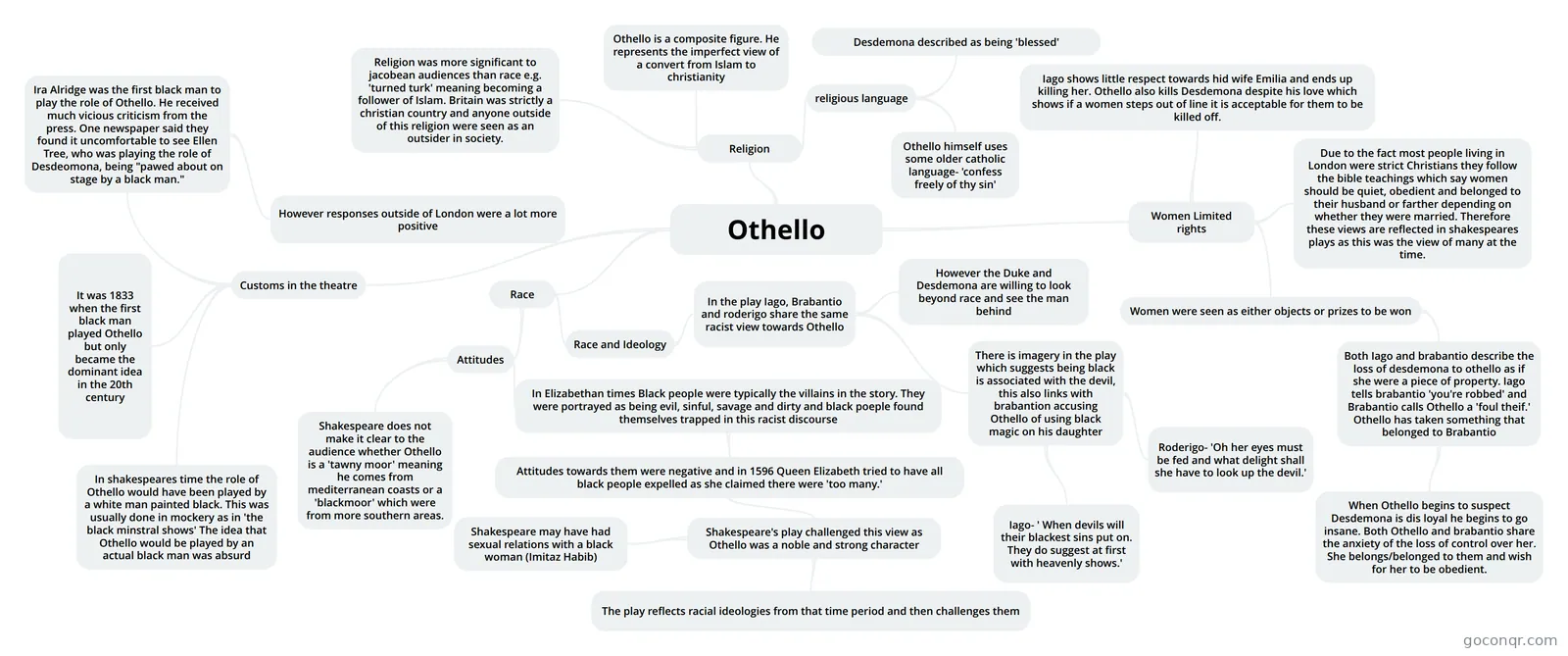
Mind map: Othello themes
Conteúdo do mapa
Othello
Race
- Attitudes
- In Elizabethan times Black people were typically the villains in the story. They were portrayed as being evil, sinful, savage and dirty and black poeple found themselves trapped in this racist discourse
- Attitudes towards them were negative and in 1596 Queen Elizabeth tried to have all black people expelled as she claimed there were 'too many.'
- Shakespeare's play challenged this view as Othello was a noble and strong character
- Shakespeare may have had sexual relations with a black woman (Imitaz Habib)
- The play reflects racial ideologies from that time period and then challenges them
- Shakespeare's play challenged this view as Othello was a noble and strong character
- Attitudes towards them were negative and in 1596 Queen Elizabeth tried to have all black people expelled as she claimed there were 'too many.'
- Shakespeare does not make it clear to the audience whether Othello is a 'tawny moor' meaning he comes from mediterranean coasts or a 'blackmoor' which were from more southern areas.
- In Elizabethan times Black people were typically the villains in the story. They were portrayed as being evil, sinful, savage and dirty and black poeple found themselves trapped in this racist discourse
- Race and Ideology
- In the play Iago, Brabantio and roderigo share the same racist view towards Othello
- However the Duke and Desdemona are willing to look beyond race and see the man behind
- There is imagery in the play which suggests being black is associated with the devil, this also links with brabantion accusing Othello of using black magic on his daughter
- Iago- ' When devils will their blackest sins put on. They do suggest at first with heavenly shows.'
- Roderigo- 'Oh her eyes must be fed and what delight shall she have to look up the devil.'
- In the play Iago, Brabantio and roderigo share the same racist view towards Othello
- Attitudes
Customs in the theatre
- In shakespeares time the role of Othello would have been played by a white man painted black. This was usually done in mockery as in 'the black minstral shows' The idea that Othello would be played by an actual black man was absurd
- It was 1833 when the first black man played Othello but only became the dominant idea in the 20th century
- Ira Alridge was the first black man to play the role of Othello. He received much vicious criticism from the press. One newspaper said they found it uncomfortable to see Ellen Tree, who was playing the role of Desdeomona, being "pawed about on stage by a black man."
- However responses outside of London were a lot more positive
Women Limited rights
- Women were seen as either objects or prizes to be won
- Both Iago and brabantio describe the loss of desdemona to othello as if she were a piece of property. Iago tells brabantio 'you're robbed' and Brabantio calls Othello a 'foul theif.' Othello has taken something that belonged to Brabantio
- When Othello begins to suspect Desdemona is dis loyal he begins to go insane. Both Othello and brabantio share the anxiety of the loss of control over her. She belongs/belonged to them and wish for her to be obedient.
- Both Iago and brabantio describe the loss of desdemona to othello as if she were a piece of property. Iago tells brabantio 'you're robbed' and Brabantio calls Othello a 'foul theif.' Othello has taken something that belonged to Brabantio
- Iago shows little respect towards hid wife Emilia and ends up killing her. Othello also kills Desdemona despite his love which shows if a women steps out of line it is acceptable for them to be killed off.
- Due to the fact most people living in London were strict Christians they follow the bible teachings which say women should be quiet, obedient and belonged to their husband or farther depending on whether they were married. Therefore these views are reflected in shakespeares plays as this was the view of many at the time.
- Women were seen as either objects or prizes to be won
Religion
- Religion was more significant to jacobean audiences than race e.g. 'turned turk' meaning becoming a follower of Islam. Britain was strictly a christian country and anyone outside of this religion were seen as an outsider in society.
- Othello is a composite figure. He represents the imperfect view of a convert from Islam to christianity
- religious language
- Othello himself uses some older catholic language- 'confess freely of thy sin'
- Desdemona described as being 'blessed'
Informações
- Descrição
- Mapa Mental sobre Othello, criado por kitkat12 em 13-09-2015.
- Criado por
- kitkat12
- Visualizações
- 1
- Avaliação