
Mapa mental
Beowulf- Mark Fouad
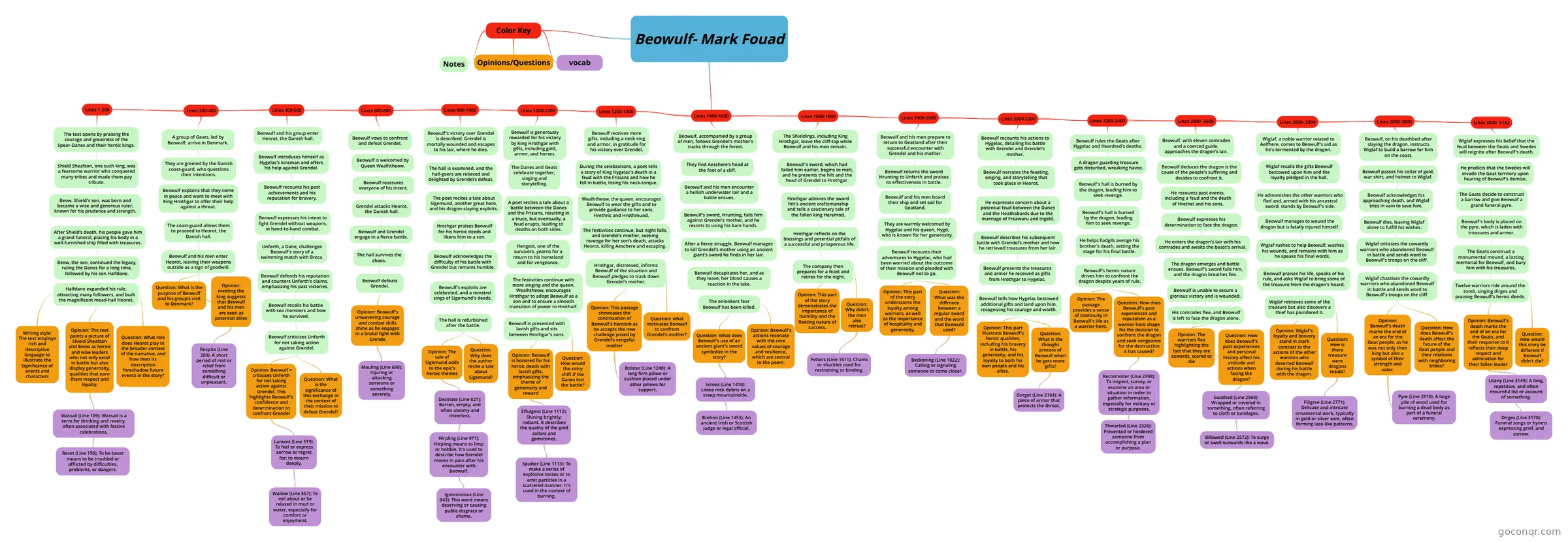
Mind map: Beowulf
Conteúdo do mapa
Beowulf- Mark Fouad
Lines 1400-1600
- Lines 1600-1800
- Lines 1800-2000
- Lines 2000-2200
- Lines 2200-2400
- Lines 2400- 2600
- Lines 2600- 2800
- Lines 2800-3000
- Lines 3000- 3182
- Wiglaf expresses his belief that the feud between the Geats and Swedes will reignite after Beowulf's death.
- He predicts that the Swedes will invade the Geat territory upon hearing of Beowulf's demise.
- The Geats decide to construct a barrow and give Beowulf a grand funeral pyre.
- Beowulf's body is placed on the pyre, which is laden with treasures and armor.
- The Geats construct a monumental mound, a lasting memorial for Beowulf, and bury him with his treasures.
- Twelve warriors ride around the tomb, singing dirges and praising Beowulf's heroic deeds.
- Opinion: Beowulf's death marks the end of an era for the Geats, and their response to it reflects their deep respect and admiration for their fallen leader
- Litany (Line 3149): A long, repetitive, and often mournful list or account of something.
- Dirges (Line 3170): Funeral songs or hymns expressing grief, and sorrow.
- Litany (Line 3149): A long, repetitive, and often mournful list or account of something.
- Question: How would this story be different if Beowulf didn't die?
- Opinion: Beowulf's death marks the end of an era for the Geats, and their response to it reflects their deep respect and admiration for their fallen leader
- Twelve warriors ride around the tomb, singing dirges and praising Beowulf's heroic deeds.
- The Geats construct a monumental mound, a lasting memorial for Beowulf, and bury him with his treasures.
- Beowulf's body is placed on the pyre, which is laden with treasures and armor.
- The Geats decide to construct a barrow and give Beowulf a grand funeral pyre.
- He predicts that the Swedes will invade the Geat territory upon hearing of Beowulf's demise.
- Wiglaf expresses his belief that the feud between the Geats and Swedes will reignite after Beowulf's death.
- Beowulf, on his deathbed after slaying the dragon, instructs Wiglaf to build a barrow for him on the coast.
- Beowulf passes his collar of gold, war shirt, and helmet to Wiglaf.
- Beowulf acknowledges his approaching death, and Wiglaf tries in vain to save him.
- Beowulf dies, leaving Wiglaf alone to fulfill his wishes.
- Wiglaf criticizes the cowardly warriors who abandoned Beowulf in battle and sends word to Beowulf's troops on the cliff.
- Wiglaf chastises the cowardly warriors who abandoned Beowulf in battle and sends word to Beowulf's troops on the cliff.
- Question: How does Beowulf's death affect the future of the Geat people and their relations with neighboring tribes?
- Opinion: Beowulf's death marks the end of an era for the Geat people, as he was not only their king but also a symbol of their strength and valor.
- Pyre (Line 2818): A large pile of wood used for burning a dead body as part of a funeral ceremony.
- Wiglaf chastises the cowardly warriors who abandoned Beowulf in battle and sends word to Beowulf's troops on the cliff.
- Wiglaf criticizes the cowardly warriors who abandoned Beowulf in battle and sends word to Beowulf's troops on the cliff.
- Beowulf dies, leaving Wiglaf alone to fulfill his wishes.
- Beowulf acknowledges his approaching death, and Wiglaf tries in vain to save him.
- Beowulf passes his collar of gold, war shirt, and helmet to Wiglaf.
- Lines 3000- 3182
- Wiglaf, a noble warrior related to Aelfhere, comes to Beowulf's aid as he's tormented by the dragon.
- Wiglaf recalls the gifts Beowulf bestowed upon him and the loyalty pledged in the hall.
- He admonishes the other warriors who fled and, armed with his ancestral sword, stands by Beowulf's side.
- Beowulf manages to wound the dragon but is fatally injured himself.
- Wiglaf rushes to help Beowulf, washes his wounds, and remains with him as he speaks his final words.
- Beowulf praises his life, speaks of his rule, and asks Wiglaf to bring some of the treasure from the dragon's hoard.
- Wiglaf retrieves some of the treasure but also discovers a thief has plundered it.
- Opinion: Wiglaf's loyalty and bravery stand in stark contrast to the actions of the other warriors who deserted Beowulf during his battle with the dragon.
- Question: How is there treasure were dragons reside?
- Filigree (Line 2771): Delicate and intricate ornamental work, typically in gold or silver wire, often forming lace-like patterns.
- Wiglaf retrieves some of the treasure but also discovers a thief has plundered it.
- Beowulf praises his life, speaks of his rule, and asks Wiglaf to bring some of the treasure from the dragon's hoard.
- Wiglaf rushes to help Beowulf, washes his wounds, and remains with him as he speaks his final words.
- Beowulf manages to wound the dragon but is fatally injured himself.
- He admonishes the other warriors who fled and, armed with his ancestral sword, stands by Beowulf's side.
- Wiglaf recalls the gifts Beowulf bestowed upon him and the loyalty pledged in the hall.
- Lines 2800-3000
- Beowulf, with eleven comrades and a coerced guide, approaches the dragon's lair.
- Beowulf deduces the dragon is the cause of the people's suffering and decides to confront it.
- He recounts past events, including a feud and the death of Hrethel and his sons.
- Beowulf expresses his determination to face the dragon.
- He enters the dragon's lair with his comrades and awaits the beast's arrival.
- The dragon emerges and battle ensues. Beowulf's sword fails him, and the dragon breathes fire.
- Beowulf is unable to secure a glorious victory and is wounded.
- His comrades flee, and Beowulf is left to face the dragon alone.
- Opinion: The warriors flee highlighting the fact that they are cowards, scared to die
- Question: How does Beowulf's past experiences and personal history affect his attitude and actions when facing the dragon?
- Swathed (Line 2560): Wrapped or covered in something, often referring to cloth or bandages.
- Billowed (Line 2572): To surge or swell outwards like a wave.
- Swathed (Line 2560): Wrapped or covered in something, often referring to cloth or bandages.
- His comrades flee, and Beowulf is left to face the dragon alone.
- Beowulf is unable to secure a glorious victory and is wounded.
- The dragon emerges and battle ensues. Beowulf's sword fails him, and the dragon breathes fire.
- He enters the dragon's lair with his comrades and awaits the beast's arrival.
- Beowulf expresses his determination to face the dragon.
- He recounts past events, including a feud and the death of Hrethel and his sons.
- Beowulf deduces the dragon is the cause of the people's suffering and decides to confront it.
- Lines 2600- 2800
- Beowulf rules the Geats after Hygelac and Heardred's deaths.
- A dragon guarding treasure gets disturbed, wreaking havoc.
- Beowulf's hall is burned by the dragon, leading him to seek revenge.
- Beowulf's hall is burned by the dragon, leading him to seek revenge.
- He helps Eadgils avenge his brother's death, setting the stage for his final battle.
- Beowulf's heroic nature drives him to confront the dragon despite years of rule.
- Question: How does Beowulf's past experiences and reputation as a warrior-hero shape his the decision to confront the dragon and seek vengeance for the destruction it has caused?
- Reconnoiter (Line 2398): To inspect, survey, or examine an area or situation in order to gather information, especially for military or strategic purposes.
- Thwarted (Line 2326): Prevented or hindered someone from accomplishing a plan or purpose.
- Reconnoiter (Line 2398): To inspect, survey, or examine an area or situation in order to gather information, especially for military or strategic purposes.
- Opinion: The passage provides a sense of continuity in Beowulf's life as a warrior-hero.
- Question: How does Beowulf's past experiences and reputation as a warrior-hero shape his the decision to confront the dragon and seek vengeance for the destruction it has caused?
- Beowulf's heroic nature drives him to confront the dragon despite years of rule.
- He helps Eadgils avenge his brother's death, setting the stage for his final battle.
- Beowulf's hall is burned by the dragon, leading him to seek revenge.
- Beowulf's hall is burned by the dragon, leading him to seek revenge.
- A dragon guarding treasure gets disturbed, wreaking havoc.
- Lines 2400- 2600
- Beowulf recounts his actions to Hygelac, detailing his battle with Grendel and Grendel's mother.
- Beowulf narrates the feasting, singing, and storytelling that took place in Heorot.
- He expresses concern about a potential feud between the Danes and the Heathobards due to the marriage of Freawaru and Ingeld.
- Beowulf describes his subsequent battle with Grendel's mother and how he retrieved treasures from her lair.
- Beowulf presents the treasures and armor he received as gifts from Hrothgar to Hygelac.
- Beowulf tells how Hygelac bestowed additional gifts and land upon him, recognizing his courage and worth.
- Opinion: This part illustrate Beowulf's heroic qualities, including his bravery in battle, his generosity, and his loyalty to both his own people and his allies.
- Question: What is the thought process of Beowulf when he gets more gifts?
- Gorget (Line 2164): A piece of armor that protects the throat.
- Beowulf tells how Hygelac bestowed additional gifts and land upon him, recognizing his courage and worth.
- Beowulf presents the treasures and armor he received as gifts from Hrothgar to Hygelac.
- Beowulf describes his subsequent battle with Grendel's mother and how he retrieved treasures from her lair.
- He expresses concern about a potential feud between the Danes and the Heathobards due to the marriage of Freawaru and Ingeld.
- Beowulf narrates the feasting, singing, and storytelling that took place in Heorot.
- Lines 2200-2400
- Beowulf and his men prepare to return to Geatland after their successful encounter with Grendel and his mother.
- Beowulf returns the sword Hrunting to Unferth and praises its effectiveness in battle.
- Beowulf and his men board their ship and set sail for Geatland.
- They are warmly welcomed by Hygelac and his queen, Hygd, who is known for her generosity.
- Beowulf recounts their adventures to Hygelac, who had been worried about the outcome of their mission and pleaded with Beowulf not to go.
- Opinion: This part of the sotry underscores the loyalty among warriors, as well as the importance of hospitality and generosity.
- Question: What was the diffrnece between a regular sword and the word that Beowuld used?
- Beckoning (Line 1822): Calling or signaling someone to come closer.
- Beowulf recounts their adventures to Hygelac, who had been worried about the outcome of their mission and pleaded with Beowulf not to go.
- They are warmly welcomed by Hygelac and his queen, Hygd, who is known for her generosity.
- Beowulf and his men board their ship and set sail for Geatland.
- Beowulf returns the sword Hrunting to Unferth and praises its effectiveness in battle.
- Lines 2000-2200
- The Shieldings, including King Hrothgar, leave the cliff-top while Beowulf and his men remain.
- Beowulf's sword, which had failed him earlier, begins to melt, and he presents the hilt and the head of Grendel to Hrothgar.
- Hrothgar admires the sword hilt's ancient craftsmanship and tells a cautionary tale of the fallen king Heremod.
- Hrothgar reflects on the blessings and potential pitfalls of a successful and prosperous life.
- The company then prepares for a feast and retires for the night.
- Opinion: This part of the story demonstrates the importance of humility and the fleeting nature of success.
- Question: Why didn't the men also retreat?
- Fetters (Line 1611): Chains or shackles used for restraining or binding.
- The company then prepares for a feast and retires for the night.
- Hrothgar reflects on the blessings and potential pitfalls of a successful and prosperous life.
- Hrothgar admires the sword hilt's ancient craftsmanship and tells a cautionary tale of the fallen king Heremod.
- Beowulf's sword, which had failed him earlier, begins to melt, and he presents the hilt and the head of Grendel to Hrothgar.
- Lines 1800-2000
- Lines 1200-1400
- Lines 1000-1200
- Beowulf is generously rewarded for his victory by King Hrothgar with gifts, including gold, armor, and horses.
- The Danes and Geats celebrate together, singing and storytelling.
- A poet recites a tale about a battle between the Danes and the Frisians, resulting in a truce, but eventually, a feud erupts, leading to deaths on both sides.
- Hengest, one of the survivors, yearns for a return to his homeland and for vengeance.
- The festivities continue with more singing and the queen, Wealhtheow, encourages Hrothgar to adopt Beowulf as a son and to ensure a smooth transition of power to Hrothulf.
- Beowulf is presented with lavish gifts and sits between Hrothgar's sons.
- Opinion: Beowulf is honored for his heroic deeds with lavish gifts, emphasizing the theme of generosity and reward
- Effulgent (Line 1112): Shining brightly; radiant. It describes the quality of the gold collars and gemstones.
- Sputter (Line 1113): To make a series of explosive noises or to emit particles in a scattered manner. It's used in the context of burning.
- Effulgent (Line 1112): Shining brightly; radiant. It describes the quality of the gold collars and gemstones.
- Question: How would the sotry shift if the Danes lost the battle?
- Opinion: Beowulf is honored for his heroic deeds with lavish gifts, emphasizing the theme of generosity and reward
- Beowulf is presented with lavish gifts and sits between Hrothgar's sons.
- The festivities continue with more singing and the queen, Wealhtheow, encourages Hrothgar to adopt Beowulf as a son and to ensure a smooth transition of power to Hrothulf.
- Hengest, one of the survivors, yearns for a return to his homeland and for vengeance.
- A poet recites a tale about a battle between the Danes and the Frisians, resulting in a truce, but eventually, a feud erupts, leading to deaths on both sides.
- The Danes and Geats celebrate together, singing and storytelling.
- Lines 800-1000
- Lines 600-800
- Lines 400-600
- Lines 200-400
- Lines 1-200
- The text opens by praising the courage and greatness of the Spear-Danes and their heroic kings.
- Shield Sheafson, one such king, was a fearsome warrior who conquered many tribes and made them pay tribute.
- Beow, Shield's son, was born and became a wise and generous ruler, known for his prudence and strength.
- After Shield's death, his people gave him a grand funeral, placing his body in a well-furnished ship filled with treasures.
- Beow, the son, continued the legacy, ruling the Danes for a long time, followed by his son Halfdane.
- Halfdane expanded his rule, attracting many followers, and built the magnificent mead-hall Heorot.
- Question: What role does Heorot play in the broader context of the narrative, and how does its description foreshadow future events in the story?
- Opinion: The text paints a picture of Shield Sheafson and Beow as heroic and wise leaders who not only excel in battle but also display generosity, qualities that earn them respect and loyalty.
- Wassail (Line 109): Wassail is a term for drinking and revelry, often associated with festive celebrations.
- Beset (Line 150); To be beset means to be troubled or afflicted by difficulties, problems, or dangers.
- Wassail (Line 109): Wassail is a term for drinking and revelry, often associated with festive celebrations.
- Writing style: The text employs rich and descriptive language to illustrate the Significance of events and characters
- Halfdane expanded his rule, attracting many followers, and built the magnificent mead-hall Heorot.
- Beow, the son, continued the legacy, ruling the Danes for a long time, followed by his son Halfdane.
- After Shield's death, his people gave him a grand funeral, placing his body in a well-furnished ship filled with treasures.
- Beow, Shield's son, was born and became a wise and generous ruler, known for his prudence and strength.
- Shield Sheafson, one such king, was a fearsome warrior who conquered many tribes and made them pay tribute.
- The text opens by praising the courage and greatness of the Spear-Danes and their heroic kings.
- A group of Geats, led by Beowulf, arrive in Denmark.
- They are greeted by the Danish coast-guard, who questions their intentions.
- Beowulf explains that they come in peace and want to meet with King Hrothgar to offer their help against a threat.
- The coast-guard allows them to proceed to Heorot, the Danish hall.
- Beowulf and his men enter Heorot, leaving their weapons outside as a sign of goodwill.
- Question: What is the purpose of Beowulf and his group's visit to Denmark?
- Opinion: meeting the king suggests that Beowulf and his men are seen as potential allies
- Respite (Line 280): A short period of rest or relief from something difficult or unpleasant.
- Beowulf and his men enter Heorot, leaving their weapons outside as a sign of goodwill.
- The coast-guard allows them to proceed to Heorot, the Danish hall.
- Beowulf explains that they come in peace and want to meet with King Hrothgar to offer their help against a threat.
- They are greeted by the Danish coast-guard, who questions their intentions.
- Lines 1-200
- Beowulf and his group enter Heorot, the Danish hall.
- Beowulf introduces himself as Hygelac's kinsman and offers his help against Grendel.
- Beowulf recounts his past achievements and his reputation for bravery.
- Beowulf expresses his intent to fight Grendel without weapons, in hand-to-hand combat.
- Unferth, a Dane, challenges Beowulf's story of a swimming match with Breca.
- Beowulf defends his reputation and counters Unferth's claims, emphasizing his past victories.
- Beowulf recalls his battle with sea monsters and how he survived.
- Beowulf criticizes Unferth for not taking action against Grendel.
- Opinion: Beowulf = criticizes Unferth for not taking action against Grendel. This highlights Beowulf's confidence and determination to confront Grendel
- Lament (Line 519): To feel or express sorrow or regret for; to mourn deeply.
- Wallow (Line 557): To roll about or lie relaxed in mud or water, especially for comfort or enjoyment.
- Lament (Line 519): To feel or express sorrow or regret for; to mourn deeply.
- Question: What is the significance of this exchange in the context of their mission to defeat Grendel?
- Opinion: Beowulf = criticizes Unferth for not taking action against Grendel. This highlights Beowulf's confidence and determination to confront Grendel
- Beowulf criticizes Unferth for not taking action against Grendel.
- Beowulf recalls his battle with sea monsters and how he survived.
- Beowulf defends his reputation and counters Unferth's claims, emphasizing his past victories.
- Unferth, a Dane, challenges Beowulf's story of a swimming match with Breca.
- Beowulf expresses his intent to fight Grendel without weapons, in hand-to-hand combat.
- Beowulf recounts his past achievements and his reputation for bravery.
- Beowulf introduces himself as Hygelac's kinsman and offers his help against Grendel.
- Lines 200-400
- Beowulf vows to confront and defeat Grendel.
- Beowulf is welcomed by Queen Wealhtheow.
- Beowulf reassures everyone of his intent.
- Grendel attacks Heorot, the Danish hall.
- Beowulf and Grendel engage in a fierce battle.
- The hall survives the chaos.
- Beowulf defeats Grendel.
- Opinion: Beowulf's unwavering courage and combat skills shine as he engages in a brutal fight with Grende
- Mauling (Line 690): Injuring or attacking someone or something severely.
- Opinion: Beowulf's unwavering courage and combat skills shine as he engages in a brutal fight with Grende
- Beowulf defeats Grendel.
- The hall survives the chaos.
- Beowulf and Grendel engage in a fierce battle.
- Grendel attacks Heorot, the Danish hall.
- Beowulf reassures everyone of his intent.
- Beowulf is welcomed by Queen Wealhtheow.
- Lines 400-600
- Beowulf's victory over Grendel is described. Grendel is mortally wounded and escapes to his lair, where he dies.
- The hall is examined, and the hall-goers are relieved and delighted by Grendel's defeat.
- The poet recites a tale about Sigemund, another great hero, and his dragon-slaying exploits.
- Hrothgar praises Beowulf for his heroic deeds and likens him to a son.
- Beowulf acknowledges the difficulty of his battle with Grendel but remains humble.
- Beowulf's exploits are celebrated, and a minstrel sings of Sigemund's deeds.
- The hall is refurbished after the battle.
- Opinion: The tale of Sigemund adds to the epic's heroic themes
- Desolate (Line 821): Barren, empty, and often aloomy and cheerless.
- Hirpling (Line 971): Hirpling means to limp or hobble. It's used to describe how Grendel moves in pain after his encounter with Beowulf.
- Ignominious (Line 843): This word means deserving or causing public disgrace or shame.
- Hirpling (Line 971): Hirpling means to limp or hobble. It's used to describe how Grendel moves in pain after his encounter with Beowulf.
- Desolate (Line 821): Barren, empty, and often aloomy and cheerless.
- Question: Why does the author recite a tale about Sigemund?
- Opinion: The tale of Sigemund adds to the epic's heroic themes
- The hall is refurbished after the battle.
- Beowulf's exploits are celebrated, and a minstrel sings of Sigemund's deeds.
- Beowulf acknowledges the difficulty of his battle with Grendel but remains humble.
- Hrothgar praises Beowulf for his heroic deeds and likens him to a son.
- The poet recites a tale about Sigemund, another great hero, and his dragon-slaying exploits.
- The hall is examined, and the hall-goers are relieved and delighted by Grendel's defeat.
- Lines 600-800
- Beowulf is generously rewarded for his victory by King Hrothgar with gifts, including gold, armor, and horses.
- Beowulf receives more gifts, including a neck-ring and armor, in gratitude for his victory over Grendel.
- During the celebrations, a poet tells a story of King Hygelac's death in a feud with the Frisians and how he fell in battle, losing his neck-torque.
- Wealhtheow, the queen, encourages Beowulf to wear the gifts and to provide guidance to her sons, Hrethric and Hrothmund.
- The festivities continue, but night falls, and Grendel's mother, seeking revenge for her son's death, attacks Heorot, killing Aeschere and escaping.
- Hrothgar, distressed, informs Beowulf of the situation and Beowulf pledges to track down Grendel's mother.
- Question: what motivates Beowulf to confront Grendel's mother?
- Opinion: This passage showcases the continuation of Beowulf's heroism as he accepts the new challenge posed by Grendel's vengeful mother
- Bolster (Line 1240): A long firm pillow or cushion placed under other pillows for support.
- Hrothgar, distressed, informs Beowulf of the situation and Beowulf pledges to track down Grendel's mother.
- The festivities continue, but night falls, and Grendel's mother, seeking revenge for her son's death, attacks Heorot, killing Aeschere and escaping.
- Wealhtheow, the queen, encourages Beowulf to wear the gifts and to provide guidance to her sons, Hrethric and Hrothmund.
- During the celebrations, a poet tells a story of King Hygelac's death in a feud with the Frisians and how he fell in battle, losing his neck-torque.
- Lines 1000-1200
- Beowulf, accompanied by a group of men, follows Grendel's mother's tracks through the forest.
- They find Aeschere's head at the foot of a cliff.
- Beowulf and his men encounter a hellish underwater lair and a battle ensues.
- Beowulf's sword, Hrunting, fails him against Grendel's mother, and he resorts to using his bare hands.
- After a fierce struggle, Beowulf manages to kill Grendel's mother using an ancient giant's sword he finds in her lair.
- Beowulf decapitates her, and as they leave, her blood causes a reaction in the lake.
- The onlookers fear Beowulf has been killed.
- Question: What does Beowulf's use of an ancient giant's sword symbolize in the story?
- Screes (Line 1410): Loose rock debris on a steep mountainside.
- Brehon (Line 1453): An ancient Irish or Scottish judge or legal official.
- Screes (Line 1410): Loose rock debris on a steep mountainside.
- Opinion: Beowulf's actions resonate with the core values of courage and resilience, which are central to the poem.
- Question: What does Beowulf's use of an ancient giant's sword symbolize in the story?
- The onlookers fear Beowulf has been killed.
- Beowulf decapitates her, and as they leave, her blood causes a reaction in the lake.
- After a fierce struggle, Beowulf manages to kill Grendel's mother using an ancient giant's sword he finds in her lair.
- Beowulf's sword, Hrunting, fails him against Grendel's mother, and he resorts to using his bare hands.
- Beowulf and his men encounter a hellish underwater lair and a battle ensues.
- They find Aeschere's head at the foot of a cliff.
- Lines 1600-1800
Color Key
- Notes
- Opinions/Questions
- vocab
Informações
- Descrição
- Mapa Mental sobre Beowulf- Mark Fouad, criado por Mark Fouad em 27-03-2022.
- Criado por
- Mark Fouad
- Visualizações
- 0
- Avaliação