
Mapa mental
T 21 the programming of the ForeignLanguage Area
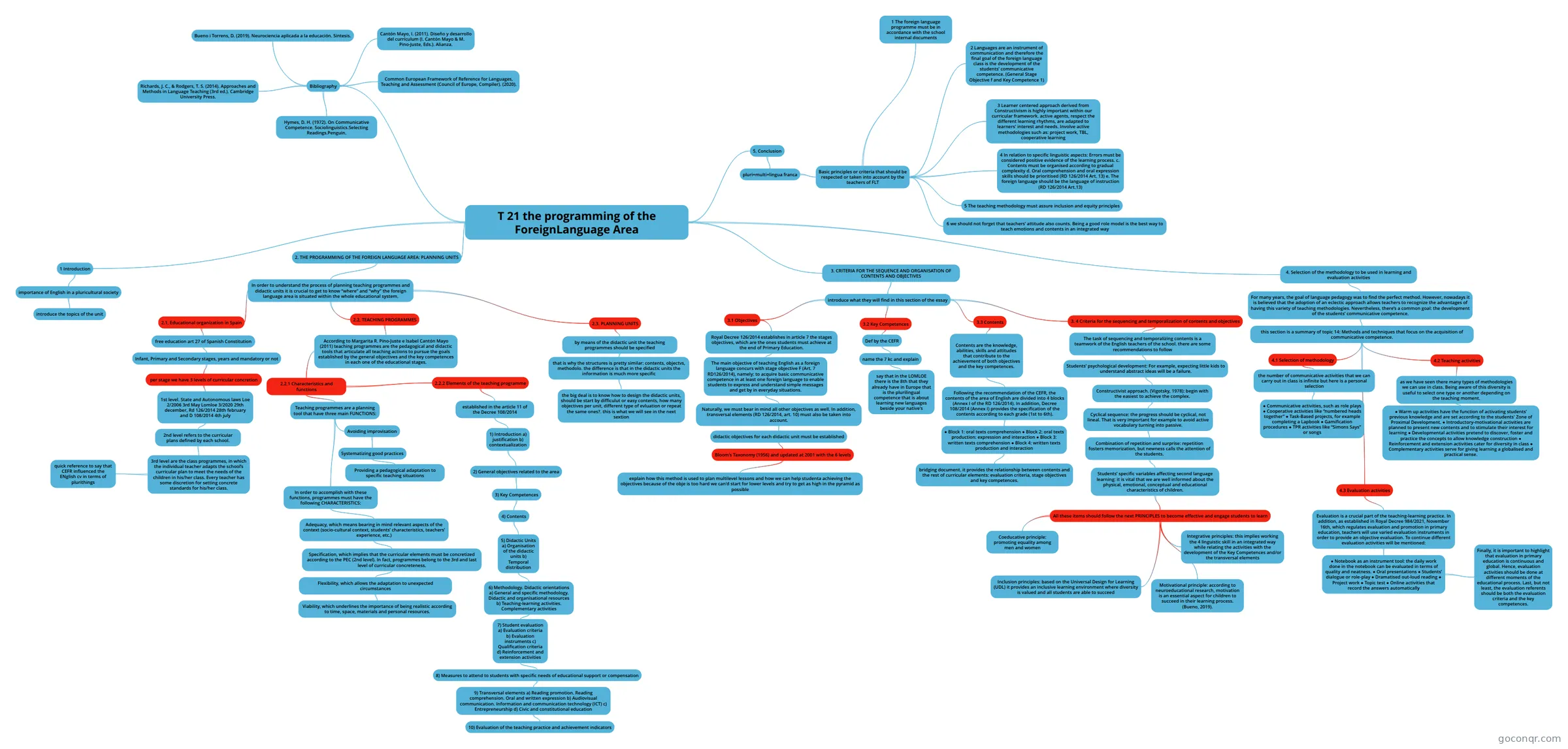
Mind map: Programming of the foreign language area
Conteúdo do mapa
T 21 the programming of the ForeignLanguage Area
1 Introduction
- importance of English in a pluricultural society
- introduce the topics of the unit
- importance of English in a pluricultural society
2. THE PROGRAMMING OF THE FOREIGN LANGUAGE AREA: PLANNING UNITS
- In order to understand the process of planning teaching programmes and didactic units it is crucial to get to know “where” and “why” the foreign language area is situated within the whole educational system.
- 2.1. Educational organization in Spain
- free education art 27 of Spanish Constitution
- Infant, Primary and Secondary stages, years and mandatory or not
- per stage we have 3 levels of curricular concretion
- 1st level. State and Autonomous laws Loe 2/2006 3rd May Lomloe 3/2020 29th december, Rd 126/2014 28th february and D 108/2014 4th july
- 2nd level refers to the curricular plans defined by each school.
- 3rd level are the class programmes, in which the individual teacher adapts the school’s curricular plan to meet the needs of the children in his/her class. Every teacher has some discretion for setting concrete standards for his/her class.
- quick reference to say that CEFR influenced the ENglish cv in terms of plurithings
- 3rd level are the class programmes, in which the individual teacher adapts the school’s curricular plan to meet the needs of the children in his/her class. Every teacher has some discretion for setting concrete standards for his/her class.
- 2nd level refers to the curricular plans defined by each school.
- 1st level. State and Autonomous laws Loe 2/2006 3rd May Lomloe 3/2020 29th december, Rd 126/2014 28th february and D 108/2014 4th july
- per stage we have 3 levels of curricular concretion
- Infant, Primary and Secondary stages, years and mandatory or not
- free education art 27 of Spanish Constitution
- 2.2. TEACHING PROGRAMMES
- According to Margarita R. Pino-Juste e Isabel Cantón Mayo (2011) teaching programmes are the pedagogical and didactic tools that articulate all teaching actions to pursue the goals established by the general objectives and the key competences in each one of the educational stages.
- 2.2.1 Characteristics and functions
- Teaching programmes are a planning tool that have three main FUNCTIONS:
- Avoiding improvisation
- Systematizing good practices
- Providing a pedagogical adaptation to specific teaching situations
- Systematizing good practices
- In order to accomplish with these functions, programmes must have the following CHARACTERISTICS:
- Adequacy, which means bearing in mind relevant aspects of the context (socio-cultural context, students’ characteristics, teachers’ experience, etc.)
- Specification, which implies that the curricular elements must be concretized according to the PEC (2nd level). In fact, programmes belong to the 3rd and last level of curricular concreteness.
- Flexibility, which allows the adaptation to unexpected circumstances
- Viability, which underlines the importance of being realistic according to time, space, materials and personal resources.
- Flexibility, which allows the adaptation to unexpected circumstances
- Specification, which implies that the curricular elements must be concretized according to the PEC (2nd level). In fact, programmes belong to the 3rd and last level of curricular concreteness.
- Adequacy, which means bearing in mind relevant aspects of the context (socio-cultural context, students’ characteristics, teachers’ experience, etc.)
- Avoiding improvisation
- 2.2.2 Elements of the teaching programme
- established in the article 11 of the Decree 108/2014
- 1) Introduction a) justification b) contextualization
- 2) General objectives related to the area
- 3) Key Competences
- 4) Contents
- 5) Didactic Units a) Organisation of the didactic units b) Temporal distribution
- 6) Methodology. Didactic orientations a) General and specific methodology. Didactic and organisational resources b) Teaching-learning activities. Complementary activities
- 7) Student evaluation a) Evaluation criteria b) Evaluation instruments c) Qualification criteria d) Reinforcement and extension activities
- 8) Measures to attend to students with specific needs of educational support or compensation
- 9) Transversal elements a) Reading promotion. Reading comprehension. Oral and written expression b) Audiovisual communication. Information and communication technology (ICT) c) Entrepreneurship d) Civic and constitutional education
- 10) Evaluation of the teaching practice and achievement indicators
- 9) Transversal elements a) Reading promotion. Reading comprehension. Oral and written expression b) Audiovisual communication. Information and communication technology (ICT) c) Entrepreneurship d) Civic and constitutional education
- 8) Measures to attend to students with specific needs of educational support or compensation
- 7) Student evaluation a) Evaluation criteria b) Evaluation instruments c) Qualification criteria d) Reinforcement and extension activities
- 6) Methodology. Didactic orientations a) General and specific methodology. Didactic and organisational resources b) Teaching-learning activities. Complementary activities
- 5) Didactic Units a) Organisation of the didactic units b) Temporal distribution
- 4) Contents
- 3) Key Competences
- 2) General objectives related to the area
- 1) Introduction a) justification b) contextualization
- established in the article 11 of the Decree 108/2014
- Teaching programmes are a planning tool that have three main FUNCTIONS:
- 2.2.1 Characteristics and functions
- According to Margarita R. Pino-Juste e Isabel Cantón Mayo (2011) teaching programmes are the pedagogical and didactic tools that articulate all teaching actions to pursue the goals established by the general objectives and the key competences in each one of the educational stages.
- 2.3. PLANNING UNITS
- by means of the didactic unit the teaching programmes should be specified
- that is why the structures is pretty similar: contents, objectvs, methodolo. the difference is that in the didactic units the information is much more specific
- the big deal is to know how to design the didactic units, should be start by difficulut or easy contents, how many objectives per unit, different type of evluation or repeat the same ones?. this is what we will see in the next sextion
- that is why the structures is pretty similar: contents, objectvs, methodolo. the difference is that in the didactic units the information is much more specific
- by means of the didactic unit the teaching programmes should be specified
- 2.1. Educational organization in Spain
- In order to understand the process of planning teaching programmes and didactic units it is crucial to get to know “where” and “why” the foreign language area is situated within the whole educational system.
3. CRITERIA FOR THE SEQUENCE AND ORGANISATION OF CONTENTS AND OBJECTIVES
- introduce what they will find in this section of the essay
- 3.1 Objectives
- Royal Decree 126/2014 establishes in article 7 the stages objectives, which are the ones students must achieve at the end of Primary Education.
- The main objective of teaching English as a foreign language concurs with stage objective F (Art. 7 RD126/2014), namely: to acquire basic communicative competence in at least one foreign language to enable students to express and understand simple messages and get by in everyday situations.
- Naturally, we must bear in mind all other objectives as well. In addition, transversal elements (RD 126/2014, art. 10) must also be taken into account.
- didactic objectives for each didactic unit must be established
- Bloom's Taxonomy (1956) and updated at 2001 with the 6 levels
- explain how this method is used to plan multilevel lessons and how we can help studenta achieving the objectives because of the obje is too hard we can'd start for lower levels and try to get as high in the pyramid as possible
- Bloom's Taxonomy (1956) and updated at 2001 with the 6 levels
- didactic objectives for each didactic unit must be established
- Naturally, we must bear in mind all other objectives as well. In addition, transversal elements (RD 126/2014, art. 10) must also be taken into account.
- The main objective of teaching English as a foreign language concurs with stage objective F (Art. 7 RD126/2014), namely: to acquire basic communicative competence in at least one foreign language to enable students to express and understand simple messages and get by in everyday situations.
- Royal Decree 126/2014 establishes in article 7 the stages objectives, which are the ones students must achieve at the end of Primary Education.
- 3.2 Key Competences
- Def by the CEFR
- name the 7 kc and explain
- say that in the LOMLOE there is the 8th that they already have in Europe that is the plurilingual competence that is about learning new languages beside your native's
- name the 7 kc and explain
- Def by the CEFR
- 3.3 Contents
- Contents are the knowledge, abilities, skills and attitudes that contribute to the achievement of both objectives and the key competences.
- Following the recommendation of the CEFR, the contents of the area of English are divided into 4 blocks (Annex I of the RD 126/2014). In addition, Decree 108/2014 (Annex I) provides the specification of the contents according to each grade (1st to 6th).
- ● Block 1: oral texts comprehension ● Block 2: oral texts production: expression and interaction ● Block 3: written texts comprehension ● Block 4: written texts production and interaction
- bridging document. it provides the relationship between contents and the rest of curricular elements: evaluation criteria, stage objectives and key competences.
- ● Block 1: oral texts comprehension ● Block 2: oral texts production: expression and interaction ● Block 3: written texts comprehension ● Block 4: written texts production and interaction
- Following the recommendation of the CEFR, the contents of the area of English are divided into 4 blocks (Annex I of the RD 126/2014). In addition, Decree 108/2014 (Annex I) provides the specification of the contents according to each grade (1st to 6th).
- Contents are the knowledge, abilities, skills and attitudes that contribute to the achievement of both objectives and the key competences.
- 3. 4 Criteria for the sequencing and temporalization of contents and objectives
- The task of sequencing and temporalizing contents is a teamwork of the English teachers of the school. there are some recommendations to follow
- Students’ psychological development: For example, expecting little kids to understand abstract ideas will be a failure.
- Constructivist approach. (Vigotsky, 1978): begin with the easiest to achieve the complex.
- Cyclical sequence: the progress should be cyclical, not lineal. That is very important for example to avoid active vocabulary turning into passive.
- Combination of repetition and surprise: repetition fosters memorization, but newness calls the attention of the students.
- Students’ specific variables affecting second language learning: it is vital that we are well informed about the physical, emotional, conceptual and educational characteristics of children.
- All these items should follow the next PRINCIPLES to become effective and engage students to learn
- Coeducative principle: promoting equality among men and women
- Inclusion principles: based on the Universal Design for Learning (UDL) it provides an inclusive learning environment where diversity is valued and all students are able to succeed
- Motivational principle: according to neuroeducational research, motivation is an essential aspect for children to succeed in their learning process. (Bueno, 2019).
- Integrative principles: this implies working the 4 linguistic skill in an integrated way while relating the activities with the development of the Key Competences and/or the transversal elements
- All these items should follow the next PRINCIPLES to become effective and engage students to learn
- Students’ specific variables affecting second language learning: it is vital that we are well informed about the physical, emotional, conceptual and educational characteristics of children.
- Combination of repetition and surprise: repetition fosters memorization, but newness calls the attention of the students.
- Cyclical sequence: the progress should be cyclical, not lineal. That is very important for example to avoid active vocabulary turning into passive.
- Constructivist approach. (Vigotsky, 1978): begin with the easiest to achieve the complex.
- Students’ psychological development: For example, expecting little kids to understand abstract ideas will be a failure.
- The task of sequencing and temporalizing contents is a teamwork of the English teachers of the school. there are some recommendations to follow
- 3.1 Objectives
- introduce what they will find in this section of the essay
4. Selection of the methodology to be used in learning and evaluation activities
- For many years, the goal of language pedagogy was to find the perfect method. However, nowadays it is believed that the adoption of an eclectic approach allows teachers to recognize the advantages of having this variety of teaching methodologies. Nevertheless, there’s a common goal: the development of the students’ communicative competence.
- this section is a summary of topic 14: Methods and techniques that focus on the acquisition of communicative competence.
- 4.1 Selection of methodology
- the number of communicative activities that we can carry out in class is infinite but here is a personal selection
- ● Communicative activities, such as role plays ● Cooperative activities like “numbered heads together” ● Task-Based projects, for example completing a Lapbook ● Gamification procedures ● TPR activities like “Simons Says” or songs
- the number of communicative activities that we can carry out in class is infinite but here is a personal selection
- 4.2 Teaching activities
- as we have seen there many types of methodologies we can use in class. Being aware of this diversity is useful to select one type or another depending on the teaching moment.
- ● Warm up activities have the function of activating students’ previous knowledge and are set according to the students' Zone of Proximal Development. ● Introductory-motivational activities are planned to present new contents and to stimulate their interest for learning ● Developmental activities pretend to discover, foster and practice the concepts to allow knowledge construction ● Reinforcement and extension activities cater for diversity in class ● Complementary activities serve for giving learning a globalised and practical sense.
- as we have seen there many types of methodologies we can use in class. Being aware of this diversity is useful to select one type or another depending on the teaching moment.
- 4.3 Evaluation activities
- Evaluation is a crucial part of the teaching-learning practice. In addition, as established in Royal Decree 984/2021, November 16th, which regulates evaluation and promotion in primary education, teachers will use varied evaluation instruments in order to provide an objective evaluation. To continue different evaluation activities will be mentioned:
- ● Notebook as an instrument tool: the daily work done in the notebook can be evaluated in terms of quality and neatness. ● Oral presentations ● Students’ dialogue or role-play ● Dramatised out-loud reading ● Project work ● Topic test ● Online activities that record the answers automatically
- Finally, it is important to highlight that evaluation in primary education is continuous and global. Hence, evaluation activities should be done at different moments of the educational process. Last, but not least, the evaluation referents should be both the evaluation criteria and the key competences.
- ● Notebook as an instrument tool: the daily work done in the notebook can be evaluated in terms of quality and neatness. ● Oral presentations ● Students’ dialogue or role-play ● Dramatised out-loud reading ● Project work ● Topic test ● Online activities that record the answers automatically
- Evaluation is a crucial part of the teaching-learning practice. In addition, as established in Royal Decree 984/2021, November 16th, which regulates evaluation and promotion in primary education, teachers will use varied evaluation instruments in order to provide an objective evaluation. To continue different evaluation activities will be mentioned:
- 4.1 Selection of methodology
- this section is a summary of topic 14: Methods and techniques that focus on the acquisition of communicative competence.
- For many years, the goal of language pedagogy was to find the perfect method. However, nowadays it is believed that the adoption of an eclectic approach allows teachers to recognize the advantages of having this variety of teaching methodologies. Nevertheless, there’s a common goal: the development of the students’ communicative competence.
5. Conclusion
- pluri+multi+lingua franca
- Basic principles or criteria that should be respected or taken into account by the teachers of FLT
- 1 The foreign language programme must be in accordance with the school internal documents
- 2 Languages are an instrument of communication and therefore the final goal of the foreign language class is the development of the students’ communicative competence. (General Stage Objective f and Key Competence 1)
- 3 Learner centered approach derived from Constructivism is highly important within our curricular framework. active agents, respect the different learning rhythms, are adapted to learners' interest and needs. Involve active methodologies such as: project work, TBL, cooperative learning
- 4 In relation to specific linguistic aspects: Errors must be considered positive evidence of the learning process. c. Contents must be organised according to gradual complexity d. Oral comprehension and oral expression skills should be prioritised (RD 126/2014 Art. 13) e. The foreign language should be the language of instruction (RD 126/2014 Art.13)
- 5 The teaching methodology must assure inclusion and equity principles
- 6 we should not forget that teachers’ attitude also counts. Being a good role model is the best way to teach emotions and contents in an integrated way
- Basic principles or criteria that should be respected or taken into account by the teachers of FLT
- pluri+multi+lingua franca
Bibliography
- Bueno i Torrens, D. (2019). Neurociencia aplicada a la educación. Síntesis.
- Cantón Mayo, I. (2011). Diseño y desarrollo del currículum (I. Cantón Mayo & M. Pino-Juste, Eds.). Alianza.
- Common European Framework of Reference for Languages, Teaching and Assessment (Council of Europe, Compiler). (2020).
- Hymes, D. H. (1972). On Communicative Competence. Sociolinguistics.Selecting Readings.Penguin.
- Richards, J. C., & Rodgers, T. S. (2014). Approaches and Methods in Language Teaching (3rd ed.). Cambridge University Press.
Informações
- Descrição
- C1 Profesores de Primaria (Opos) Mapa Mental sobre T 21 the programming of the ForeignLanguage Area, criado por Jorge Pomar em 06-05-2022.
- Criado por
- Jorge Pomar
- Visualizações
- 15
- Avaliação