
Mapa mental
TOPIC 5 GEOGRAPHICAL, HISTORICAL AND CULTURAL FRAMEWORK OF ENGLISH SPEAKING COUNTRIES. DIDACTIC APPLICATION
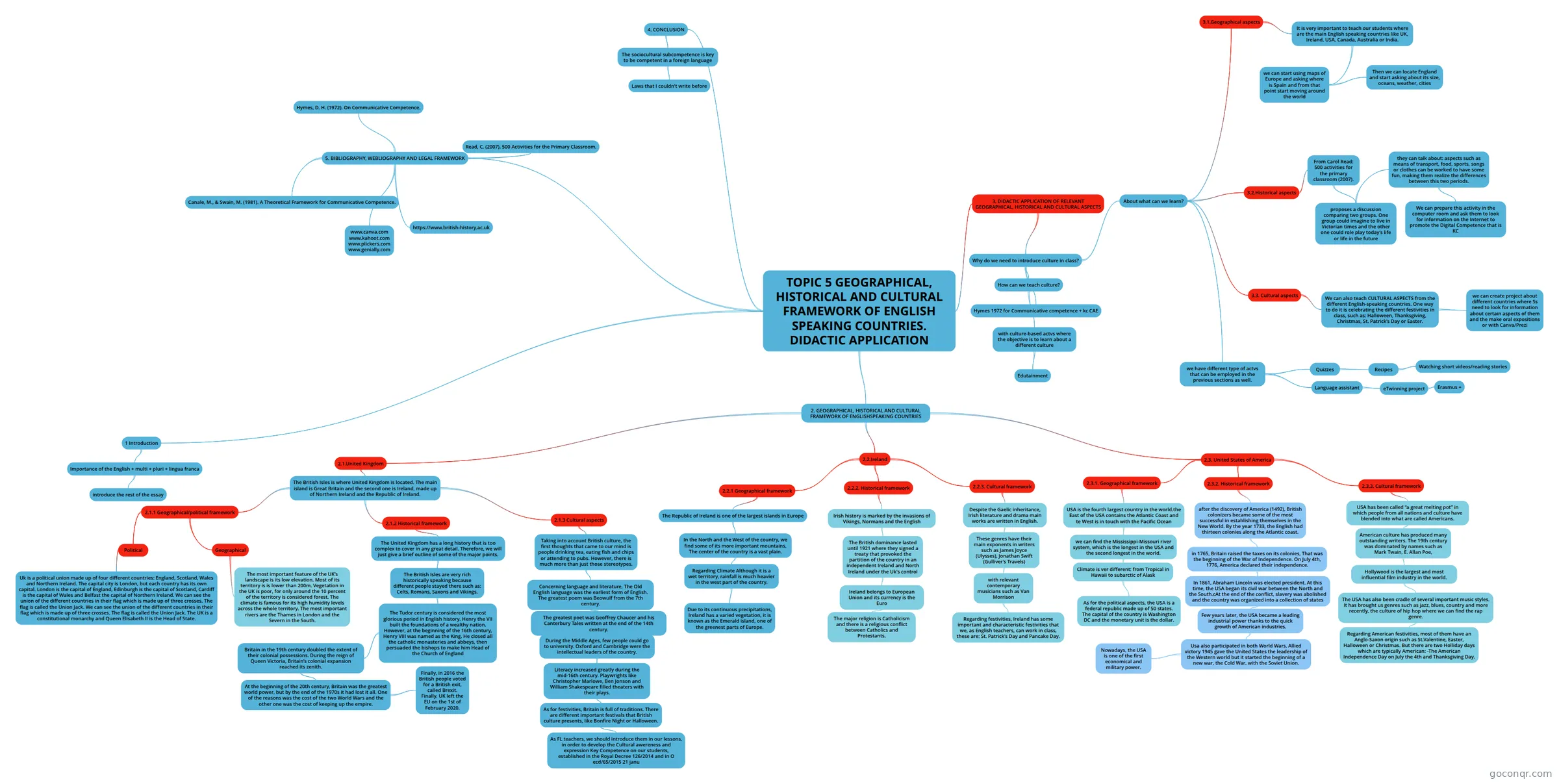
Mind map: English speaking countries geographical historical cultural framework
Conteúdo do mapa
TOPIC 5 GEOGRAPHICAL, HISTORICAL AND CULTURAL FRAMEWORK OF ENGLISH SPEAKING COUNTRIES. DIDACTIC APPLICATION
1 Introduction
- Importance of the English + multi + pluri + lingua franca
- introduce the rest of the essay
- Importance of the English + multi + pluri + lingua franca
2. GEOGRAPHICAL, HISTORICAL AND CULTURAL FRAMEWORK OF ENGLISHSPEAKING COUNTRIES
- 2.1.United Kingdom
- The British Isles is where United Kingdom is located. The main island is Great Britain and the second one is Ireland, made up of Northern Ireland and the Republic of Ireland.
- 2.1.1 Geographical/political framework
- Political
- Uk is a political union made up of four different countries: England, Scotland, Wales and Northern Ireland. The capital city is London, but each country has its own capital. London is the capital of England, Edinburgh is the capital of Scotland, Cardiff is the capital of Wales and Belfast the capital of Northern Ireland. We can see the union of the different countries in their flag which is made up of three crosses. The flag is called the Union Jack. We can see the union of the different countries in their flag which is made up of three crosses. The flag is called the Union Jack. The UK is a constitutional monarchy and Queen Elisabeth II is the Head of State.
- Geographical
- The most important feature of the UK’s landscape is its low elevation. Most of its territory is is lower than 200m. Vegetation in the UK is poor, for only around the 10 percent of the territory is considered forest. The climate is famous for its high humidity levels across the whole territory. The most important rivers are the Thames in London and the Severn in the South.
- Political
- 2.1.2 Historical framework
- The United Kingdom has a long history that is too complex to cover in any great detail. Therefore, we will just give a brief outline of some of the major points.
- The British Isles are very rich historically speaking because different people stayed there such as: Celts, Romans, Saxons and Vikings.
- The Tudor century is considered the most glorious period in English history. Henry the VII built the foundations of a wealthy nation. However, at the beginning of the 16th century, Henry VIII was named as the King. He closed all the catholic monasteries and abbeys, then persuaded the bishops to make him Head of the Church of England
- Britain in the 19th century doubled the extent of their colonial possessions. During the reign of Queen Victoria, Britain’s colonial expansion reached its zenith.
- At the beginning of the 20th century, Britain was the greatest world power, but by the end of the 1970s it had lost it all. One of the reasons was the cost of the two World Wars and the other one was the cost of keeping up the empire.
- Finally, in 2016 the British people voted for a British exit, called Brexit. Finally, UK left the EU on the 1st of February 2020.
- At the beginning of the 20th century, Britain was the greatest world power, but by the end of the 1970s it had lost it all. One of the reasons was the cost of the two World Wars and the other one was the cost of keeping up the empire.
- Britain in the 19th century doubled the extent of their colonial possessions. During the reign of Queen Victoria, Britain’s colonial expansion reached its zenith.
- The Tudor century is considered the most glorious period in English history. Henry the VII built the foundations of a wealthy nation. However, at the beginning of the 16th century, Henry VIII was named as the King. He closed all the catholic monasteries and abbeys, then persuaded the bishops to make him Head of the Church of England
- The British Isles are very rich historically speaking because different people stayed there such as: Celts, Romans, Saxons and Vikings.
- The United Kingdom has a long history that is too complex to cover in any great detail. Therefore, we will just give a brief outline of some of the major points.
- 2.1.3 Cultural aspects
- Taking into account British culture, the first thoughts that came to our mind is people drinking tea, eating fish and chips or attending to pubs. However, there is much more than just those stereotypes.
- Concerning language and literature, The Old English language was the earliest form of English. The greatest poem was Beowulf from the 7th century.
- The greatest poet was Geoffrey Chaucer and his Canterbury Tales written at the end of the 14th century.
- During the Middle Ages, few people could go to university. Oxford and Cambridge were the intellectual leaders of the country.
- Literacy increased greatly during the mid-16th century. Playwrights like Christopher Marlowe, Ben Jonson and William Shakespeare filled theaters with their plays.
- As for festivities, Britain is full of traditions. There are different important festivals that British culture presents, like Bonfire Night or Halloween.
- As FL teachers, we should introduce them in our lessons, in order to develop the Cultural awereness and expression Key Competence on our students, established in the Royal Decree 126/2014 and in O ecd/65/2015 21 janu
- As for festivities, Britain is full of traditions. There are different important festivals that British culture presents, like Bonfire Night or Halloween.
- Literacy increased greatly during the mid-16th century. Playwrights like Christopher Marlowe, Ben Jonson and William Shakespeare filled theaters with their plays.
- During the Middle Ages, few people could go to university. Oxford and Cambridge were the intellectual leaders of the country.
- The greatest poet was Geoffrey Chaucer and his Canterbury Tales written at the end of the 14th century.
- Concerning language and literature, The Old English language was the earliest form of English. The greatest poem was Beowulf from the 7th century.
- Taking into account British culture, the first thoughts that came to our mind is people drinking tea, eating fish and chips or attending to pubs. However, there is much more than just those stereotypes.
- 2.1.1 Geographical/political framework
- The British Isles is where United Kingdom is located. The main island is Great Britain and the second one is Ireland, made up of Northern Ireland and the Republic of Ireland.
- 2.2.Ireland
- 2.2.1 Geographical framework
- The Republic of Ireland is one of the largest islands in Europe
- In the North and the West of the country, we find some of its more important mountains, The center of the country is a vast plain.
- Regarding Climate Although it is a wet territory, rainfall is much heavier in the west part of the country.
- Due to its continuous precipitations, Ireland has a varied vegetation, it is known as the Emerald island, one of the greenest parts of Europe.
- Regarding Climate Although it is a wet territory, rainfall is much heavier in the west part of the country.
- In the North and the West of the country, we find some of its more important mountains, The center of the country is a vast plain.
- The Republic of Ireland is one of the largest islands in Europe
- 2.2.2. Historical framework
- Irish history is marked by the invasions of Vikings, Normans and the English
- The British dominance lasted until 1921 where they signed a treaty that provoked the partition of the country in an independent Ireland and North Ireland under the Uk's control
- Ireland belongs to European Union and its currency is the Euro
- The major religion is Catholicism and there is a religious conflict between Catholics and Protestants.
- Ireland belongs to European Union and its currency is the Euro
- The British dominance lasted until 1921 where they signed a treaty that provoked the partition of the country in an independent Ireland and North Ireland under the Uk's control
- Irish history is marked by the invasions of Vikings, Normans and the English
- 2.2.3. Cultural framework
- Despite the Gaelic inheritance, Irish literature and drama main works are written in English.
- These genres have their main exponents in writers such as James Joyce (Ulysses), Jonathan Swift (Gulliver’s Travels)
- with relevant contemporary musicians such as Van Morrison
- Regarding festivities, Ireland has some important and characteristic festivities that we, as English teachers, can work in class, these are: St. Patrick’s Day and Pancake Day.
- with relevant contemporary musicians such as Van Morrison
- These genres have their main exponents in writers such as James Joyce (Ulysses), Jonathan Swift (Gulliver’s Travels)
- Despite the Gaelic inheritance, Irish literature and drama main works are written in English.
- 2.2.1 Geographical framework
- 2.3. United States of America
- 2.3.1. Geographical framework
- USA is the fourth largest country in the world.the East of the USA contains the Atlantic Coast and te West is in touch with the Pacific Ocean
- we can find the Mississippi-Missouri river system, which is the longest in the USA and the second longest in the world.
- Climate is ver different: from Tropical in Hawaii to subarctic of Alask
- As for the political aspects, the USA is a federal republic made up of 50 states. The capital of the country is Washington DC and the monetary unit is the dollar.
- Climate is ver different: from Tropical in Hawaii to subarctic of Alask
- we can find the Mississippi-Missouri river system, which is the longest in the USA and the second longest in the world.
- USA is the fourth largest country in the world.the East of the USA contains the Atlantic Coast and te West is in touch with the Pacific Ocean
- 2.3.2. Historical framework
- after the discovery of America (1492), British colonizers became some of the most successful in establishing themselves in the New World. By the year 1733, the English had thirteen colonies along the Atlantic coast.
- in 1765, Britain raised the taxes on its colonies, That was the beginning of the War of Independence. On July 4th, 1776, America declared their independence.
- In 1861, Abraham Lincoln was elected president. At this time, the USA began its civil war between the North and the South.cAt the end of the conflict, slavery was abolished and the country was organized into a collection of states
- Few years later, the USA became a leading industrial power thanks to the quick growth of American industries.
- Usa also participated in both World Wars. Allied victory 1945 gave the United States the leadership of the Western world but it started the beginning of a new war, the Cold War, with the Soviet Union.
- Nowadays, the USA is one of the first economical and military power.
- Usa also participated in both World Wars. Allied victory 1945 gave the United States the leadership of the Western world but it started the beginning of a new war, the Cold War, with the Soviet Union.
- Few years later, the USA became a leading industrial power thanks to the quick growth of American industries.
- In 1861, Abraham Lincoln was elected president. At this time, the USA began its civil war between the North and the South.cAt the end of the conflict, slavery was abolished and the country was organized into a collection of states
- in 1765, Britain raised the taxes on its colonies, That was the beginning of the War of Independence. On July 4th, 1776, America declared their independence.
- after the discovery of America (1492), British colonizers became some of the most successful in establishing themselves in the New World. By the year 1733, the English had thirteen colonies along the Atlantic coast.
- 2.3.3. Cultural framework
- USA has been called “a great melting pot” in which people from all nations and culture have blended into what are called Americans.
- American culture has produced many outstanding writers. The 19th century was dominated by names such as Mark Twain, E. Allan Poe,
- Hollywood is the largest and most influential film industry in the world.
- The USA has also been cradle of several important music styles. It has brought us genres such as jazz, blues, country and more recently, the culture of hip hop where we can find the rap genre.
- Regarding American festivities, most of them have an Anglo-Saxon origin such as St.Valentine, Easter, Halloween or Christmas. But there are two Holliday days which are typically American: -The American Independence Day on July the 4th and Thanksgiving Day.
- The USA has also been cradle of several important music styles. It has brought us genres such as jazz, blues, country and more recently, the culture of hip hop where we can find the rap genre.
- Hollywood is the largest and most influential film industry in the world.
- American culture has produced many outstanding writers. The 19th century was dominated by names such as Mark Twain, E. Allan Poe,
- USA has been called “a great melting pot” in which people from all nations and culture have blended into what are called Americans.
- 2.3.1. Geographical framework
- 2.1.United Kingdom
3. DIDACTIC APPLICATION OF RELEVANT GEOGRAPHICAL, HISTORICAL AND CULTURAL ASPECTS
- Why do we need to introduce culture in class?
- Hymes 1972 for Communicative competence + kc CAE
- How can we teach culture?
- with culture-based actvs where the objective is to learn about a different culture
- Edutainment
- with culture-based actvs where the objective is to learn about a different culture
- About what can we learn?
- 3.1.Geographical aspects
- It is very important to teach our students where are the main English speaking countries like UK, Ireland, USA, Canada, Australia or India.
- we can start using maps of Europe and asking where is Spain and from that point start moving around the world
- Then we can locate England and start asking about its size, oceans, weather, cities
- we can start using maps of Europe and asking where is Spain and from that point start moving around the world
- It is very important to teach our students where are the main English speaking countries like UK, Ireland, USA, Canada, Australia or India.
- 3.2.Historical aspects
- From Carol Read: 500 activities for the primary classroom (2007).
- proposes a discussion comparing two groups. One group could imagine to live in Victorian times and the other one could role play today’s life or life in the future
- they can talk about: aspects such as means of transport, food, sports, songs or clothes can be worked to have some fun, making them realize the differences between this two periods.
- We can prepare this activity in the computer room and ask them to look for information on the Internet to promote the Digital Competence that is KC
- they can talk about: aspects such as means of transport, food, sports, songs or clothes can be worked to have some fun, making them realize the differences between this two periods.
- proposes a discussion comparing two groups. One group could imagine to live in Victorian times and the other one could role play today’s life or life in the future
- From Carol Read: 500 activities for the primary classroom (2007).
- 3.3. Cultural aspects
- We can also teach CULTURAL ASPECTS from the different English-speaking countries. One way to do it is celebrating the different festivities in class, such as: Halloween, Thanksgiving, Christmas, St. Patrick’s Day or Easter.
- we can create project about different countries where Ss need to look for information about certain aspects of them and the make oral expositions or with Canva/Prezi
- We can also teach CULTURAL ASPECTS from the different English-speaking countries. One way to do it is celebrating the different festivities in class, such as: Halloween, Thanksgiving, Christmas, St. Patrick’s Day or Easter.
- we have different type of actvs that can be employed in the previous sections as well.
- Quizzes
- Recipes
- Watching short videos/reading stories
- Recipes
- Language assistant
- eTwinning project
- Erasmus +
- eTwinning project
- Quizzes
- 3.1.Geographical aspects
- Why do we need to introduce culture in class?
4. CONCLUSION
- The sociocultural subcompetence is key to be competent in a foreign language
- Laws that I couldn't write before
- The sociocultural subcompetence is key to be competent in a foreign language
5. BIBLIOGRAPHY, WEBLIOGRAPHY AND LEGAL FRAMEWORK
- Canale, M., & Swain, M. (1981). A Theoretical Framework for Communicative Competence.
- Hymes, D. H. (1972). On Communicative Competence.
- Read, C. (2007). 500 Activities for the Primary Classroom.
- https://www.british-history.ac.uk
- www.canva.com www.kahoot.com www.plickers.com www.genially.com
Informações
- Descrição
- C1 Profesores de Primaria (Opos) Mapa Mental sobre TOPIC 5 GEOGRAPHICAL, HISTORICAL AND CULTURAL FRAMEWORK OF ENGLISH SPEAKING COUNTRIES. DIDACTIC APPLICATION, criado por Jorge Pomar em 19-05-2022.
- Criado por
- Jorge Pomar
- Visualizações
- 55
- Avaliação