
Mapa mental
THE CREATURE
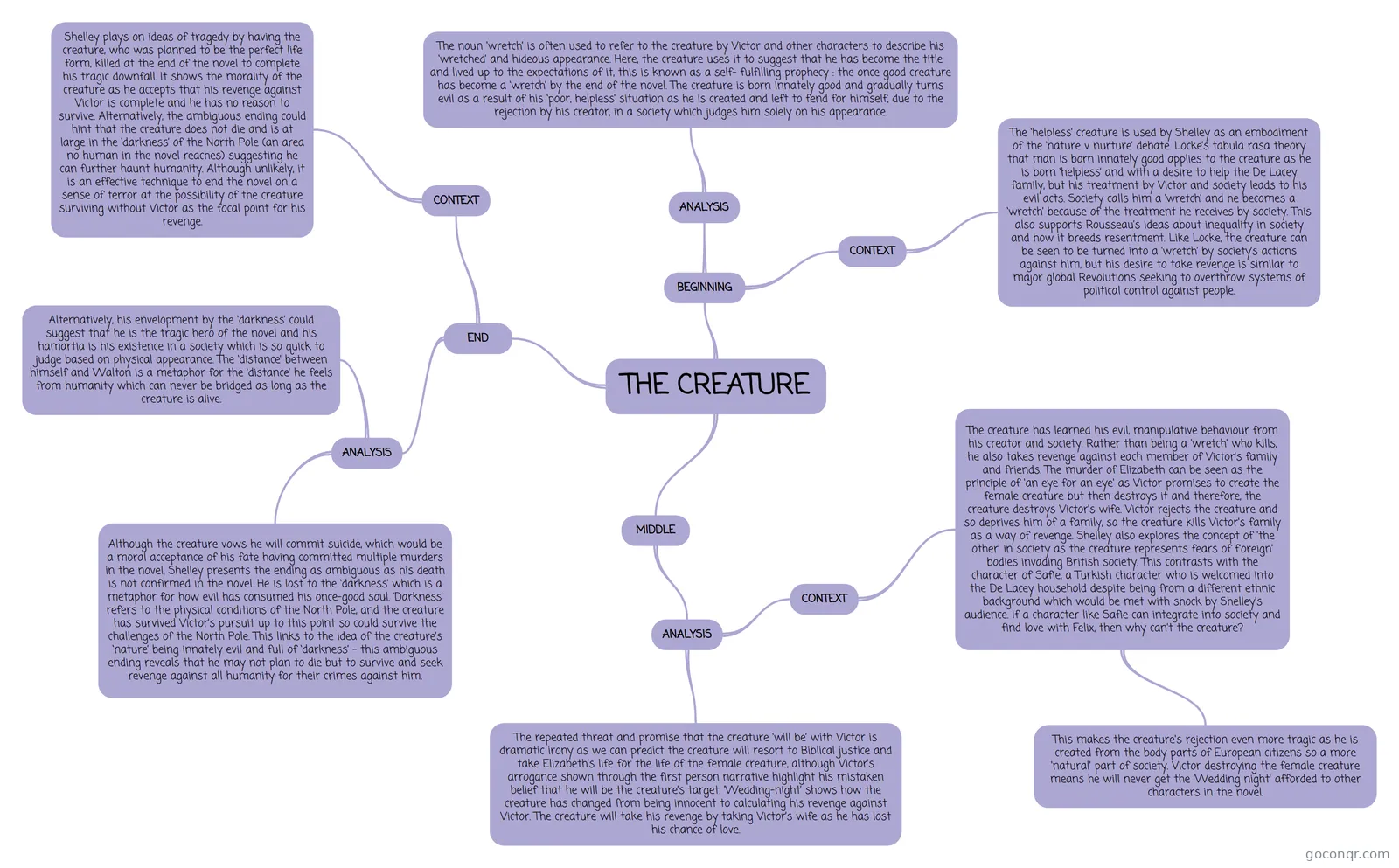
Mind map: the creature story structure
Conteúdo do mapa
THE CREATURE
BEGINNING
- ANALYSIS
- The noun 'wretch’ is often used to refer to the creature by Victor and other characters to describe his ‘wretched’ and hideous appearance. Here, the creature uses it to suggest that he has become the title and lived up to the expectations of it, this is known as a self- fulfilling prophecy : the once good creature has become a ‘wretch’ by the end of the novel. The creature is born innately good and gradually turns evil as a result of his ‘poor, helpless’ situation as he is created and left to fend for himself, due to the rejection by his creator, in a society which judges him solely on his appearance.
- CONTEXT
- The ‘helpless’ creature is used by Shelley as an embodiment of the ‘nature v nurture’ debate. Locke’s tabula rasa theory that man is born innately good applies to the creature as he is born ‘helpless’ and with a desire to help the De Lacey family, but his treatment by Victor and society leads to his evil acts. Society calls him a ‘wretch’ and he becomes a ‘wretch’ because of the treatment he receives by society. This also supports Rousseau’s ideas about inequality in society and how it breeds resentment. Like Locke, the creature can be seen to be turned into a ‘wretch’ by society’s actions against him, but his desire to take revenge is similar to major global Revolutions seeking to overthrow systems of political control against people.
- ANALYSIS
MIDDLE
- ANALYSIS
- The repeated threat and promise that the creature ‘will be’ with Victor is dramatic irony as we can predict the creature will resort to Biblical justice and take Elizabeth’s life for the life of the female creature, although Victor’s arrogance shown through the first person narrative highlight his mistaken belief that he will be the creature’s target. ‘Wedding-night’ shows how the creature has changed from being innocent to calculating his revenge against Victor. The creature will take his revenge by taking Victor’s wife as he has lost his chance of love.
- CONTEXT
- The creature has learned his evil, manipulative behaviour from his creator and society. Rather than being a 'wretch' who kills, he also takes revenge against each member of Victor's family and friends. The murder of Elizabeth can be seen as the principle of 'an eye for an eye' as Victor promises to create the female creature but then destroys it and therefore, the creature destroys Victor's wife. Victor rejects the creature and so deprives him of a family, so the creature kills Victor's family as a way of revenge. Shelley also explores the concept of 'the other' in society as the creature represents fears of f'oreign' bodies invading British society. This contrasts with the character of Safie, a Turkish character who is welcomed into the De Lacey household despite being from a different ethnic background which would be met with shock by Shelley's audience. If a character like Safie can integrate into society and find love with Felix, then why can't the creature?
- This makes the creature's rejection even more tragic as he is created from the body parts of European citizens so a more 'natural' part of society. Victor destroying the female creature means he will never get the 'Wedding night' afforded to other characters in the novel.
- The creature has learned his evil, manipulative behaviour from his creator and society. Rather than being a 'wretch' who kills, he also takes revenge against each member of Victor's family and friends. The murder of Elizabeth can be seen as the principle of 'an eye for an eye' as Victor promises to create the female creature but then destroys it and therefore, the creature destroys Victor's wife. Victor rejects the creature and so deprives him of a family, so the creature kills Victor's family as a way of revenge. Shelley also explores the concept of 'the other' in society as the creature represents fears of f'oreign' bodies invading British society. This contrasts with the character of Safie, a Turkish character who is welcomed into the De Lacey household despite being from a different ethnic background which would be met with shock by Shelley's audience. If a character like Safie can integrate into society and find love with Felix, then why can't the creature?
- ANALYSIS
END
- ANALYSIS
- Although the creature vows he will commit suicide, which would be a moral acceptance of his fate having committed multiple murders in the novel, Shelley presents the ending as ambiguous as his death is not confirmed in the novel. He is lost to the ‘darkness’ which is a metaphor for how evil has consumed his once-good soul. ‘Darkness’ refers to the physical conditions of the North Pole, and the creature has survived Victor’s pursuit up to this point so could survive the challenges of the North Pole. This links to the idea of the creature’s ‘nature’ being innately evil and full of ‘darkness’ – this ambiguous ending reveals that he may not plan to die but to survive and seek revenge against all humanity for their crimes against him.
- Alternatively, his envelopment by the ‘darkness’ could suggest that he is the tragic hero of the novel and his hamartia is his existence in a society which is so quick to judge based on physical appearance. The ‘distance’ between himself and Walton is a metaphor for the ‘distance’ he feels from humanity which can never be bridged as long as the creature is alive.
- CONTEXT
- Shelley plays on ideas of tragedy by having the creature, who was planned to be the perfect life form, killed at the end of the novel to complete his tragic downfall. It shows the morality of the creature as he accepts that his revenge against Victor is complete and he has no reason to survive. Alternatively, the ambiguous ending could hint that the creature does not die and is at large in the ‘darkness’ of the North Pole (an area no human in the novel reaches) suggesting he can further haunt humanity. Although unlikely, it is an effective technique to end the novel on a sense of terror at the possibility of the creature surviving without Victor as the focal point for his revenge.
- ANALYSIS
Informações
- Descrição
- Mapa Mental sobre THE CREATURE, criado por Sarah Mawson em 31-05-2022.
- Criado por
- Sarah Mawson
- Visualizações
- 2
- Avaliação
Mais sobre Frankenstein Characters