
Mapa mental
Flood Management - defence methods
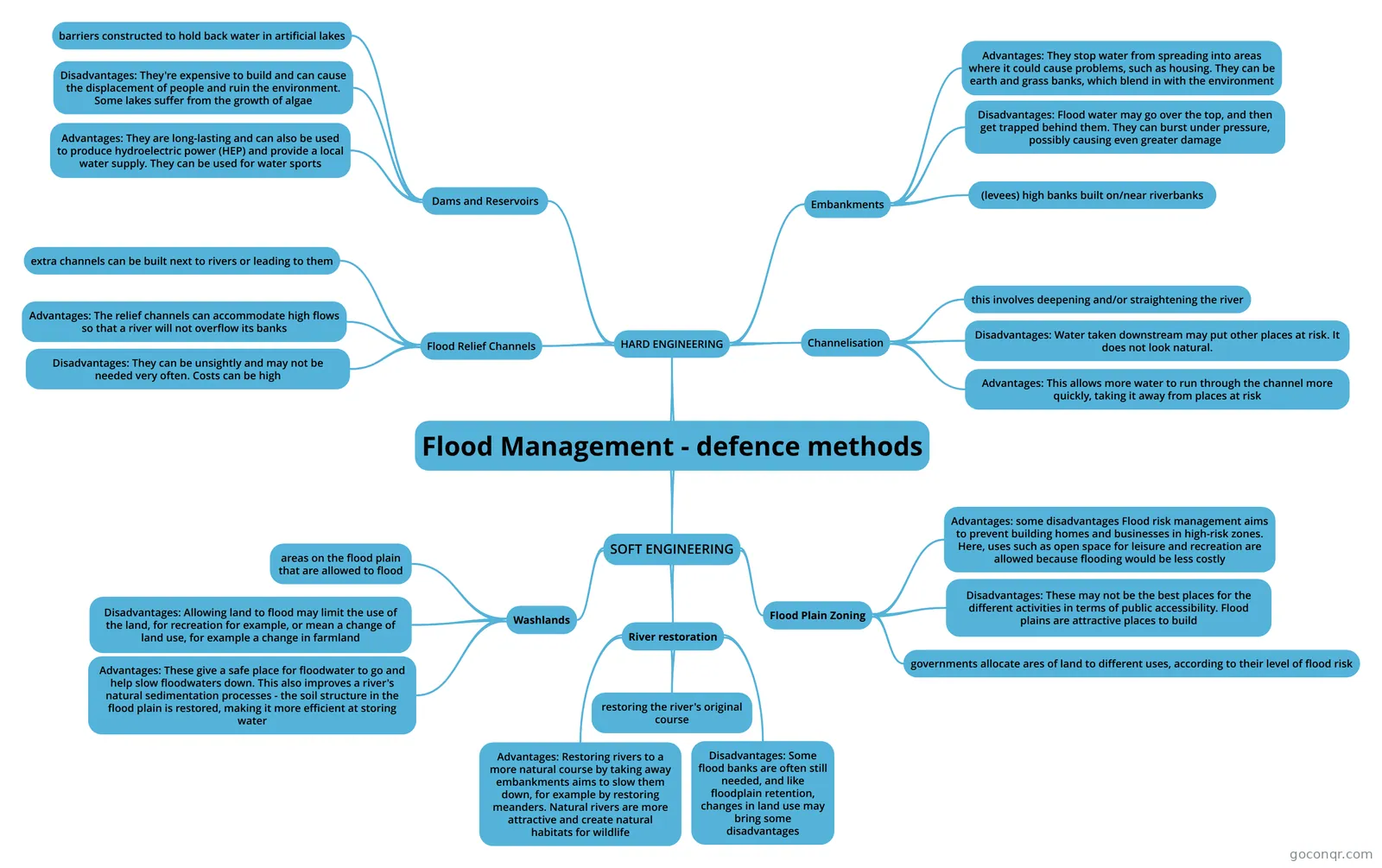
Mind map: Flood Management - defence methods
Conteúdo do mapa
Flood Management - defence methods
SOFT ENGINEERING
- Washlands
- areas on the flood plain that are allowed to flood
- Advantages: These give a safe place for floodwater to go and help slow floodwaters down. This also improves a river's natural sedimentation processes - the soil structure in the flood plain is restored, making it more efficient at storing water
- Disadvantages: Allowing land to flood may limit the use of the land, for recreation for example, or mean a change of land use, for example a change in farmland
- River restoration
- restoring the river's original course
- Advantages: Restoring rivers to a more natural course by taking away embankments aims to slow them down, for example by restoring meanders. Natural rivers are more attractive and create natural habitats for wildlife
- Disadvantages: Some flood banks are often still needed, and like floodplain retention, changes in land use may bring some disadvantages
- Flood Plain Zoning
- governments allocate ares of land to different uses, according to their level of flood risk
- Advantages: some disadvantages Flood risk management aims to prevent building homes and businesses in high-risk zones. Here, uses such as open space for leisure and recreation are allowed because flooding would be less costly
- Disadvantages: These may not be the best places for the different activities in terms of public accessibility. Flood plains are attractive places to build
- Washlands
HARD ENGINEERING
- Embankments
- (levees) high banks built on/near riverbanks
- Advantages: They stop water from spreading into areas where it could cause problems, such as housing. They can be earth and grass banks, which blend in with the environment
- Disadvantages: Flood water may go over the top, and then get trapped behind them. They can burst under pressure, possibly causing even greater damage
- Channelisation
- Advantages: This allows more water to run through the channel more quickly, taking it away from places at risk
- this involves deepening and/or straightening the river
- Disadvantages: Water taken downstream may put other places at risk. It does not look natural.
- Flood Relief Channels
- extra channels can be built next to rivers or leading to them
- Advantages: The relief channels can accommodate high flows so that a river will not overflow its banks
- Disadvantages: They can be unsightly and may not be needed very often. Costs can be high
- Dams and Reservoirs
- barriers constructed to hold back water in artificial lakes
- Advantages: They are long-lasting and can also be used to produce hydroelectric power (HEP) and provide a local water supply. They can be used for water sports
- Disadvantages: They're expensive to build and can cause the displacement of people and ruin the environment. Some lakes suffer from the growth of algae
- Embankments
Informações
- Descrição
- Mapa Mental sobre Flood Management - defence methods, criado por Allegra Hinton em 10-03-2024.
- Criado por
- Allegra Hinton
- Visualizações
- 1
- Avaliação
Mais sobre Flood and River Management