
Mapa mental
Discourse Community Map
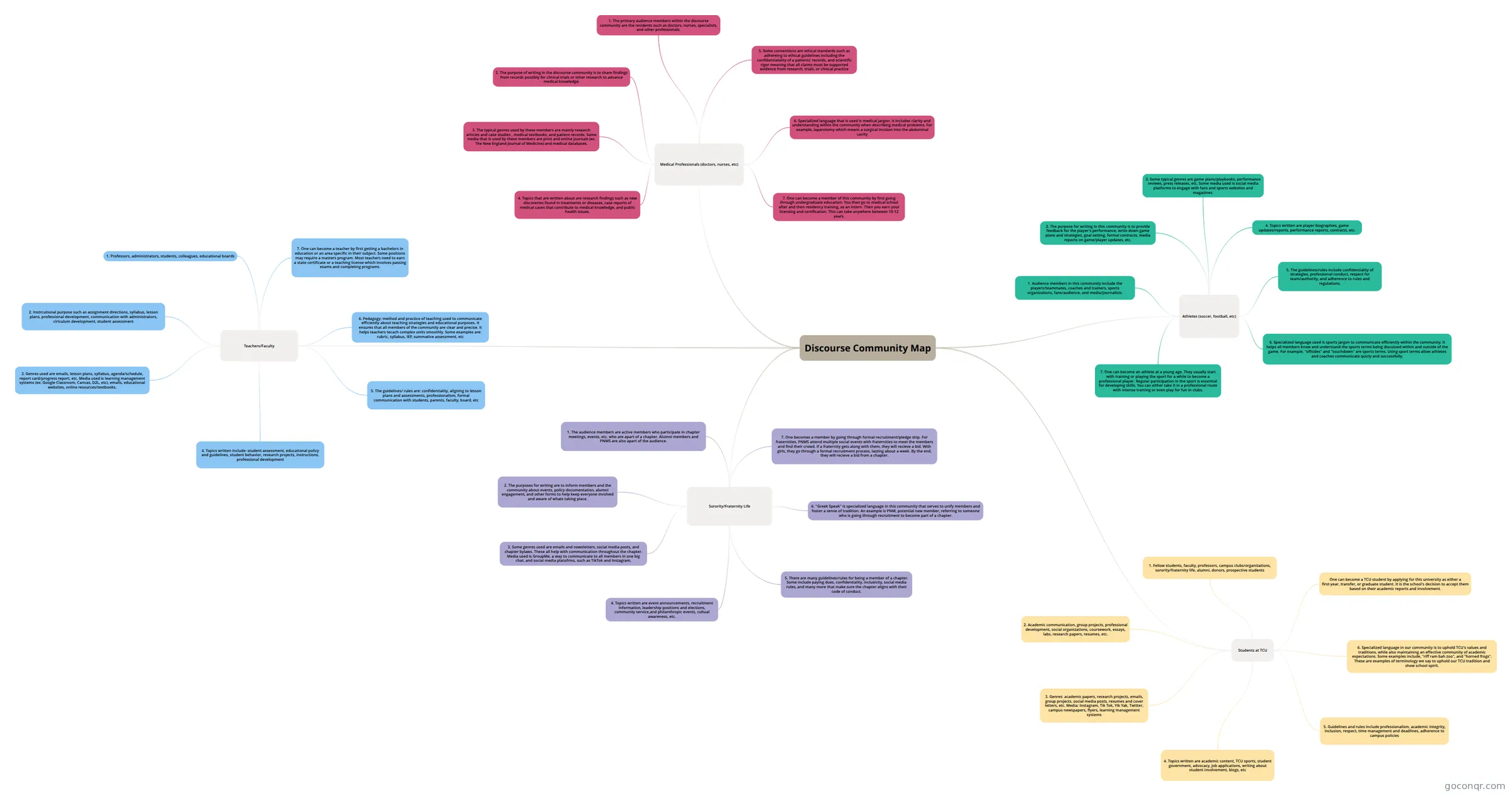
Mind map: discourse community map
Conteúdo do mapa
Discourse Community Map
Medical Professionals (doctors, nurses, etc)
- 1. The primary audience members within the discourse community are the residents such as doctors, nurses, specialists, and other professionals.
- 2. The purpose of writing in the discourse community is to share findings from records possibly for clinical trials or other research to advance medical knowledge.
- 3. The typical genres used by these members are mainly research articles and case studies , medical textbooks, and patient records. Some media that is used by these members are print and online journals (ex. The New England Journal of Medicine) and medical databases.
- 4. Topics that are written about are research findings such as new discoveries found in treatments or diseases, case reports of medical cases that contribute to medical knowledge, and public health issues.
- 5. Some conventions are ethical standards such as adhereing to ethical guidelines including the confidentialality of a patients' records, and scientific rigor meaning that all claims must be supported evidence from research, trials, or clinical practice
- 6. Specialized language that is used is medical jargon. It includes clarity and understanding within the community when describing medical problems. For example, laparotomy which means a surgical incision into the abdominal cavity
- 7. One can become a member of this community by first going through undergraduate education. You then go to medical school after and then residency training, as an intern. Then you earn your licensing and certification. This can take anywhere between 10-12 years.
Sorority/Fraternity Life
- 1. The audience members are active members who participate in chapter meetings, events, etc. who are apart of a chapter. Alumni members and PNMS are also apart of the audience.
- 2. The purposes for writing are to inform members and the community about events, policy documentation, alumni engagement, and other forms to help keep everyone involved and aware of whats taking place.
- 3. Some genres used are emails and newsletters, social media posts, and chapter bylaws. These all help with communication throughout the chapter. Media used is GroupMe, a way to communicate to all members in one big chat, and social media platofrms, such as TikTok and Instagram,
- 4. Topics written are event announcements, recruitment information, leadership positions and elections, community service,and philanthropic events, cultual awareness, etc.
- 5. There are many guidelines/rules for being a member of a chapter. Some include paying dues, confidentiality, inclusivity, social media rules, and many more that make sure the chapter aligns with their code of conduct.
- 6. "Greek Speak" is specialized language in this community that serves to unify members and foster a sense of tradition. An example is PNM, potential new member, referring to someone who is going through recruitment to become part of a chapter.
- 7. One becomes a member by going through formal recruitment/pledge ship. For fraternities, PNMS attend multiple social events with fraternities to meet the members and find their crowd. If a fraternity gets along with them, they will recieve a bid. With girls, they go through a formal recruitment process, lasting about a week. By the end, they will recieve a bid from a chapter.
Athletes (soccer, football, etc)
- 1. Audience members in this community include the players/teammates, coaches and trainers, sports organizations, fans/audience, and media/journalists.
- 2. The purpose for writing in this community is to provide feedback for the player's performance, write down game plans and strategies, goal setting, formal contracts, media reports on game/player updates, etc.
- 3. Some typical genres are game plans/playbooks, performance reviews, press releases, etc. Some media used is social media platforms to engage with fans and sports websites and magazines.
- 4. Topics written are player biographies, game updates/reports, performance reports, contracts, etc.
- 5. The guidelines/rules include confidentiality of strategies, professional conduct, respect for team/authority, and adherence to rules and regulations.
- 6. Specialized language used is sports jargon to communicate efficiently within the community. It helps all members know and understand the sports terms being discussed within and outside of the game. For example, "offsides" and "touchdown" are sports terms. Using sport terms allow athletes and coaches communicate quicly and successfully.
- 7. One can become an athlete at a young age. They usually start with training or playing the sport for a while to become a professional player. Regular participation in the sport is essential for developing skills. You can either take it in a professional route with intense training or even play for fun in clubs.
Students at TCU
- 3. Genres: academic papers, research projects, emails, group projects, social media posts, resumes and cover letters, etc. Media: Instagram, Tik Tok, Yik Yak, Twitter, campus newspapers, flyers, learning management systems
- 1. Fellow students, faculty, professors, campus clubs/organizations, sorority/fraternity life, alumni, donors, prospective students
- 2. Academic communication, group projects, professional development, social organizations, coursework, essays, labs, research papers, resumes, etc.
- 4. Topics written are academic content, TCU sports, student government, advocacy, job applications, writing about student involvement, blogs, etc
- 5. Guidelines and rules include professionalism, academic integrity, inclusion, respect, time management and deadlines, adherence to campus policies
- 6. Specialized language in our community is to uphold TCU's values and traditions, while also maintaining an effective community of academic expectations. Some examples include, "riff ram bah zoo", and "horned frogs". These are examples of terminology we say to uphold our TCU tradition and show school spirit.
- One can become a TCU student by applying for this university as either a first-year, transfer, or graduate student. It is the school's decision to accept them based on their academic reports and involvement.
Teachers/Faculty
- 1. Professors, administrators, students, colleagues, educational boards
- 3. Genres used are emails, lesson plans, syllabus, agenda/schedule, report card/progress report, etc. Media used is learning management systems (ex: Google Classroom, Canvas, D2L, etc), emails, educational websites, online resources/textbooks.
- 5. The guidelines/ rules are: confidentiality, aligning to lesson plans and assessments, professionalism, formal communication with students, parents, faculty, board, etc
- 2. Instrcutional purpose such as assignment directions, syllabus, lesson plans, professional development, communication with administrators, ciriculum development, student assessment
- 4. Topics written include: student assessment, educational policy and guidelines, student behavior, research projects, instructions, professional development
- 6. Pedagogy; method and practice of teaching used to communicate efficiently about teaching strategies and educational purposes. It ensures that all members of the community are clear and precise. It helps teachers tecach complex units smoothly. Some examples are: rubric, syllabus, IEP, summative assessment, etc
- 7. One can become a teacher by first getting a bachelors in education or an area specific in their subject. Some positions may require a masters program. Most teachers need to earn a state certificate or a teaching license which involves passing exams and completing programs.
Informações
- Descrição
- Mapa Mental sobre Discourse Community Map, criado por Emmy Losada em 30-08-2024.
- Criado por
- Emmy Losada
- Visualizações
- 0
- Avaliação
Mais sobre Audience, Purpose and Text Types