
Mapa mental
Variation Functions 2

Conteúdo do mapa
Variation Functions
Direct
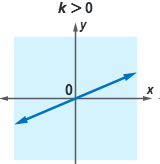
- n=1
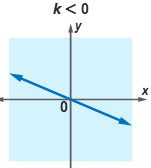
- Domain and Range are the set of all real numbers
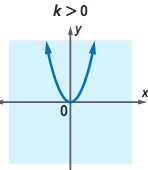
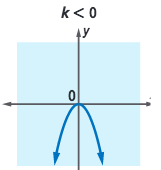
- n=2
- Domain: set of all reals Range: [y:y>0]
- Domain: set of all reals Range: [y:y<0]
- n=1
- Combined
- 3 or more variables that are in a function
- y-Kx^2/z
- 3 or more variables that are in a function
- Joint
- 3 or more variables that are being multiplied
- y-kxz
- 3 or more variables that are being multiplied
Inverse
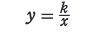
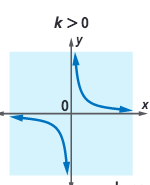
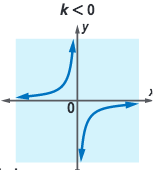
- n=1
- Domain and Range:[x:x= 0]
- Asymptotes: x-axis and y-axis
- Domain and Range:[x:x= 0]
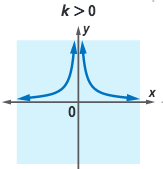
- n=2
- Domain: [x:x=0] Range: [y:y >0]
- Domain: [x:x=0] Range: [y:y >0]
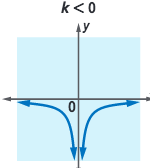
- Domain: [x:x=0] Range: [y:y <0]
- Asymptotes y-axis and x-axis
- Domain: [x:x=0] Range: [y:y <0]
- n=1
Fundamental Theorem of Variation
- If y=kx^n, that is If y varies directly as x^n, then when x is multiplied. If y=k/x^n, that is y varies inversely as x^n, and x is multiplied by a non-zero constant c, then y is divided by c^n by c, y is multiplied by c^n
Converse of Fundamental Theorem
- If multiplying every x value of a function by c results in multiplying the corresponding y values by c^n, then y varies directly as the nth power of x, that is y=k/x^n. If multipying every x value of a function by c results in dividing the corresponding y values by c^n, then y varies inversely as the nth power of x, that is y
Imagens e arquivos do mapa
Informações
- Descrição
- All the variation relations
- Criado por
- mar-tamayo · nov 2015
- Atualizado
- 19 fev 2016
- Visualizações
- 58
- Tags
- Avaliação