
Mapa mental
Discrete Maths
Conteúdo do mapa
Discrete Maths
Proofs
- Jargon
- Predicate
- truth depends on variables
- Axiom
- a basic assumption about a mathematical situation
- Statement - either true or false
- Lemma
- true statement used in proving other true statements
- Corollary
- true statement that is a simple deduction from a theorem or proposition
- Conjecture
- statement believed to be true but has no proof
- Theorem
- very important true statement
- Theorems to learn
- intermediate value theroem
- for all y between f(a) and f(b) there exists v in between a and b such that f(v) = y
- Division theorem
- for every natural number m and pos. nat. num n, there exists a unique pair of integers q and r such that q>=0, 0<=r<n, and m=q.n+r
- Euclid's theorem
- For positive integers m and n, and prime p, if p|(mn) then p|m or p|n
- Fundamental theorem of arithmetic
- For every positive integer n there is a unique finite ordered sequence of primes such that n=Π(p1,...,pl)
- intermediate value theroem
- Proposition
- interesting true statement
- Lemma
- Predicate
- Statements
- Implication
- Bi-implication (iff)
- Universal quantification (∀)
- Conjunction (AND)
- Existential quantification (∃)
- ∃! means there exists a unique
- Disjunction (OR)
- Negation (¬)
- Logical deduction
- Proof strategies
- Proof by contradiction
- A implies B, assume ¬B show mathematical contradiction
- Contrapositive
- A implies B goes to ¬B implies ¬A
- Proof by contradiction
- Scratch work
- Logical equivalences
- page 136
- Induction
- Strong induction
- Same but all k between l and n hold
- P(l) holds and ∀n>=l in N. (P(n) => P(n+1)) also holds
- then ∀m>=l in N. P(m) holds
- Strong induction
- Proof strategies
- Divisibility and congruence
- A|B - A divides B, i.e. Ak=B
- A ≡ B (mod C) - C divides A - B
- Fermat's last theorem
- Fermat's little theorem
- if p is a prime number, a(^p)≡a(mod p)
- Jargon
Numbers
- commutative monoid
- monoid laws
- 0+n = n = n+0 , (l+m)+n = l+(m+n)
- 1.n = n = n.1 , (l.m).n = l.(m.n)
- commutativity law
- m+n = n+m
- m.n = n.m
- monoid laws
- ring
- an algebraic structure with operations that generalize the arithmetic operations of addition and multiplication
- semiring
- without the requirement that each element must have an additive inverse (i.e. -x)
- division theorem
- m = quo(m,n)n + rem(m,n)
- Fundamental theorem of arithmetic
- product of primes
- commutative monoid
Sets
- Notation
- {x ∈ A|P(x)}
- subset of elements of A satisfying P
- A ⊆ B
- A is a subset of B
- Remove the bottom line for 'proper subset'
- A is a subset of B AND A is not equal to B
- #S
- cardinality (number of elements) of set S
- finite cardinality when A≅[n] for natural number n
- cardinality (number of elements) of set S
- ℙ(S)
- Powerset
- set of all possible subsets of S (includes empty set)
- Powerset
- <a, b>
- Ordered pair
- {{a}, {a, b}}
- Ordered pair
- ∅
- empty set
- u
- universal set (everything)
- A(to the power of c)
- complement
- {x ∈ A|P(x)}
- Hasse Diagrams
- Cartesian product
- AxB = {(a,b)|a∈A,b∈B}
- Big union
- UA
- union of the sets contained in A
- UF = {x∈u|∃A∈F.x∈A}
- union of the sets contained in A
- UA
- Big intersection
- ⋂A
- intersection of the sets contained in A
- ⋂F = {x∈u|∀A∈F.x∈A}
- intersection of the sets contained in A
- ⋂A
- Tagging
- {l}xA = {(l,a)|a∈A}
- Disjoint union
- A(∪ with + in) B = ({1}xA)∪({2}xB)
- Relations
- Binary relation R:A⇸B
- relation between source and target
- R⊆AxB
- Relational extensionality
- R=S:A⇸B iff (∀a∈A.∀b∈B. aRb <=> aSb)
- composition
- composition of R:A⇸B and S:B⇸C is the relation S∘R:A⇸C
- a(S∘R)c <=> ∃b∈B.aRb∧bSc
- R to the ∘n is the relation R applied n times
- composition of R:A⇸B and S:B⇸C is the relation S∘R:A⇸C
- Directed graph is just a set A and a relation R from A to A
- Preorder ⊑
- relation on one set satisfying reflexivity and transitivity
- reflexivity: ∀x∈P.x⊑x
- transitivity: ∀x,y,z∈P.(x⊑y ∧ y⊑z) => x⊑z
- partial order / poset
- preorder that satisfies antisymmetry: ∀x,y∈P.(x⊑y ∧ y⊑x) => x=y
- relation on one set satisfying reflexivity and transitivity
- partial function
- f:A⇀B
- for each element a of A there is at most one element b of B such that b is a value of f at a
- function
- bijection
- there exists a unique function as the inverse of the function
- f:A→B
- partial function but all elements in the domain are sources
- e.g. x |→ x + 3 for defined function
- bijection
- f:A⇀B
- using two lines for the shaft of the arrow means the set of all relations of that type
- Isomorphism (≅)
- A≅B when there is a bijection between them
- Equivalence relation (E)
- reflexive: xEx for all x in A
- symmetric: xEy=>yEx
- transitive: xEy AND yEz => xEz
- partitions are where all the elements are joined both ways be E
- characteristic function
- ℙ(A)≅(A=>[2])
- [2] = {0,1}
- ℙ(A)≅(A=>[2])
- surjection
- f:A↠B
- for all b, there exists an a so f(a)=b
- f:A↠B
- injection
- f:A↣B
- f(a1)=f(a2) => a1=a2
- f:A↣B
- enumerability
- there exists a surjection ℕ↠A
- a countable set is empty or enumerable
- there exists a surjection ℕ↠A
- axiom of choice
- every surjection has a section of values which can lead to the b
- Binary relation R:A⇸B
- Notation
Formal Languages and Automata
- Finite automata
- Any NFA with epsilon transitions can be represented by a DFA
- Formal Languages
- Alphabets ∑
- set of symbols
- a string is an ordered tuple of elements of ∑
- ∑* denotes all strings over ∑ of any finite length
- given an alphabet ∑, we call any subset of ∑* a formal language over the alphabet ∑
- Alphabets ∑
- Inductive Definitions
- axioms and rules with the fraction thing
- can be thought of as a tree with leaves as axioms and the root as the string
- transitive closure
- for a relation R, R+ is the smallest binary relation on X that contains R and is transitive
- reflexive transitive closure
- R* is reflexive too
- Abstract Syntax Trees
- finite rooted trees. vertexes with n children are labelled by operators expecting n arguments
- Union, Concat, Star, Null, Empty, Syma
- finite rooted trees. vertexes with n children are labelled by operators expecting n arguments
- Regular Languages
- a language that can be represented by a DFA
- The Pumping Lemma
- Kleene's theorem
- A language is regular iff it is equal to L(M), the set of strings accepted by some deterministic finite automaton M
- For any regular expression r, the set L(r) of strings matching r is a regular language
- regex to automata, can do diagrammaticically by cases
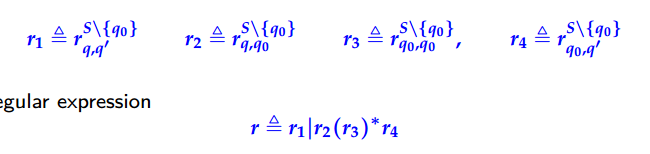
- Conversely, every regular language is the form L(r) for some regular expression r
- simple OR of all accepting states
- matching
- Finite automata
Imagens e arquivos do mapa
Informações
- Descrição
- Mapa Mental sobre Discrete Maths, criado por Dan Ellis em 15-11-2015.
- Criado por
- Dan Ellis · nov 2015
- Atualizado
- 15 mai 2016
- Visualizações
- 24
- Avaliação