
Mapa mental
vertebrate
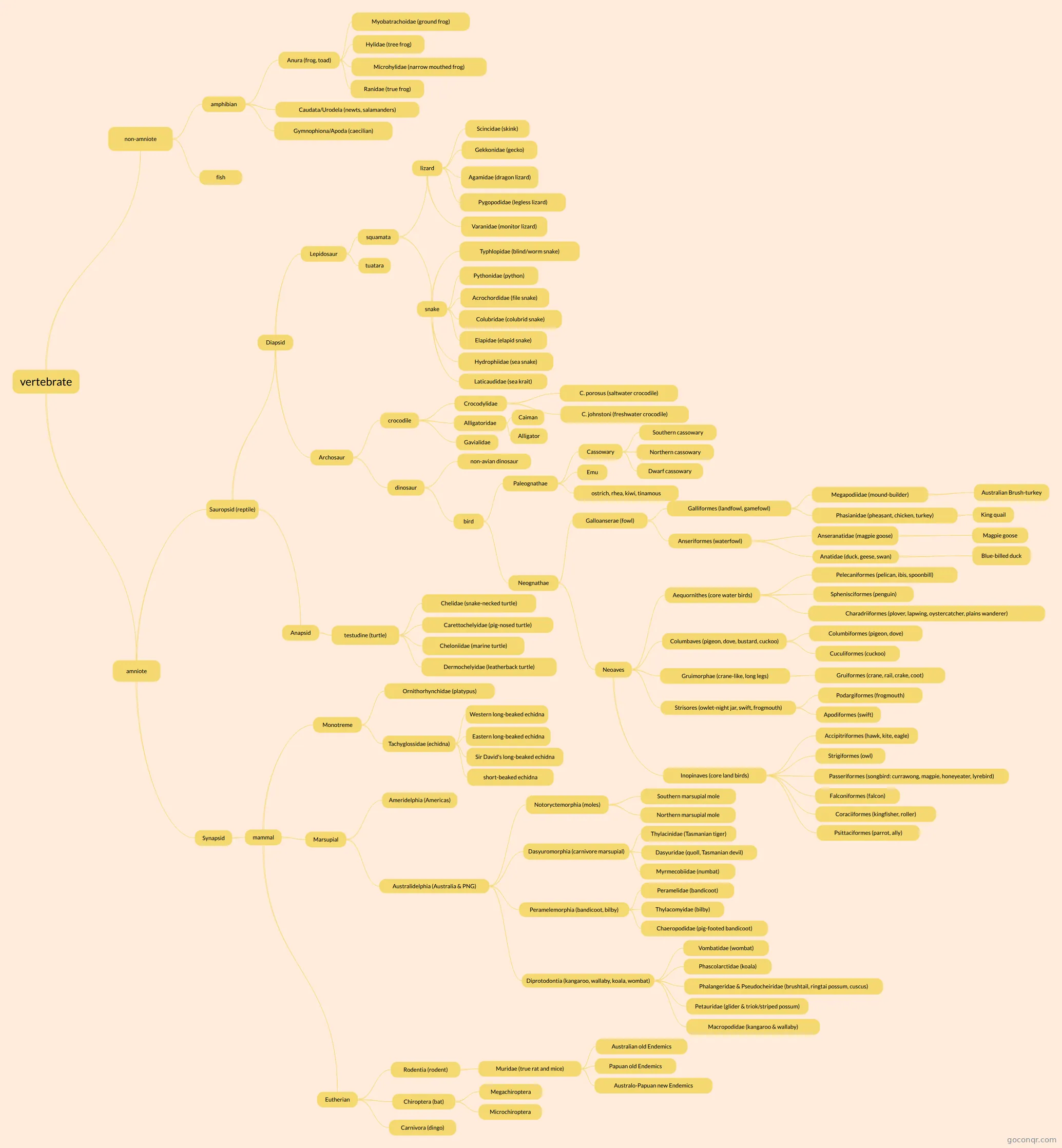
Mind map: Vertebrate
Conteúdo do mapa
vertebrate
non-amniote
- amphibian
- Anura (frog, toad)
- -colour: dorsal/ventral -toes: webbed feet, adhesive toe pads, keratinized tubercles -legs: long and muscular, short and stocky
- Myobatrachoidae (ground frog)
- largest family -quick metamorphosis of tadpoles, eggs laid in foam, swallow eggs and incubation in stomach -metatarsal tubercles -round body, short limbs -secrete cocoon layer Corroboree frog-chytrid fungus
- Hylidae (tree frog)
- arboreal, non-arboreal, fossorial -forward-facing eyes -expanded sticky circular discs on tips -webbed feet -eggs laid underwater in clumps attached to vegetation -opposable thumbs
- Microhylidae (narrow mouthed frog)
- arboreal, terrestrial (walker) -bypass tadpole stage
- Ranidae (true frog)
- Caudata/Urodela (newts, salamanders)
- Salamanders-northern Pangaea: Laurasia
- Gymnophiona/Apoda (caecilian)
- Anura (frog, toad)
- fish
- amphibian
amniote
- Synapsid
- mammal
- -endothermic -hair provide insulation -respiration with a muscular diaphragm: tidal flow (in and out) -mammary gland (ability to suckle) -differentiation of teeth: heterodont dentition -refinement of ear bones: one bone in lower jaw, three bones in middle ear
- Monotreme
- -'Monotremata' means 'one hole': single hole from both faeces and urine is voided -egg-laying mammals, female lay soft-shelled eggs -suckle young via milk secreted through numerous ducts opening onto the surface of the abdomen (not via teats) -presence of a true cloaca: one external orifice and tube for excretory and reproductive products -two seperate uteri and cervices
- Ornithorhynchidae (platypus)
- -restricted to areas with permanent streams -more primitive than echidna -normal body temperature maintained by elevation of metabolic rate -only venomous Australian mammal, males have spur and venom gland -semi-aquatic -diet: aquatic invertebrates (sifted from bottom sediments) -forelimbs: alternate for propulsion, short and strong hindlimbs and tail: rudder -forefoot: significant webbing hindfoot: less webbing, sharp claws -broad and flat tail -crepuscular activity -long-lived: up to 21 years -streamlined body: torpedo shaped -nostril: ventrally located, closed by a valve when diving -groove that houses eyes and ears is closed when diving -skeletal heavy enough to support large muscles -teeth presented in young, shed by adulthood -spend ~60s under water foraging: blood has higher oxygen-carrying capacity -bill: bones of snout + extensive cartilage sheet, covered by soft, sensitive skin primary sense organ: tiny specialised pones- electroreceptors or touch receptors detect smell, electrical stimuli given off by active prey -prey initially stored in cheek pouches, keratinised dental pads are used to grind prey, indigestable parts filtered out along grooves -simple GIT -females build burrows and line it with moist vegetation to shelter and raise young young are suckled in the burrow for 3-4 months
- Tachyglossidae (echidna)
- -oviporous -bony bill or beak, no teeth -no marsupial shelf in mandible -ancient shoulder girdle (5 bones): a series of extra bones, a less well-developed scapula -presence of epipubis bone -detect prey using electromagnetic sensors in bill or beak -no teats associated with mammary glands -low body temperature -baby named 'puggle' -testicond (internal testes), unique penis structure: four head -well-developed forelimbs -well-developed olfactory bulb (processing smell)
- Western long-beaked echidna
- Eastern long-beaked echidna
- Sir David's long-beaked echidna
- short-beaked echidna
- -'Tachyglossus' = quick tongue -widespread in Australia -snot bubble -spiky ball -eat ants and termites -small mouth, open ventrally, upper and lower jaw joined by ligament that form a tunnel -crepuscular activity (dawn and dusk) -solitary -autumn & winter: torpor, deep hibernation -burrow up to 1m -long tongue to protrude into soil and wood
- Marsupial
- -'Marsupialia' = pouch except males, some species of females, echidna develop a puch when suckling-most have an opposable first digit on hindfeet: hallux -usually smaller brain, large olfactory bulbs, smaller surface area of cerebral cortex -slightly lower body temperature and metabolic rate -males: scrotum in front of penis -young are born in an embryonic and underdeveloped condition, altricial young well-developed forelimbs, olfaction, inner ears, GIT neonate has circular mouth -short gestation (pregnancy) -extended period of lactation: young suckle milk secreted through a teat, often with a pouch milk composition changes during lactation, antibodies are transferred across the gut wall for relatively long periods of time -pouch: high humidity, stable temperature, formed by invagination of skin of ventral abdomen through a gap in the cutaneous muscles, interior skin relatively hairless, produces a brown secretion that coats the poach wall, mammary glands in pouch with long teats-path of ureters prevent fusion of vagina into a single structure:~two lateral + one median vaginae~two uteri~two cervices-one external orifice for reproduction and excretion -teeth: incisors (cutting and securing food), canines (seizing and piercing prey), premolars (piercing), molars (cutting and crushing)
- Ameridelphia (Americas)
- Australidelphia (Australia & PNG)
- Notoryctemorphia (moles)
- -ancient lineage -2 species (Northern and Southern)-carnivorous/insectivorous -low metabolic rate, highly variable body temperature -polyprodont dentition,teeth are simple, blunt and widely seperated -extremely simple brain, olfactory bulb enormous -relatively simple GIT, no caecum (no boundary between small and large intestine) -fossorial lifestyle: digging or burrowing and lives underground -adaptation: blind, absence of external pinnae (ears) but distinct ear openings beneath the fur, heavily keratinised skin on nose with small, slit-like nostril -pouch in male and female -no syndactyly -testes lie between the skin and abdomen -forelimbs: short and powerful, digits 3&4 develop into large, spade-like claws for digging tail: shortened and immensely strong neck vertebrate fused: provide more strength for head
- Northern marsupial mole
- Southern marsupial mole
- Dasyuromorphia (carnivore marsupial)
- -carnivorous/insectivorous -polyprodont dentition: 3 pairs of equal-sized lower incisors, well-developed upper and lower canines, blade-like premolars, molars with sharp cusps (except numbat) -forelimbs: 5 clawed digits radiating from the palm hindfoot: 5 seperate toes (no syndactyly) arboreal- broad and small, opposable hallux terrestrial- longer and hallux vestigial quadrupedal -non-prehensile tail -GIT: simple stomach, no caecum, short small intestine and colon -reproduction: smaller insectivores >3 young, lifespan <3 years larger carnivores 1-2 young, lifespan ~6 years -semelparity (some species): males produce a sigle cohort of sperm then die, very intensive mating period with long copulations, very high testosterone and cortisol concentration
- Thylacinidae (Tasmanian tiger)
- Dasyuridae (quoll, Tasmanian devil)
- Myrmecobiidae (numbat)
- Peramelemorphia (bandicoot, bilby)
- -omnivorous marsupial -long, pointed head -compact body -hindlimb: large with 4 toes digit 1 absent, digits 2/3 syndactyly, digits 4/5 well-developed forelimb: shorter, mascular, well-developed claws (digging) digits 2/3/4 well-developed -bound gait: shorter forelimb, longer hindlimb -non-prehensile, short tail -polyprotodont dentition 3 pairs of equal-sized lower incisors well-developed canine long jaw -brain: large olfactory bulbs -some plant: more complex GIT than carnivores -fast reproducer!! fastest growth rate
- Peramelidae (bandicoot)
- Thylacomyidae (bilby)
- Chaeropodidae (pig-footed bandicoot)
- extinct!
- Diprotodontia (kangaroo, wallaby, koala, wombat)
- -syndactyly digit 2/3 hindlimb -herbivores (grazer/browser, foregut/hindgut) or omnivores -one pair of lower incisors no lower canines no premolar --diastema (space)
- Vombatidae (wombat)
- Phascolarctidae (koala)
- Phalangeridae & Pseudocheiridae (brushtail, ringtai possum, cuscus)
- Petauridae (glider & triok/striped possum)
- Macropodidae (kangaroo & wallaby)
- Notoryctemorphia (moles)
- Eutherian
- -placental mammals -those that are not monotremes nor marsupials -one median vagina, one uterus, one cervix, two external orifices
- Rodentia (rodent)
- Muridae (true rat and mice)
- Australian old Endemics
- Papuan old Endemics
- Australo-Papuan new Endemics
- Muridae (true rat and mice)
- Chiroptera (bat)
- Megachiroptera
- Microchiroptera
- Carnivora (dingo)
- mammal
- Sauropsid (reptile)
- reptile (Aus. 1st sp.) -air breathing lung -3 chambered heart (crocodile 4 chambered) -ectothermic: cold-blooded (except bird and leatherback turtle) -thermoregulation: body temp reflect surroundings -heliotherm: basking and shuttling -brumation (cold) & aestivation (hot/drought) -scales, scutes
- Diapsid
- temporal fenestrae
- Archosaur
- leader -anteorbital fenestra: hole in front of eyes mandibular fenestra: hole on lower jaw -thecodont dentition: teeth fixed in sockets in jaw -osteoderm (crocodile), feather (bird) -upright limbs
- crocodile
- Crocodylidae
- -juvenile: pale yellow; adult: green/brown -opportunistic carnivores, drown and swallow prey ~digestive system (large prey): neurologically control heart valve blood to bypass lung and go straight to stomach increase gastric juice production by 10x ~special muscle alongside lungs to push
- C. porosus (saltwater crocodile)
- -larger -wetland, swamps, estuary, open ocean (dry) -social basking, highly territorial -head: U-shape, nuchal pattern
- C. johnstoni (freshwater crocodile)
- -smaller -freshwater wetland, billabong creek but saltwater -shy, rarely aggressive -head: V-shape, nuchal pattern, occipital pattern
- Gavialidae
- Alligatoridae
- Alligator
- Caiman
- Crocodylidae
- dinosaur
- non-avian dinosaur
- bird
- -most numerically successful class of tetrapod (forelimbs as wings) -10k living species, Australia 900 species 45% endemic -endothermic -feathers: made of keratin -beaked jaws: bony core surrounded by keratin, toothless -high metabolic rate -4-chambered heart -light-weight skeleton
- Paleognathae
- ostrich: 2-toed others: 3-toed
- Emu
- Cassowary
- Southern cassowary
- -casque: made of keratin, spongy centre ~protection, heat dissipation, hearing/sexual selection -3-toed: thick, powerful, equipped with lethal dagger-like claws -males take care of young -diet: fallen fruit and fungi, safely digesting food that is toxic to others -solitary (pairs only in breeding season)
- Northern cassowary
- Dwarf cassowary
- Southern cassowary
- ostrich, rhea, kiwi, tinamous
- Neognathae
- Galloanserae (fowl)
- -prolific: clutches of 5-10 eggs -social: notoriously polygynous (one M, multiple F ) / polygamous (multiple partners) -young develop quicky: able to swim / fly soon after emerge
- Galliformes (landfowl, gamefowl)
- Megapodiidae (mound-builder)
- -large foot -massive nest mounds regulate heat while eggs develop-superprecocial: very mature when hatched-browser-mainly solitary
- Australian Brush-turkey
- Phasianidae (pheasant, chicken, turkey)
- -heavy, ground-living -sexual dimorphism -short wings, strong legs -many have a spur on legs
- King quail
- Megapodiidae (mound-builder)
- Anseriformes (waterfowl)
- Anseranatidae (magpie goose)
- -once widespread in southern Australia, disappeared due to drainage of wetlands used for breeding -high cultural significance has led to habitat protection
- Magpie goose
- Anatidae (duck, geese, swan)
- -cosmopolitan distribution: all continents, many undertake annual migrations -adapted for swimming, floating, diving -herbivorous -monogamous breeders (one partner) -sexual dimorphism -long necks, short legs, webbed feet
- Blue-billed duck
- Anseranatidae (magpie goose)
- Neoaves
- Aequornithes (core water birds)
- Pelecaniformes (pelican, ibis, spoonbill)
- Sphenisciformes (penguin)
- Charadriiformes (plover, lapwing, oystercatcher, plains wanderer)
- Columbaves (pigeon, dove, bustard, cuckoo)
- Columbiformes (pigeon, dove)
- Cuculiformes (cuckoo)
- Gruimorphae (crane-like, long legs)
- Gruiformes (crane, rail, crake, coot)
- Strisores (owlet-night jar, swift, frogmouth)
- Podargiformes (frogmouth)
- Apodiformes (swift)
- Inopinaves (core land birds)
- Accipitriformes (hawk, kite, eagle)
- Strigiformes (owl)
- Passeriformes (songbird: currawong, magpie, honeyeater, lyrebird)
- Falconiformes (falcon)
- Coraciiformes (kingfisher, roller)
- Psittaciformes (parrot, ally)
- Aequornithes (core water birds)
- Galloanserae (fowl)
- Lepidosaur
- scale -acrodont (attached to the crest of jawbone) pleurodont(attached to the side of jawbone) dentition: no root -overlapping keratinized scales -sprawling limbs -caudal anatomy: defense mechanism
- tuatara
- squamata
- snake
- cranial: head caudal: tail dorsal: back ventral: belly
- Typhlopidae (blind/worm snake)
- small, slender, cylindrical fossorial, live underground-blunt head-eyes sunk below thickened scales: black spots-no external trace of limbs-mouth can't open wide-smooth, small, uniform scales -normal length ventral scales -short, thick, blunt tail with thorn-like terminal scale
- Pythonidae (python)
- heavy-bodied and muscular - a pair of small spur-like vestiges of hind limbs on either side of vent -head scales: large symmetrical plates/small irregular scales -ventral scales: double width of other scales (arboreal) -tapering tail -have loreal scale, non-venomous -sharp, recurved teeth for gripping prey -some have sensory pits on labial scales: sense infrared thermal radiation (warm prey) -kill prey by constriction
- Acrochordidae (file snake)
- aquatic snake in freshwater /estuarine environment -nostril positioned dorsally: on top of the snout (breathing while submerge) -obvious round eyes -loose baggy skin -small, granular scales -tapering tail, not prehensile -have loreal scale, non-venomous, constriction and grip of slippery prey -scale sensilla(on head, around eyes) highly developed: to feel movement by vibration
- Colubridae (colubrid snake)
- semi-arboreal -ventral scales: about body width -head scales: large symmetrical plates -tapering tail -flexible body for climbing, burrowing, swimming -have loreal scale, non-venomous -some very mild venom with rear-fanged dentition
- Elapidae (elapid snake)
- -no loreal scale, highly venomous (immobilize prey) -permanently erect, hollow fangs at front of upper jaw -ventral scales: about body width -head scales: large symmetrical plates
- Hydrophiidae (sea snake)
- marine dwelling (have lung) -laterally compressed tail (swimming) -venomous, some have loreal scale -head scales: large symmetrical plates-central body scales: variable in size-ventral scales: reduced or absent in fully marine species-has fang in front of upper jaw-ovoviviparous, all life stage at sea
- Laticaudidae (sea krait)
- semi-aquatic -lay eggs on land -less laterally compressed tail -ventral scales: half the body width -no loreal scale, venomous - fangs at front of upper jaw -oviporous, must come to land
- lizard
- Agamidae (dragon lizard)
- -limbs well-developed -distal digits clawed -lower eyelid movable -small, granular, spinose scales -broad, fleshy tongue -acrodont dentition -flat body shape -frill necked: cartilage (bluffing behaviour)
- Gekkonidae (gecko)
- -distal limbs end in dilated pads (foot uncurl each step) ~lamellae: folds of skin ~setae: fine hair-line structure ~spatulae: tips of setae branch-immovable eyelid, clear scale: brille-small, granular scales, smooth and soft skin-fleshy, long tongue (clean eyes)
- Pygopodidae (legless lizard)
- Scincidae (skink)
- largest diverse family of Lapidosauria -limb varying from well-developed to absent externally -clawed digits -lower eyelids: varying from thick to scaly, moveable to immovable -overlapping large scales, each with a layer of bone underneath (osteoderm) -broad and fleshy tongue
- Varanidae (monitor lizard)
- large, robust -well-developed muscular skeletal structure -long neck, pointed snout -strong, elongated tail (balance and defense) -distal end of digit have large claws -lower eyelid thick, scaly and movable -granular, spinose scales -sharp, recurved, replaceable teeth -long, slender, bifurcated (forked) tongue: chemoreception
- Agamidae (dragon lizard)
- snake
- Anapsid
- testudine (turtle)
- -carapace (top shell): ribcage and vertebrae fused into plaston (bottom shell): formed from shoulder girdle and sternum to pelvic girdle -no teeth, using sharp-edge beaks to cut food -scutes made of keratin
- Chelidae (snake-necked turtle)
- -Bellinger River Snapping turtle -Gondwana origin-highly aquatic-side-neck orientation head drawn under shell in horizontal S-bend-distinct ankle joints-cloaca breathing in some species-bottom of freshwater river-beds & swamps-aestivate (bury under leaf litter)-basking heliotherms (land or water surface)-webbed feet, clawed digits
- Carettochelyidae (pig-nosed turtle)
- /pitted shelled turtle -monotypic family! only one single living species -native to northern AUstralia & PNG -freshwater, murky water of river -flippers like sea turtle, nose like pig -paddle-like fins with two claws -no scutes, leathery texture -aggresive and territorial -omnivorous
- Cheloniidae (marine turtle)
- -flat streamlined, rounded body -head and limbs are fixed outside the shell -distinct carapace across all species -forelimbs modified into long, paddle-like flippers (swimming) -hindlimbs smaller (steering) -small claws on flippers -late maturation, high juvenile mortality(>90% eaten by predators), migration to annual breeding sites -shedding scutes -digestive system: swallow food along with excess water, no throat, esophagus lined with papillae (cartilaginous and keratinised projections) poiting toward stomach, to trap food whilst excess water is expelled -salt glands on eyes
- Dermochelyidae (leatherback turtle)
- -marine dwelling -largest of all marine turtles -love jellyfish, soft-bodied invertebrate -carapace is leathery-like skin with osteoderm to support skin (7 ridges) ~osteoderm interconnected with collagen fibres called sutures, allow flexing -front (larger) and back flippers, no claws -endothermic, warm-blood -adaptation for diving: ~flexible shell that absorb N2 ~collapsible lungs to compress as pressure changes ~large stores of O2 in blood and muscle -slow heart rate to conserve O2 -thermoregulation -salt glands in eyes twice the size of brain -pink spot: lies about pineal gland (third eye), regulate circadian rhythm [sunlight filters, allow turtle to measure sunlight and detect seasonal changes, trigger migration]
- testudine (turtle)
- Synapsid
Informações
- Descrição
- Mapa Mental sobre vertebrate, criado por Rosie Yaw em 11-11-2025.
- Criado por
- Rosie Yaw
- Visualizações
- 0
- Avaliação