
Mapa mental
Indigenizing/Decolonizing Public Education in BC
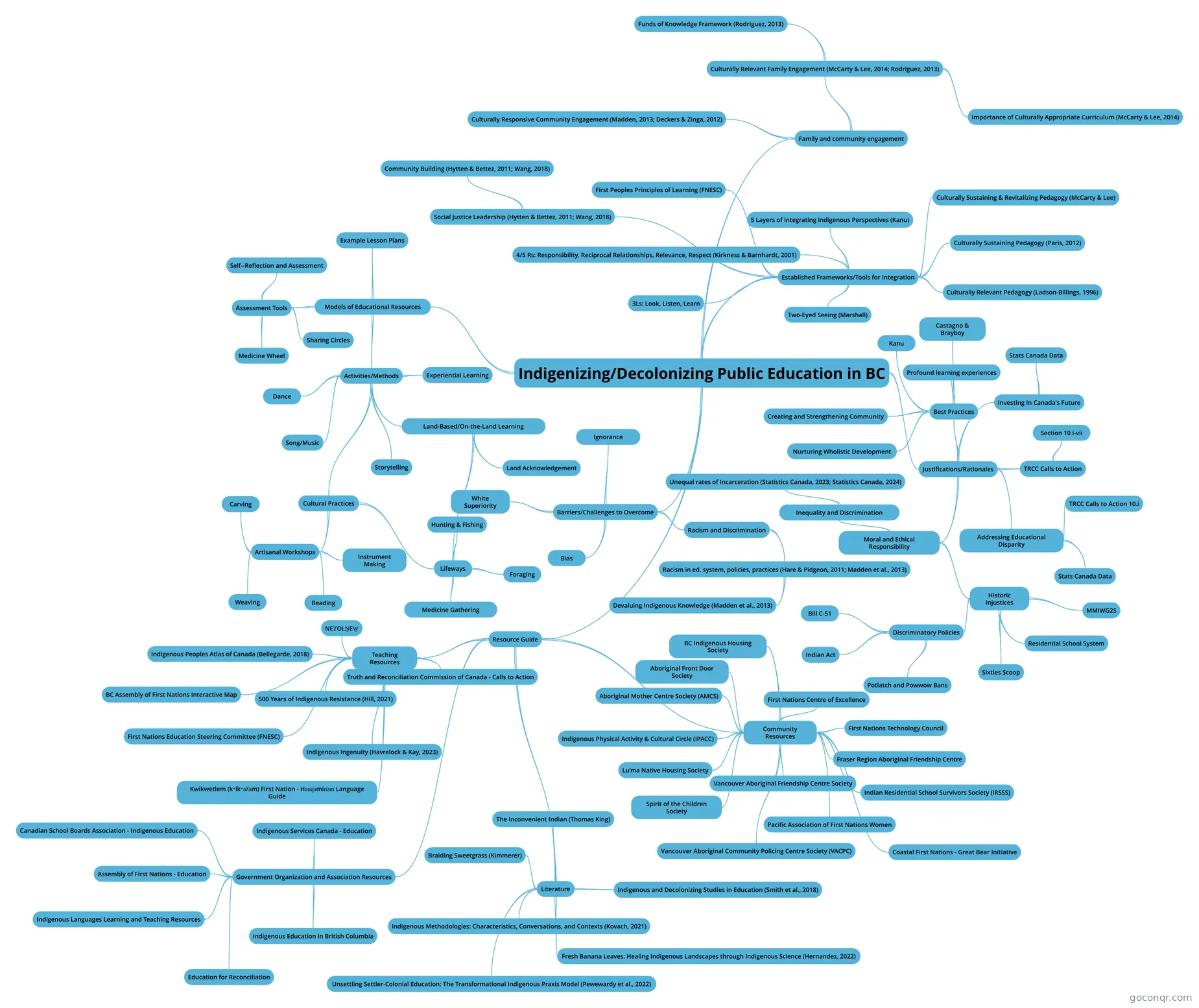
Mind map: Indigenizing and decolonizing public education in BC
Conteúdo do mapa
Indigenizing/Decolonizing Public Education in BC
Justifications/Rationales
- TRCC Calls to Action
- Section 10 i-vii
- We call on the federal government to draft new Aboriginal education legislation with the full participation and informed consent of Aboriginal peoples. The new legislation would include a commitment to sufficient funding and would incorporate the following principles: i. Providing sufficient funding to close identified educational achievement gaps within one generation. ii. Improving education attainment levels and success rates. iii. Developing culturally appropriate curricula. iv. Protecting the right to Aboriginal languages, including the teaching of Aboriginal languages as credit courses. v. Enabling parental and community responsibility, control, and accountability, similar to what parents enjoy in public school systems. vi. Enabling parents to fully participate in the education of their children. vii. Respecting and honouring Treaty relationships
- Section 10 i-vii
- Best Practices
- Kanu
- Castagno & Brayboy
- Profound learning experiences
- Creating and Strengthening Community
- Nurturing Wholistic Development
- Investing In Canada's Future
- Stats Canada Data
- Addressing Educational Disparity
- TRCC Calls to Action 10.i
- Stats Canada Data
- Moral and Ethical Responsibility
- Historic Injustices
- Residential School System
- Sixties Scoop
- Discriminatory Policies
- Potlatch and Powwow Bans
- Indian Act
- Bill C-51
- MMIWG2S
- Inequality and Discrimination
- Unequal rates of Incarceration (Statistics Canada, 2023; Statistics Canada, 2024)
- Historic Injustices
- TRCC Calls to Action
Barriers/Challenges to Overcome
- Racism and Discrimination
- Racism in ed. system, policies, practices (Hare & Pidgeon, 2011; Madden et al., 2013)
- Establishing relationships with families can be challenging for a variety of reasons that include language barriers, work and family responsibilities and obligations, and poor relationships with schools, teachers, and administrators resulting from colonial legacies (Madden, 2013).
- Devaluing Indigenous Knowledge (Madden et al., 2013)
- Racism in ed. system, policies, practices (Hare & Pidgeon, 2011; Madden et al., 2013)
- Bias
- Ignorance
- White Superiority
- Racism and Discrimination
Established Frameworks/Tools for Integration
- Culturally Relevant Pedagogy (Ladson-Billings, 1996)
- Ladson-Billings (2014) based her theory in three assumptions: (a) that all students can achieve academic success; (b) that students should develop competency in one or more cultures apart from the dominant culture; and (c) that students should develop critical consciousness which can be utilized to critique and take action to change social systems, policies, and practices that embody iniquity and injustice. A vital element of culturally relevant pedagogy is that “learners can be sources and resources of knowledge and skills” (Ladson-Billings, 2009; as cited in Ladson-Billlings, 2014, p.79). The key to providing culturally relevant pedagogy is connecting learning principles with a profound understanding of and appreciation for culture (Ladson-Billlings, 2014) Culturally revitalizing education prepares Indigenous students for academic success; empowers them to navigate the dominant culture and their traditional cultures and communities; and supports them in reclaiming and restoring their cultures (Ladson-Billlings, 2014).
- Culturally Sustaining Pedagogy (Paris, 2012)
- Culturally Sustaining & Revitalizing Pedagogy (McCarty & Lee)
- Culturally sustaining and revitalizing pedagogy is an educational theory developed by McCarty and Lee (2014) that applies Ladson-Billings’s (1996) culturally relevant pedagogy to Indigenous communities. CSRP emphasizes the integration of Indigenous worldviews, languages, knowledge systems, pedagogies, and cultural practices in the curriculum to support Indigenous student learning (McCarty & Lee, 2014). CSRP is most effective in bilingual or immersion education for Indigenous students, but it also has a place in urban public schools. Indigenous languages are inseparable from the CSRP approach. Indigenous language is vital to cultural continuity and community sustainability because it embodies everyday and sacred knowledge, and is essential to ceremonial practices, cultural identifications, spirituality, and connection to the land (McCarty & Lee, 2014).
- 5 Layers of Integrating Indigenous Perspectives (Kanu)
- Yatta Kanu (2011) posits that there are five layers within education where teachers should integrate Indigenous knowledges and pedagogies: at the level of lesson and unit planning; in educational resources and content; in instructional methods; in assessment of learning; and in the philosophy underpinning the curriculum.
- 4/5 Rs: Responsibility, Reciprocal Relationships, Relevance, Respect (Kirkness & Barnhardt, 2001)
- The four R’s reflect core values that are essential in many Indigenous communities (Kirkness & Barnhardt, 2001). Education that is based in the four R’s takes a holistic approach to education that respects students’ unique cultural knowledge, ensuring teachings are culturally relevant; values responsible and reciprocal relationships with students, families, and the community; and emphasizes the development of resilience, a strong sense of responsibility, and giving back to the community.
- Two-Eyed Seeing (Marshall)
- Two-eyed seeing is a concept developed by Marshall that can be utilized in education and in a range of other fields or domains. This concept is based in the idea that both Indigenous perspectives and Eurocentric perspectives have value. Following a two-eyed seeing approach to education prepares students to consider problems and issues through diverse perspectives. Additionally, it makes space within education for Indigenous worldviews, epistemologies, cultural practices, and pedagogies, rather than relying solely on Western Eurocentric perspectives and knowledge systems. Two-eyed seeing is an effective tool that educators can utilize to create a culturally responsive learning environment in urban settings.
- 3Ls: Look, Listen, Learn
- First Peoples Principles of Learning (FNESC)
- Social Justice Leadership (Hytten & Bettez, 2011; Wang, 2018)
- Social justice education fosters the development of justice-oriented citizens capable of making strategic changes to social, political and economic problems (Westheimer & Kahne, 2004; as cited in Hytten & Bettez, 2011). The concept of social justice embodies fairness, equity, participation and empowerment, democracy, social transformation, inclusion, a critical approach, and ethical care (Wang, 2018). A social justice orientation can be justified through numerous social and educational theories including democratic education, critical pedagogy, multiculturalism, feminism, anti-oppressive theory, post-colonialism, and critical race theory (Hytten & Bettez, 2011). Carlisle et al. (2006) suggest five principles for a socially just school: promote inclusion and equity; hold high expectations for students; develop reciprocal community relationships; take a system wide approach; and direct social justice education and intervention (as cited in Hytten & Bettez, 2011).
- Community Building (Hytten & Bettez, 2011; Wang, 2018)
- Social justice leadership is critical to building relationships and enacting positive change in culturally diverse school communities. According to Bettez and Hytten (2011), social justice leadership involves becoming both spiritually and culturally responsive to diverse populations in the school community. Teachers must make pedagogical choices that are based in their students’ interests, focus on issues that are important in their communities, and develop practical solutions that can help their communities (Rodriguez, 2013).
- Culturally Relevant Pedagogy (Ladson-Billings, 1996)
Models of Educational Resources
- Activities/Methods
- Land-Based/On-the-Land Learning
- Land-based or place-based learning is an Indigenous way-of-knowing that centres teaching and learning in its local context and emphasizes connection to the natural world and the land, and the interconnectedness between all things (Restoule & Chaw-win-is, 2017). Land-based learning is an approach that emphasizes holistic learning, using observation and the senses in learning, enables connections to mind, body, emotions, and spirit, and promotes student wellbeing.
- Land Acknowledgement
- An important aspect of land-based learning is the land-acknowledgement which expresses recognition of ancestral lands and territories, and appreciation for the ability to inhabit, work, and learn in a particular place.
- Lifeways
- Land-based learning may also involve teaching and learning about the traditional life-ways of people who inhabit a particular place; histories and stories located in a particular place; and the natural systems and beings found in a place (Restoule & Chaw-win-is, 2017).
- Experiential Learning
- Storytelling
- Dance
- Song/Music
- Cultural Practices
- Artisanal Workshops
- Beading
- Weaving
- Carving
- Instrument Making
- Lifeways
- Medicine Gathering
- Hunting & Fishing
- Foraging
- Artisanal Workshops
- Land-Based/On-the-Land Learning
- Example Lesson Plans
- Assessment Tools
- Medicine Wheel
- Sharing Circles
- Self--Reflection and Assessment
- Activities/Methods
Resource Guide
- Teaching Resources
- 500 Years of Indigenous Resistance (Hill, 2021)
- Indigenous Ingenuity (Havrelock & Kay, 2023)
- Indigenous Peoples Atlas of Canada (Bellegarde, 2018)
- BC Assembly of First Nations Interactive Map
- First Nations Education Steering Committee (FNESC)
- Kwikwetlem (kʷikʷəƛ̓əm) First Nation - Hən̓q̓əmin̓əm̓ Language Guide
- NEȾOLṈEW̱
- Truth and Reconciliation Commission of Canada - Calls to Action
- Community Resources
- Aboriginal Front Door Society
- Aboriginal Mother Centre Society (AMCS)
- BC Indigenous Housing Society
- First Nations Centre of Excellence
- First Nations Technology Council
- Fraser Region Aboriginal Friendship Centre
- Indian Residential School Survivors Society (IRSSS)
- Indigenous Physical Activity & Cultural Circle (IPACC)
- Lu’ma Native Housing Society
- Pacific Association of First Nations Women
- Spirit of the Children Society
- Vancouver Aboriginal Community Policing Centre Society (VACPC)
- Vancouver Aboriginal Friendship Centre Society
- Coastal First Nations - Great Bear Initiative
- Government Organization and Association Resources
- Indigenous Services Canada - Education
- Indigenous Education in British Columbia
- Assembly of First Nations - Education
- Indigenous Languages Learning and Teaching Resources
- Canadian School Boards Association - Indigenous Education
- Education for Reconciliation
- Literature
- Braiding Sweetgrass (Kimmerer)
- The Inconvenient Indian (Thomas King)
- Indigenous and Decolonizing Studies in Education (Smith et al., 2018)
- Unsettling Settler-Colonial Education: The Transformational Indigenous Praxis Model (Pewewardy et al., 2022)
- Indigenous Methodologies: Characteristics, Conversations, and Contexts (Kovach, 2021)
- Fresh Banana Leaves: Healing Indigenous Landscapes through Indigenous Science (Hernandez, 2022)
- Teaching Resources
Family and community engagement
- Culturally Responsive Community Engagement (Madden, 2013; Deckers & Zinga, 2012)
- Engaging students’ communities in their education can be mutually beneficial to the student, their families, the community, and the school. Teachers should work to build strong relationships with community members and organizations that can contribute to students’ education and provide access to community services and resources (Madden, 2013; Deckers & Zinga, 2012). Educators should strive to create a of community within the school that promotes respect for diversity and provides students with a sense of belonging. This can be achieved by encouraging students to participate in clubs, sports, and other social activities hosted by the school. Furthermore, in working towards intercultural understanding and respect, school staff can organize school events that promote students’ cultural practices and share students’ unique cultural knowledge. Research has shown that students who have a strong sense of belonging and community achieve improved academic success and experience greater social and emotional wellbeing (see Deckers & Zinga, 2012).
- Culturally Relevant Family Engagement (McCarty & Lee, 2014; Rodriguez, 2013)
- Research has shown that student learning outcomes and general wellbeing increase when families are engaged in student learning (Rodriguez, 2013).
- Importance of Culturally Appropriate Curriculum (McCarty & Lee, 2014)
- Indigenous families want their children to be successful academically while also being prepared to have a role as leaders in their communities, which requires cultural and linguistic knowledge (McCarty & Lee, 2014).
- Funds of Knowledge Framework (Rodriguez, 2013)
- Teachers should strive to involve students’ families in decision making about their children’s education and invite them to participate in learning and social activities at the school. Rodriguez (2013) developed the Funds of Knowledge framework which proposes that educators must demonstrate that they value and have respect for students’, their families’, and their communities’ unique cultural knowledge and ways-of-knowing, and work to integrate these in school curricula and activities. Educators should consider that many families may be struggling with social and/or economic issues and should inform themselves about resources offered by government and non-government organizations in the community and support families in accessing these (Rodriguez, 2013).
- Culturally Responsive Community Engagement (Madden, 2013; Deckers & Zinga, 2012)
Informações
- Descrição
- Mapa Mental sobre Indigenizing/Decolonizing Public Education in BC, criado por Ben Ross em 21-01-2026.
- Criado por
- Ben Ross
- Visualizações
- 3
- Avaliação
Mais sobre Indigenous Education