
Mapa mental
Green Logistics Management System
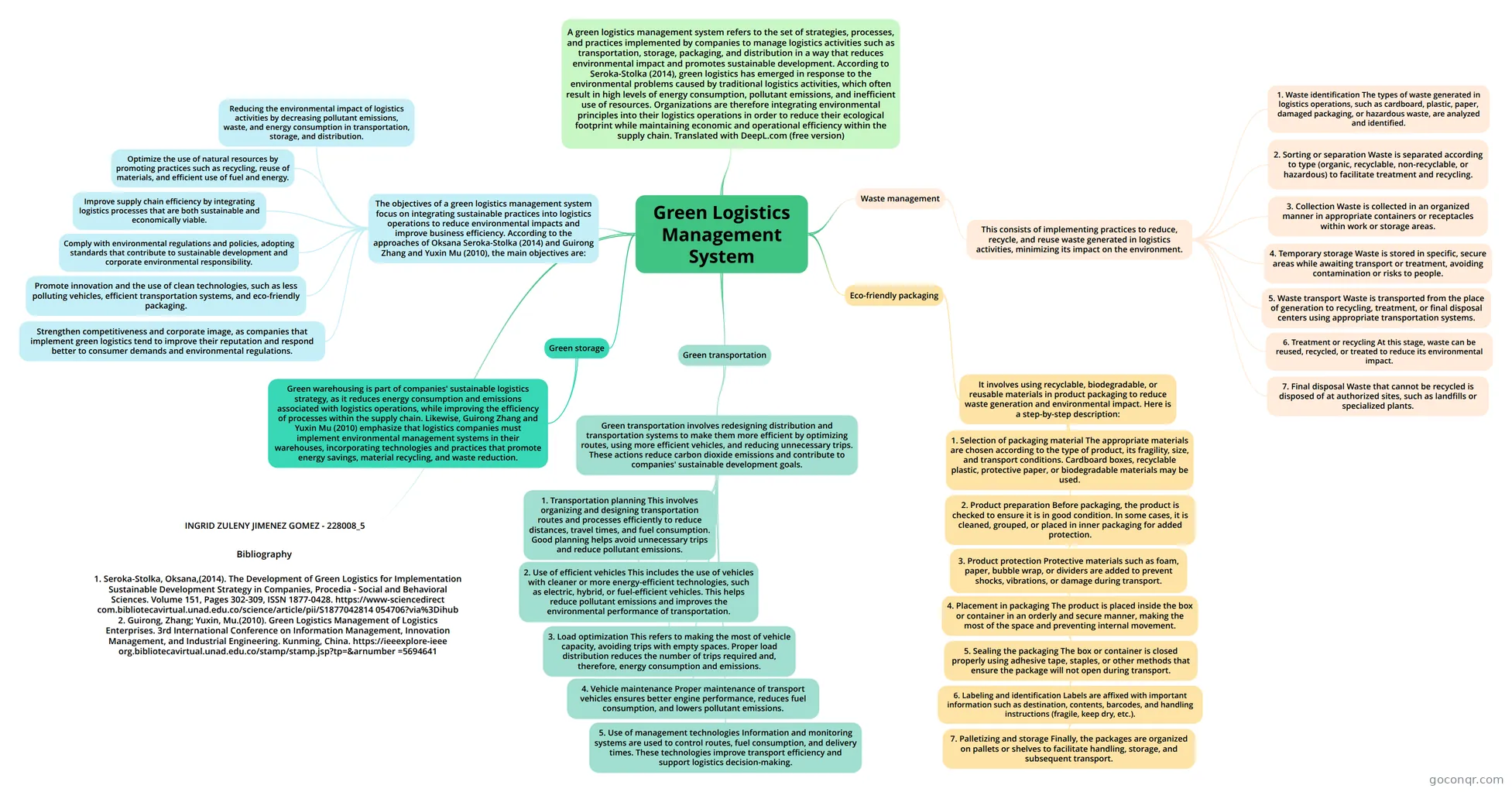
Mind map: Green logistics management system
Conteúdo do mapa
Green Logistics Management System
A green logistics management system refers to the set of strategies, processes, and practices implemented by companies to manage logistics activities such as transportation, storage, packaging, and distribution in a way that reduces environmental impact and promotes sustainable development. According to Seroka-Stolka (2014), green logistics has emerged in response to the environmental problems caused by traditional logistics activities, which often result in high levels of energy consumption, pollutant emissions, and inefficient use of resources. Organizations are therefore integrating environmental principles into their logistics operations in order to reduce their ecological footprint while maintaining economic and operational efficiency within the supply chain. Translated with DeepL.com (free version)
The objectives of a green logistics management system focus on integrating sustainable practices into logistics operations to reduce environmental impacts and improve business efficiency. According to the approaches of Oksana Seroka-Stolka (2014) and Guirong Zhang and Yuxin Mu (2010), the main objectives are:
- Reducing the environmental impact of logistics activities by decreasing pollutant emissions, waste, and energy consumption in transportation, storage, and distribution.
- Optimize the use of natural resources by promoting practices such as recycling, reuse of materials, and efficient use of fuel and energy.
- Improve supply chain efficiency by integrating logistics processes that are both sustainable and economically viable.
- Comply with environmental regulations and policies, adopting standards that contribute to sustainable development and corporate environmental responsibility.
- Promote innovation and the use of clean technologies, such as less polluting vehicles, efficient transportation systems, and eco-friendly packaging.
- Strengthen competitiveness and corporate image, as companies that implement green logistics tend to improve their reputation and respond better to consumer demands and environmental regulations.
Green storage
- Green warehousing is part of companies' sustainable logistics strategy, as it reduces energy consumption and emissions associated with logistics operations, while improving the efficiency of processes within the supply chain. Likewise, Guirong Zhang and Yuxin Mu (2010) emphasize that logistics companies must implement environmental management systems in their warehouses, incorporating technologies and practices that promote energy savings, material recycling, and waste reduction.
Green transportation
- Green transportation involves redesigning distribution and transportation systems to make them more efficient by optimizing routes, using more efficient vehicles, and reducing unnecessary trips. These actions reduce carbon dioxide emissions and contribute to companies' sustainable development goals.
- 1. Transportation planning This involves organizing and designing transportation routes and processes efficiently to reduce distances, travel times, and fuel consumption. Good planning helps avoid unnecessary trips and reduce pollutant emissions.
- 2. Use of efficient vehicles This includes the use of vehicles with cleaner or more energy-efficient technologies, such as electric, hybrid, or fuel-efficient vehicles. This helps reduce pollutant emissions and improves the environmental performance of transportation.
- 4. Vehicle maintenance Proper maintenance of transport vehicles ensures better engine performance, reduces fuel consumption, and lowers pollutant emissions.
- 5. Use of management technologies Information and monitoring systems are used to control routes, fuel consumption, and delivery times. These technologies improve transport efficiency and support logistics decision-making.
- 3. Load optimization This refers to making the most of vehicle capacity, avoiding trips with empty spaces. Proper load distribution reduces the number of trips required and, therefore, energy consumption and emissions.
- Green transportation involves redesigning distribution and transportation systems to make them more efficient by optimizing routes, using more efficient vehicles, and reducing unnecessary trips. These actions reduce carbon dioxide emissions and contribute to companies' sustainable development goals.
Eco-friendly packaging
- It involves using recyclable, biodegradable, or reusable materials in product packaging to reduce waste generation and environmental impact. Here is a step-by-step description:
- 1. Selection of packaging material The appropriate materials are chosen according to the type of product, its fragility, size, and transport conditions. Cardboard boxes, recyclable plastic, protective paper, or biodegradable materials may be used.
- 2. Product preparation Before packaging, the product is checked to ensure it is in good condition. In some cases, it is cleaned, grouped, or placed in inner packaging for added protection.
- 3. Product protection Protective materials such as foam, paper, bubble wrap, or dividers are added to prevent shocks, vibrations, or damage during transport.
- 4. Placement in packaging The product is placed inside the box or container in an orderly and secure manner, making the most of the space and preventing internal movement.
- 5. Sealing the packaging The box or container is closed properly using adhesive tape, staples, or other methods that ensure the package will not open during transport.
- 6. Labeling and identification Labels are affixed with important information such as destination, contents, barcodes, and handling instructions (fragile, keep dry, etc.).
- 7. Palletizing and storage Finally, the packages are organized on pallets or shelves to facilitate handling, storage, and subsequent transport.
- 6. Labeling and identification Labels are affixed with important information such as destination, contents, barcodes, and handling instructions (fragile, keep dry, etc.).
- 5. Sealing the packaging The box or container is closed properly using adhesive tape, staples, or other methods that ensure the package will not open during transport.
- 4. Placement in packaging The product is placed inside the box or container in an orderly and secure manner, making the most of the space and preventing internal movement.
- 3. Product protection Protective materials such as foam, paper, bubble wrap, or dividers are added to prevent shocks, vibrations, or damage during transport.
- It involves using recyclable, biodegradable, or reusable materials in product packaging to reduce waste generation and environmental impact. Here is a step-by-step description:
Waste management
- This consists of implementing practices to reduce, recycle, and reuse waste generated in logistics activities, minimizing its impact on the environment.
- 1. Waste identification The types of waste generated in logistics operations, such as cardboard, plastic, paper, damaged packaging, or hazardous waste, are analyzed and identified.
- 2. Sorting or separation Waste is separated according to type (organic, recyclable, non-recyclable, or hazardous) to facilitate treatment and recycling.
- 3. Collection Waste is collected in an organized manner in appropriate containers or receptacles within work or storage areas.
- 4. Temporary storage Waste is stored in specific, secure areas while awaiting transport or treatment, avoiding contamination or risks to people.
- 5. Waste transport Waste is transported from the place of generation to recycling, treatment, or final disposal centers using appropriate transportation systems.
- 6. Treatment or recycling At this stage, waste can be reused, recycled, or treated to reduce its environmental impact.
- 7. Final disposal Waste that cannot be recycled is disposed of at authorized sites, such as landfills or specialized plants.
- This consists of implementing practices to reduce, recycle, and reuse waste generated in logistics activities, minimizing its impact on the environment.
Bibliography
- 1. Seroka-Stolka, Oksana,(2014). The Development of Green Logistics for Implementation Sustainable Development Strategy in Companies, Procedia - Social and Behavioral Sciences. Volume 151, Pages 302-309, ISSN 1877-0428. https://www-sciencedirect com.bibliotecavirtual.unad.edu.co/science/article/pii/S1877042814 054706?via%3Dihub 2. Guirong, Zhang; Yuxin, Mu.(2010). Green Logistics Management of Logistics Enterprises. 3rd International Conference on Information Management, Innovation Management, and Industrial Engineering. Kunming, China. https://ieeexplore-ieee org.bibliotecavirtual.unad.edu.co/stamp/stamp.jsp?tp=&arnumber =5694641
- INGRID ZULENY JIMENEZ GOMEZ - 228008_5
Informações
- Descrição
- Mapa Mental sobre Green Logistics Management System, criado por Ingrid Zuleny Jiménez Gómez em 04-03-2026.
- Criado por
- Ingrid Zuleny Jiménez Gómez
- Visualizações
- 0
- Avaliação
Mais sobre Reverse and Green Logistics