
Mapa mental
Forest Ecology
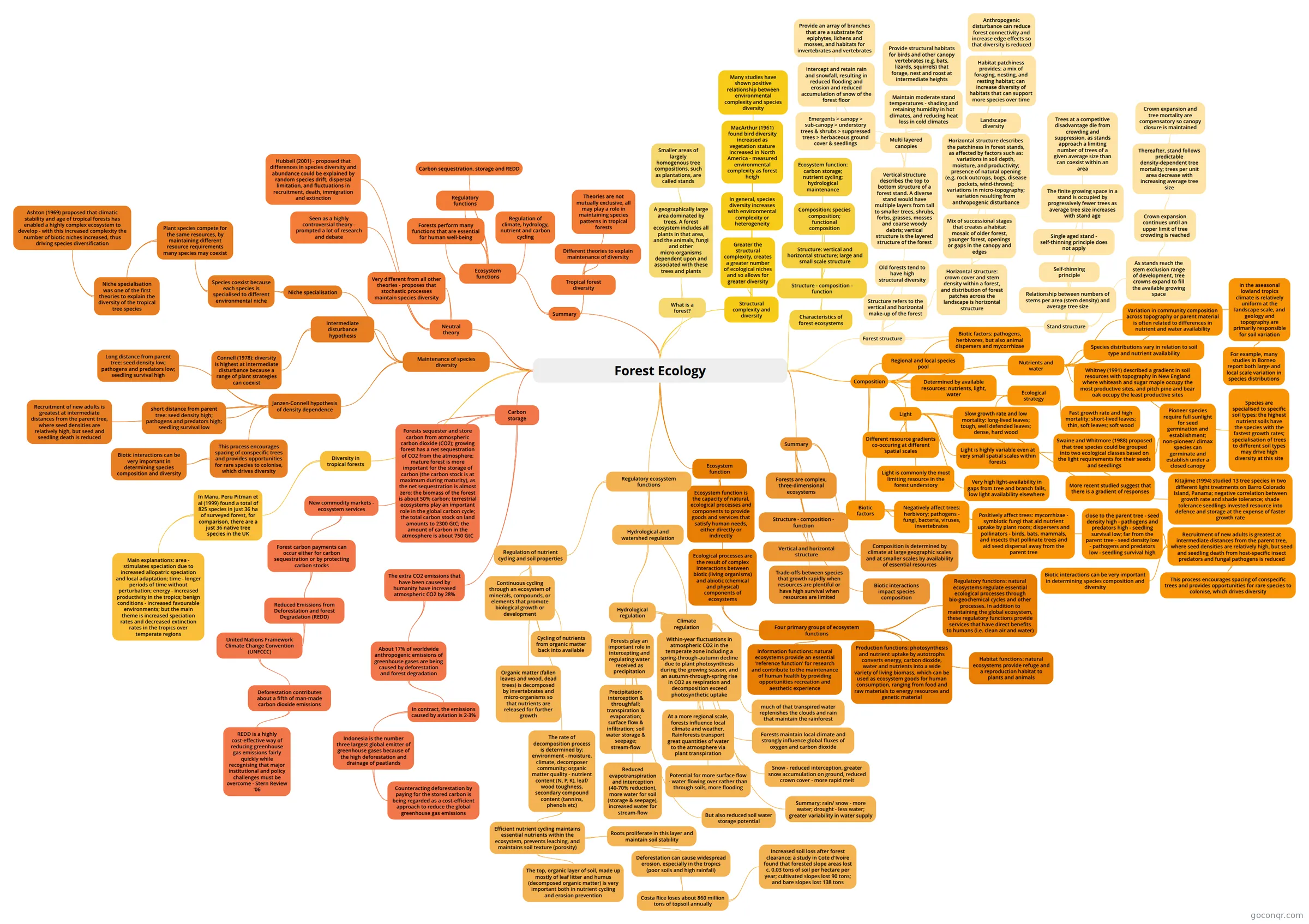
Mind map: forest ecology
Conteúdo do mapa
Forest Ecology
What is a forest?
- A geographically large area dominated by trees. A forest ecosystem includes all plants in that area, and the animals, fungi and other micro-organisms dependent upon and associated with these trees and plants
- Smaller areas of largely homogenous tree compositions, such as plantations, are called stands
- A geographically large area dominated by trees. A forest ecosystem includes all plants in that area, and the animals, fungi and other micro-organisms dependent upon and associated with these trees and plants
Structural complexity and diversity
- Greater the structural complexity, creates a greater number of ecological niches and so allows for greater diversity
- In general, species diversity increases with environmental complexity or heterogeneity
- MacArthur (1961) found bird diversity increased as vegetation stature increased in North America - measured environmental complexity as forest heigh
- Many studies have shown positive relationship between environmental complexity and species diversity
Characteristics of forest ecosystems
- Structure - composition - function
- Structure: vertical and horizontal structure; large and small scale structure
- Composition: species composition; functional composition
- Ecosystem function: carbon storage; nutrient cycling; hydrological maintenance
- Structure - composition - function
Forest structure
- Structure refers to the vertical and horizontal make-up of the forest
- Horizontal structure: crown cover and stem density within a forest, and distribution of forest patches across the landscape is horizontal structure
- Mix of successional stages that creates a habitat mosaic of older forest, younger forest, openings or gaps in the canopy and edges
- Horizontal structure describes the patchiness in forest stands, as affected by factors such as: variations in soil depth, moisture, and productivity; presence of natural opening (e.g. rock outcrops, bogs, disease pockets, wind-throws); variations in micro-topography; variation resulting from anthropogenic disturbance
- Habitat patchiness provides: a mix of foraging, nesting, and resting habitat; can increase diversity of habitats that can support more species over time
- Anthropogenic disturbance can reduce forest connectivity and increase edge effects so that diversity is reduced
- Landscape diversity
- Horizontal structure: crown cover and stem density within a forest, and distribution of forest patches across the landscape is horizontal structure
- Old forests tend to have high structural diversity
- Vertical structure describes the top to bottom structure of a forest stand. A diverse stand would have multiple layers from tall to smaller trees, shrubs, forbs, grasses, mosses and coarse woody debris; vertical structure is the layered structure of the forest
- Emergents > canopy > sub-canopy > understory trees & shrubs > suppressed trees > herbaceous ground cover & seedlings
- Multi layered canopies
- Maintain moderate stand temperatures - shading and retaining humidity in hot climates, and reducing heat loss in cold climates
- Intercept and retain rain and snowfall, resulting in reduced flooding and erosion and reduced accumulation of snow of the forest floor
- Provide structural habitats for birds and other canopy vertebrates (e.g. bats, lizards, squirrels) that forage, nest and roost at intermediate heights
- Provide an array of branches that are a substrate for epiphytes, lichens and mosses, and habitats for invertebrates and vertebrates
- Stand structure
- Relationship between numbers of stems per area (stem density) and average tree size
- The finite growing space in a stand is occupied by progressively fewer trees as average tree size increases with stand age
- Trees at a competitive disadvantage die from crowding and suppression, as stands approach a limiting number of trees of a given average size than can coexist within an area
- Self-thinning principle
- Single aged stand - self-thinning principle does not apply
- As stands reach the stem exclusion range of development, tree crowns expand to fill the available growing space
- Crown expansion continues until an upper limit of tree crowding is reached
- Thereafter, stand follows predictable density-dependent tree mortality; trees per unit area decrease with increasing average tree size
- Crown expansion and tree mortality are compensatory so canopy closure is maintained
- Thereafter, stand follows predictable density-dependent tree mortality; trees per unit area decrease with increasing average tree size
- Crown expansion continues until an upper limit of tree crowding is reached
- Relationship between numbers of stems per area (stem density) and average tree size
- Structure refers to the vertical and horizontal make-up of the forest
Composition
- Regional and local species pool
- Determined by available resources: nutrients, light, water
- Biotic factors: pathogens, herbivores, but also animal dispersers and mycorrhizae
- Nutrients and water
- Variation in community composition across topography or parent material is often related to differences in nutrient and water availability
- Whitney (1991) described a gradient in soil resources with topography in New England where whiteash and sugar maple occupy the most productive sites, and pitch pine and bear oak occupy the least productive sites
- In the aseasonal lowland tropics climate is relatively uniform at the landscape scale, and geology and topography are primarily responsible for soil variation
- For example, many studies in Borneo report both large and local scale variation in species distributions
- Species distributions vary in relation to soil type and nutrient availability
- Species are specialised to specific soil types; the highest nutrient soils have the species with the fastest growth rates; specialisation of trees to different soil types may drive high diversity at this site
- Ecological strategy
- Slow growth rate and low mortality: long-lived leaves; tough, well defended leaves; dense, hard wood
- Fast growth rate and high mortality: short-lived leaves; thin, soft leaves; soft wood
- Light
- Light is commonly the most limiting resource in the forest understory
- Light is highly variable even at very small spatial scales within forests
- Very high light-availability in gaps from tree and branch falls, low light availability elsewhere
- Different resource gradients co-occuring at different spatial scales
- Swaine and Whitmore (1988) proposed that tree species could be grouped into two ecological classes based on the light requirements for their seeds and seedlings
- Pioneer species require full sunlight for seed germination and establishment; non-pioneer/ climax species can germinate and establish under a closed canopy
- More recent studied suggest that there is a gradient of responses
- Kitajime (1994) studied 13 tree species in two different light treatments on Barro Colorado Island, Panama; negative correlation between growth rate and shade tolerance; shade tolerance seedlings invested resource into defence and storage at the expense of faster growth rate
- Biotic factors
- Negatively affect trees: herbivory; pathogens - fungi, bacteria, viruses, invertebrates
- Positively affect trees: mycorrhizae - symbiotic fungi that aid nutrient uptake by plant roots; dispersers and pollinators - birds, bats, mammals, and insects that pollinate trees and aid seed dispersal away from the parent tree
- close to the parent tree - seed density high - pathogens and predators high - seedling survival low; far from the parent tree - seed density low - pathogens and predators low - seedling survival high
- Recruitment of new adults is greatest at intermediate distances from the parent tree, where seed densities are relatively high, but seed and seedling death from host-specific insect predators and fungal pathogens is reduced
- This process encourages spacing of conspecific trees and provides opportunities for rare species to colonise, which drives diversity
- Biotic interactions can be very important in determining species composition and diversity
- Recruitment of new adults is greatest at intermediate distances from the parent tree, where seed densities are relatively high, but seed and seedling death from host-specific insect predators and fungal pathogens is reduced
Summary
- Forests are complex, three-dimensional ecosystems
- Structure - composition - function
- Vertical and horizontal structure
- Structure - composition - function
- Composition is determined by climate at large geographic scales and at smaller scales by availability of essential resources
- Trade-offs between species that growth rapidly when resources are plentiful or have high survival when resources are limited
- Biotic interactions impact species composition
- Forests are complex, three-dimensional ecosystems
Ecosystem function
- Ecosystem function is the capacity of natural, ecological processes and components to provide goods and services that satisfy human needs, either directly or indirectly
- Ecological processes are the result of complex interactions between biotic (living organisms) and abiotic (chemical and physical) components of ecosystems
- Four primary groups of ecosystem functions
- Regulatory functions: natural ecosystems regulate essential ecological processes through bio-geochemical cycles and other processes. In addition to maintaining the global ecosystem, these regulatory functions provide services that have direct benefits to humans (i.e. clean air and water)
- Habitat functions: natural ecosystems provide refuge and a reproduction habitat to plants and animals
- Production functions: photosynthesis and nutrient uptake by autotrophs converts energy, carbon dioxide, water and nutrients into a wide variety of living biomass, which can be used as ecosystem goods for human consumption, ranging from food and raw materials to energy resources and genetic material
- Information functions: natural ecosystems provide an essential 'reference function' for research and contribute to the maintenance of human health by providing opportunities recreation and aesthetic experience
- Four primary groups of ecosystem functions
Regulatory ecosystem functions
- Climate regulation
- Within-year fluctuations in atmospheric CO2 in the temperate zone including a spring-through-autumn decline due to plant photosynthesis during the growing season, and an autumn-through-spring rise in CO2 as respiration and decomposition exceed photosynthetic uptake
- Forests maintain local climate and strongly influence global fluxes of oxygen and carbon dioxide
- At a more regional scale, forests influence local climate and weather. Rainforests transport great quantities of water to the atmosphere via plant transpiration
- much of that transpired water replenishes the clouds and rain that maintain the rainforest
- Within-year fluctuations in atmospheric CO2 in the temperate zone including a spring-through-autumn decline due to plant photosynthesis during the growing season, and an autumn-through-spring rise in CO2 as respiration and decomposition exceed photosynthetic uptake
- Hydrological and watershed regulation
- Hydrological regulation
- Forests play an important role in intercepting and regulating water received as precipitation
- Precipitation; interception & throughfall; transpiration & evaporation; surface flow & infiltration; soil water storage & seepage; stream-flow
- Reduced evapotranspiration and interception (40-70% reduction), more water for soil (storage & seepage), increased water for stream-flow
- Potential for more surface flow - water flowing over rather than through soils, more flooding
- But also reduced soil water storage potential
- Snow - reduced interception, greater snow accumulation on ground, reduced crown cover - more rapid melt
- Summary: rain/ snow - more water; drought - less water; greater variability in water supply
- Hydrological regulation
- Regulation of nutrient cycling and soil properties
- Continuous cycling through an ecosystem of minerals, compounds, or elements that promote biological growth or development
- Cycling of nutrients from organic matter back into available
- Organic matter (fallen leaves and wood, dead trees) is decomposed by invertebrates and micro-organisms so that nutrients are released for further growth
- The rate of decomposition process is determined by: environment - moisture, climate, decomposer community; organic matter quality - nutrient content (N, P, K), leaf/ wood toughness, secondary compound content (tannins, phenols etc)
- Efficient nutrient cycling maintains essential nutrients within the ecosystem, prevents leaching, and maintains soil texture (porosity)
- The top, organic layer of soil, made up mostly of leaf litter and humus (decomposed organic matter) is very important both in nutrient cycling and erosion prevention
- Roots proliferate in this layer and maintain soil stability
- Deforestation can cause widespread erosion, especially in the tropics (poor soils and high rainfall)
- Costa Rice loses about 860 million tons of topsoil annually
- Increased soil loss after forest clearance: a study in Cote d'Ivoire found that forested slope areas lost c. 0.03 tons of soil per hectare per year; cultivated slopes lost 90 tons; and bare slopes lost 138 tons
- Costa Rice loses about 860 million tons of topsoil annually
- Deforestation can cause widespread erosion, especially in the tropics (poor soils and high rainfall)
- Efficient nutrient cycling maintains essential nutrients within the ecosystem, prevents leaching, and maintains soil texture (porosity)
- Climate regulation
Carbon storage
- Forests sequester and store carbon from atmospheric carbon dioxide (CO2); growing forest has a net sequestration of CO2 from the atmosphere; mature forest is more important for the storage of carbon (the carbon stock is at maximum during maturity), as the net sequestration is almost zero; the biomass of the forest is about 50% carbon; terrestrial ecosystems play an important role in the global carbon cycle; the total carbon stock on land amounts to 2300 GtC; the amount of carbon in the atmosphere is about 750 GtC
- The extra CO2 emissions that have been caused by humanity have increased atmospheric CO2 by 28%
- About 17% of worldwide anthropogenic emissions of greenhouse gases are being caused by deforestation and forest degradation
- In contract, the emissions caused by aviation is 2-3%
- Indonesia is the number three largest global emitter of greenhouse gases because of the high deforestation and drainage of peatlands
- Counteracting deforestation by paying for the stored carbon is being regarded as a cost-efficient approach to reduce the global greenhouse gas emissions
- Indonesia is the number three largest global emitter of greenhouse gases because of the high deforestation and drainage of peatlands
- In contract, the emissions caused by aviation is 2-3%
- About 17% of worldwide anthropogenic emissions of greenhouse gases are being caused by deforestation and forest degradation
- New commodity markets - ecosystem services
- Forest carbon payments can occur either for carbon sequestration or by protecting carbon stocks
- Reduced Emissions from Deforestation and forest Degradation (REDD)
- United Nations Framework Climate Change Convention (UNFCCC)
- Deforestation contributes about a fifth of man-made carbon dioxide emissions
- REDD is a highly cost-effective way of reducing greenhouse gas emissions fairly quickly while recognising that major institutional and policy challenges must be overcome - Stern Review '06
- Deforestation contributes about a fifth of man-made carbon dioxide emissions
- United Nations Framework Climate Change Convention (UNFCCC)
- Reduced Emissions from Deforestation and forest Degradation (REDD)
- Forest carbon payments can occur either for carbon sequestration or by protecting carbon stocks
Diversity in tropical forests
- In Manu, Peru Pitman et al (1999) found a total of 825 species in just 36 ha of surveyed forest, for comparison, there are a just 36 native tree species in the UK
- Main explanations: area - stimulates speciation due to increased allopatric speciation and local adaptation; time - longer periods of time without perturbation; energy - increased productivity in the tropics; benign conditions - increased favourable environments; but the main theme is increased speciation rates and decreased extinction rates in the tropics over temperate regions
- In Manu, Peru Pitman et al (1999) found a total of 825 species in just 36 ha of surveyed forest, for comparison, there are a just 36 native tree species in the UK
Maintenance of species diversity
- Niche specialisation
- Species coexist because each species is specialised to different environmental niche
- Plant species compete for the same resources, by maintaining different resource requirements many species may coexist
- Niche specialisation was one of the first theories to explain the diversity of the tropical tree species
- Ashton (1969) proposed that climatic stability and age of tropical forests has enabled a highly complex ecosystem to develop - with this increased complexity the number of biotic niches increased, thus driving species diversification
- Niche specialisation was one of the first theories to explain the diversity of the tropical tree species
- Plant species compete for the same resources, by maintaining different resource requirements many species may coexist
- Species coexist because each species is specialised to different environmental niche
- Intermediate disturbance hypothesis
- Connell (1978): diversity is highest at intermediate disturbance because a range of plant strategies can coexist
- Janzen-Connell hypothesis of density dependence
- short distance from parent tree: seed density high; pathogens and predators high; seedling survival low
- Long distance from parent tree: seed density low; pathogens and predators low; seedling survival high
- Recruitment of new adults is greatest at intermediate distances from the parent tree, where seed densities are relatively high, but seed and seedling death is reduced
- This process encourages spacing of conspecific trees and provides opportunities for rare species to colonise, which drives diversity
- Biotic interactions can be very important in determining species composition and diversity
- Niche specialisation
Neutral theory
- Very different from all other theories - proposes that stochastic processes maintain species diversity
- Hubbell (2001) - proposed that differences in species diversity and abundance could be explained by random species drift, dispersal limitation, and fluctuations in recruitment, death, immigration and extinction
- Seen as a highly controversial theory - prompted a lot of research and debate
Summary
- Ecosystem functions
- Forests perform many functions that are essential for human well-being
- Regulatory functions
- Regulation of climate, hydrology, nutrient and carbon cycling
- Carbon sequestration, storage and REDD
- Tropical forest diversity
- Different theories to explain maintenance of diversity
- Theories are not mutually exclusive, all may play a role in maintaining species patterns in tropical forests
- Ecosystem functions
Informações
- Descrição
- university Environmental Geography Mapa Mental sobre Forest Ecology, criado por Calli Dougall em 10-12-2015.
- Criado por
- Calli Dougall
- Visualizações
- 1
- Avaliação