
Mapa mental
Applied Ecology
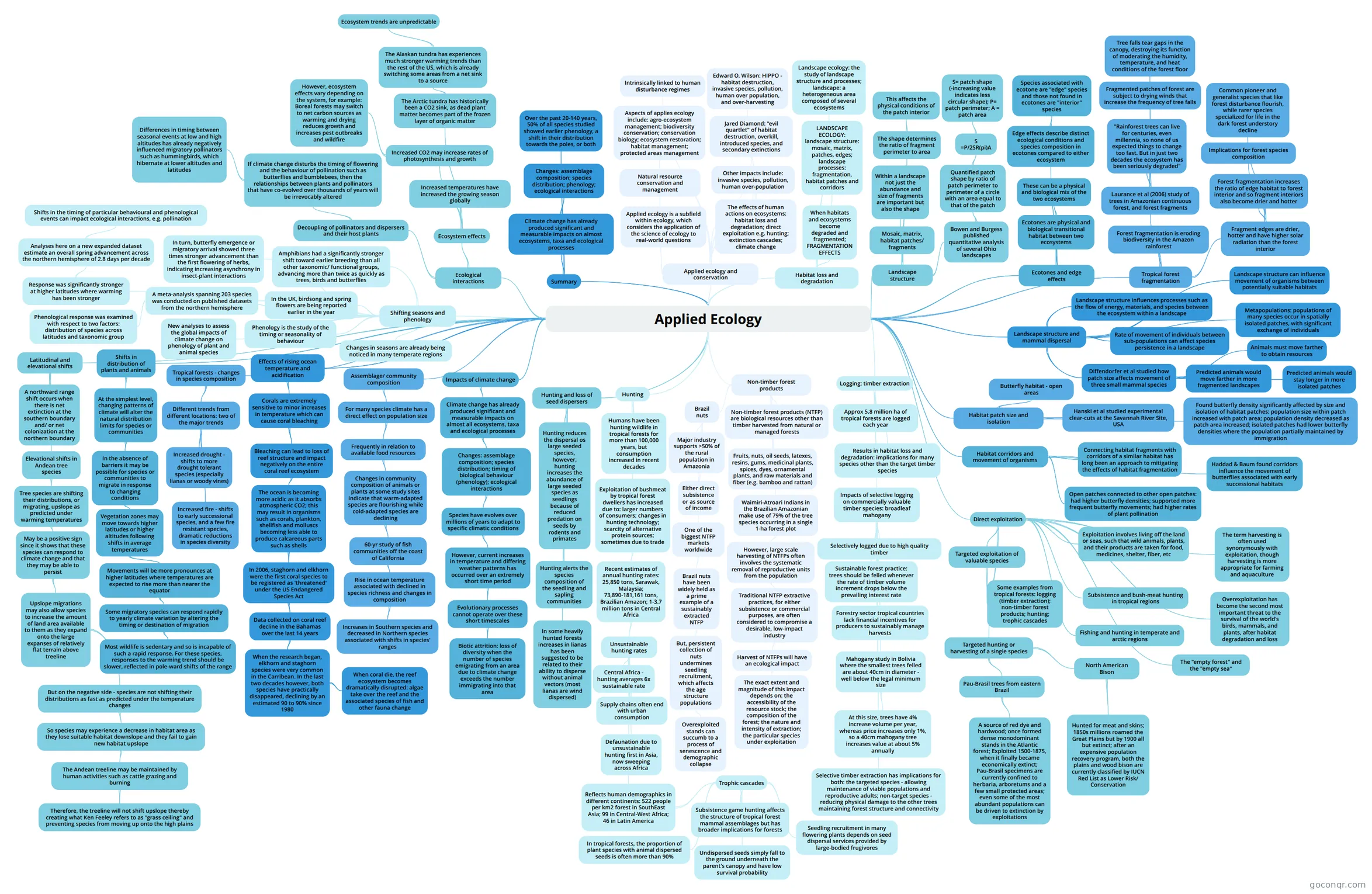
Mind map: Applied ecology
Conteúdo do mapa
Applied Ecology
Applied ecology and conservation
- Applied ecology is a subfield within ecology, which considers the application of the science of ecology to real-world questions
- Natural resource conservation and management
- Aspects of applies ecology include: agro-ecosystem management; biodiversity conservation; conservation biology; ecosystem restoration; habitat management; protected areas management
- Intrinsically linked to human disturbance regimes
- The effects of human actions on ecosystems: habitat loss and degradation; direct exploitation e.g. hunting; extinction cascades; climate change
- Edward O. Wilson: HIPPO - habitat destruction, invasive species, pollution, human over population, and over-harvesting
- Other impacts include: invasive species, pollution, human over-population
- Jared Diamond: "evil quartlet" of habitat destruction, overkill, introduced species, and secondary extinctions
Habitat loss and degradation
- When habitats and ecosystems become degraded and fragmented; FRAGMENTATION EFFECTS
- LANDSCAPE ECOLOGY: landscape structure: mosaic, matrix, patches, edges; landscape processes: fragmentation, habitat patches and corridors
- Landscape ecology: the study of landscape structure and processes; landscape: a heterogeneous area composed of several ecosystems
Landscape structure
- Mosaic, matrix, habitat patches/ fragments
- Within a landscape not just the abundance and size of fragments are important but also the shape
- The shape determines the ratio of fragment perimeter to area
- This affects the physical conditions of the patch interior
- Bowen and Burgess published quantitative analysis of several Ohio landscapes
- Quantified patch shape by ratio of patch perimeter to perimeter of a circle with an area equal to that of the patch
- S =P/2SR(pi)A
- S= patch shape (-increasing value indicates less circular shape); P= patch perimeter; A = patch area
- S =P/2SR(pi)A
- Quantified patch shape by ratio of patch perimeter to perimeter of a circle with an area equal to that of the patch
Ecotones and edge effects
- Ecotones are physical and biological transitional habitat between two ecosystems
- These can be a physical and biological mix of the two ecosystems
- Edge effects describe distinct ecological conditions and species composition in ecotones compared to either ecosystem
- Species associated with ecotone are "edge" species and those not found in ecotones are "interior" species
- Ecotones are physical and biological transitional habitat between two ecosystems
Tropical forest fragmentation
- Forest fragmentation is eroding biodiversity in the Amazon rainforest
- Laurance et al (2006) study of trees in Amazonian continuous forest, and forest fragments
- "Rainforest trees can live for centuries, even millennia, so none of us expected things to change too fast. But in just two decades the ecosystem has been seriously degraded"
- Fragmented patches of forest are subject to drying winds that increase the frequency of tree falls
- Tree falls tear gaps in the canopy, destroying its function of moderating the humidity, temperature, and heat conditions of the forest floor
- Fragment edges are drier, hotter and have higher solar radiation than the forest interior
- Forest fragmentation increases the ratio of edge habitat to forest interior and so fragment interiors also become drier and hotter
- Implications for forest species composition
- Common pioneer and generalist species that like forest disturbance flourish, while rarer species specialized for life in the dark forest understory decline
Landscape structure and mammal dispersal
- Landscape structure influences processes such as the flow of energy, materials, and species between the ecosystem within a landscape
- Landscape structure can influence movement of organisms between potentially suitable habitats
- Metapopulations: populations of many species occur in spatially isolated patches, with significant exchange of individuals
- Rate of movement of individuals between sub-populations can affect species persistence in a landscape
- Diffendorfer et al studied how patch size affects movement of three small mammal species
- Predicted animals would move farther in more fragmented landscapes
- Animals must move farther to obtain resources
- Predicted animals would stay longer in more isolated patches
Habitat patch size and isolation
- Hanski et al studied experimental clear-cuts at the Savannah River Site, USA
- Butterfly habitat - open areas
- Found butterfly density significantly affected by size and isolation of habitat patches: population size within patch increased with patch area; population density decreased as patch area increased; isolated patches had lower butterfly densities where the population partially maintained by immigration
Habitat corridors and movement of organisms
- Connecting habitat fragments with corridors of a similar habitat has long been an approach to mitigating the effects of habitat fragmentation
- Haddad & Baum found corridors influence the movement of butterflies associated with early successional habitats
- Open patches connected to other open patches: had higher butterfly densities; supported more frequent butterfly movements; had higher rates of plant pollination
Direct exploitation
- Exploitation involves living off the land or seas, such that wild animals, plants, and their products are taken for food, medicines, shelter, fiber, etc
- The term harvesting is often used synonymously with exploitation, though harvesting is more appropriate for farming and aquaculture
- Overexploitation has become the second most important threat to the survival of the world's birds, mammals, and plants, after habitat degradation and loss
- Subsistence and bush-meat hunting in tropical regions
- Fishing and hunting in temperate and arctic regions
- The "empty forest" and the "empty sea"
- Targeted hunting or harvesting of a single species
- North American Bison
- Hunted for meat and skins; 1850s millions roamed the Great Plains but by 1900 all but extinct; after an expensive population recovery program, both the plains and wood bison are currently classified by IUCN Red List as Lower Risk/ Conservation
- Pau-Brasil trees from eastern Brazil
- A source of red dye and hardwood; once formed dense monodominant stands in the Atlantic forest; Exploited 1500-1875, when it finally became economically extinct; Pau-Brasil specimens are currently confined to herbaria, arboretums and a few small protected areas; even some of the most abundant populations can be driven to extinction by exploitations
- North American Bison
- Targeted exploitation of valuable species
- Some examples from tropical forests: logging (timber extraction); non-timber forest products; hunting; trophic cascades
Logging: timber extraction
- Approx 5.8 million ha of tropical forests are logged each year
- Results in habitat loss and degradation: implications for many species other than the target timber species
- Impacts of selective logging on commercially valuable timber species: broadleaf mahogany
- Selectively logged due to high quality timber
- Sustainable forest practice: trees should be felled whenever the rate of timber volume increment drops below the prevailing interest rate
- Forestry sector tropical countries lack financial incentives for producers to sustainably manage harvests
- Mahogany study in Bolivia where the smallest trees felled are about 40cm in diameter - well below the legal minimum size
- At this size, trees have 4% increase volume per year, whereas price increases only 1%, so a 40cm mahogany tree increases value at about 5% annually
- Selective timber extraction has implications for both: the targeted species - allowing maintenance of viable populations and reproductive adults; non-target species - reducing physical damage to the other trees maintaining forest structure and connectivity
Non-timber forest products
- Non-timber forest products (NTFP) are biological resources other than timber harvested from natural or managed forests
- Fruits, nuts, oil seeds, latexes, resins, gums, medicinal plants, spices, dyes, ornamental plants, and raw materials and fiber (e.g. bamboo and rattan)
- Waimiri-Atroari Indians in the Brazilian Amazonian make use of 79% of the tree species occurring in a single 1-ha forest plot
- However, large scale harvesting of NTFPs often involves the systematic removal of reproductive units from the population
- Traditional NTFP extractive practices, for either subsistence or commercial purposes, are often considered to compromise a desirable, low-impact industry
- Harvest of NTFPs will have an ecological impact
- The exact extent and magnitude of this impact depends on: the accessibility of the resource stock; the composition of the forest; the nature and intensity of extraction; the particular species under exploitation
- Harvest of NTFPs will have an ecological impact
- Traditional NTFP extractive practices, for either subsistence or commercial purposes, are often considered to compromise a desirable, low-impact industry
- However, large scale harvesting of NTFPs often involves the systematic removal of reproductive units from the population
- Brazil nuts
- Major industry supports >50% of the rural population in Amazonia
- Either direct subsistence or as source of income
- One of the biggest NTFP markets worldwide
- Brazil nuts have been widely held as a prime example of a sustainably extracted NTFP
- But, persistent collection of nuts undermines seedling recruitment, which affects the age structure populations
- Overexploited stands can succumb to a process of senescence and demographic collapse
- But, persistent collection of nuts undermines seedling recruitment, which affects the age structure populations
- Brazil nuts have been widely held as a prime example of a sustainably extracted NTFP
Hunting
- Humans have been hunting wildlife in tropical forests for more than 100,000 years, but consumption increased in recent decades
- Exploitation of bushmeat by tropical forest dwellers has increased due to: larger numbers of consumers; changes in hunting technology; scarcity of alternative protein sources; sometimes due to trade
- Recent estimates of annual hunting rates: 25,850 tons, Sarawak, Malaysia; 73,890-181,161 tons, Brazilian Amazon; 1-3.7 million tons in Central Africa
- Unsustainable hunting rates
- Central Africa - hunting averages 6x sustainable rate
- Supply chains often end with urban consumption
- Defaunation due to unsustainable hunting first in Asia, now sweeping across Africa
- Reflects human demographics in different continents: 522 people per km2 forest in SouthEast Asia; 99 in Central-West Africa; 46 in Latin America
- Trophic cascades
- Subsistence game hunting affects the structure of tropical forest mammal assemblages but has broader implications for forests
- Seedling recruitment in many flowering plants depends on seed dispersal services provided by large-bodied frugivores
- In tropical forests, the proportion of plant species with animal dispersed seeds is often more than 90%
- Undispersed seeds simply fall to the ground underneath the parent's canopy and have low survival probability
- Trophic cascades
- Unsustainable hunting rates
- Recent estimates of annual hunting rates: 25,850 tons, Sarawak, Malaysia; 73,890-181,161 tons, Brazilian Amazon; 1-3.7 million tons in Central Africa
Hunting and loss of seed dispersers
- Hunting reduces the dispersal os large seeded species, however, hunting increases the abundance of large seeded species as seedlings because of reduced predation on seeds by rodents and primates
- Hunting alerts the species composition of the seedling and sapling communities
- In some heavily hunted forests increases in lianas has been suggested to be related to their ability to disperse without animal vectors (most lianas are wind dispersed)
Impacts of climate change
- Climate change has already produced significant and measurable impacts on almost all ecosystems, taxa and ecological processes
- Changes: assemblage composition; species distribution; timing of biological behaviour (phenology); ecological interactions
- Species have evolves over millions of years to adapt to specific climatic conditions
- However, current increases in temperature and differing weather patterns has occurred over an extremely short time period
- Evolutionary processes cannot operate over these short timescales
- Biotic attrition: loss of diversity when the number of species emigrating from an area due to climate change exceeds the number immigrating into that area
- Evolutionary processes cannot operate over these short timescales
- However, current increases in temperature and differing weather patterns has occurred over an extremely short time period
- Species have evolves over millions of years to adapt to specific climatic conditions
- Changes: assemblage composition; species distribution; timing of biological behaviour (phenology); ecological interactions
- Climate change has already produced significant and measurable impacts on almost all ecosystems, taxa and ecological processes
Assemblage/ community composition
- For many species climate has a direct effect on population size
- Frequently in relation to available food resources
- Changes in community composition of animals or plants at some study sites indicate that warm-adapted species are flourishing while cold-adapted species are declining
- 60-yr study of fish communities off the coast of California
- Rise in ocean temperature associated with declined in species richness and changes in composition
- Increases in Southern species and decreased in Northern species associated with shifts in species' ranges
- Rise in ocean temperature associated with declined in species richness and changes in composition
- 60-yr study of fish communities off the coast of California
- Changes in community composition of animals or plants at some study sites indicate that warm-adapted species are flourishing while cold-adapted species are declining
- Frequently in relation to available food resources
- For many species climate has a direct effect on population size
Effects of rising ocean temperature and acidification
- Corals are extremely sensitive to minor increases in temperature which can cause coral bleaching
- Bleaching can lead to loss of reef structure and impact negatively on the entire coral reef ecosystem
- The ocean is becoming more acidic as it absorbs atmospheric CO2; this may result in organisms such as corals, plankton, shellfish and molluscs becoming less able to produce calcareous parts such as shells
- In 2006, staghorn and elkhorn were the first coral species to be registered as 'threatened' under the US Endangered Species Act
- Data collected on coral reef decline in the Bahamas over the last 14 years
- When the research began, elkhorn and staghorn species were very common in the Carribean. In the last two decades however, both species have practically disappeared, declining by an estimated 90 to 90% since 1980
- When coral die, the reef ecosystem becomes dramatically disrupted: algae take over the reef and the associated species of fish and other fauna change
- When the research began, elkhorn and staghorn species were very common in the Carribean. In the last two decades however, both species have practically disappeared, declining by an estimated 90 to 90% since 1980
- Data collected on coral reef decline in the Bahamas over the last 14 years
- In 2006, staghorn and elkhorn were the first coral species to be registered as 'threatened' under the US Endangered Species Act
- The ocean is becoming more acidic as it absorbs atmospheric CO2; this may result in organisms such as corals, plankton, shellfish and molluscs becoming less able to produce calcareous parts such as shells
- Bleaching can lead to loss of reef structure and impact negatively on the entire coral reef ecosystem
- Corals are extremely sensitive to minor increases in temperature which can cause coral bleaching
Tropical forests - changes in species composition
- Different trends from different locations: two of the major trends
- Increased drought - shifts to more drought tolerant species (especially lianas or woody vines)
- Increased fire - shifts to early successional species, and a few fire resistant species, dramatic reductions in species diversity
- Different trends from different locations: two of the major trends
Shifts in distribution of plants and animals
- At the simplest level, changing patterns of climate will alter the natural distribution limits for species or communities
- In the absence of barriers it may be possible for species or communities to migrate in response to changing conditions
- Vegetation zones may move towards higher latitudes or higher altitudes following shifts in average temperatures
- Movements will be more pronounces at higher latitudes where temperatures are expected to rise more than nearer the equator
- Some migratory species can respond rapidly to yearly climate variation by altering the timing or destination of migration
- Most wildlife is sedentary and so is incapable of such a rapid response. For these species, responses to the warming trend should be slower, reflected in pole-ward shifts of the range
- Some migratory species can respond rapidly to yearly climate variation by altering the timing or destination of migration
- Movements will be more pronounces at higher latitudes where temperatures are expected to rise more than nearer the equator
- Vegetation zones may move towards higher latitudes or higher altitudes following shifts in average temperatures
- In the absence of barriers it may be possible for species or communities to migrate in response to changing conditions
- At the simplest level, changing patterns of climate will alter the natural distribution limits for species or communities
Latitudinal and elevational shifts
- A northward range shift occurs when there is net extinction at the southern boundary and/ or net colonization at the northern boundary
- Elevational shifts in Andean tree species
- Tree species are shifting their distributions, or migrating, upslope as predicted under warming temperatures
- May be a positive sign since it shows that these species can respond to climate change and that they may be able to persist
- Upslope migrations may also allow species to increase the amount of land area available to them as they expand onto the large expanses of relatively flat terrain above treeline
- But on the negative side - species are not shifting their distributions as fast as predicted under the temperature changes
- So species may experience a decrease in habitat area as they lose suitable habitat downslope and they fail to gain new habitat upslope
- The Andean treeline may be maintained by human activities such as cattle grazing and burning
- Therefore, the treeline will not shift upslope thereby creating what Ken Feeley refers to as "grass ceiling" and preventing species from moving up onto the high plains
- The Andean treeline may be maintained by human activities such as cattle grazing and burning
- So species may experience a decrease in habitat area as they lose suitable habitat downslope and they fail to gain new habitat upslope
- But on the negative side - species are not shifting their distributions as fast as predicted under the temperature changes
- Upslope migrations may also allow species to increase the amount of land area available to them as they expand onto the large expanses of relatively flat terrain above treeline
- May be a positive sign since it shows that these species can respond to climate change and that they may be able to persist
- Tree species are shifting their distributions, or migrating, upslope as predicted under warming temperatures
Shifting seasons and phenology
- Changes in seasons are already being noticed in many temperate regions
- Phenology is the study of the timing or seasonality of behaviour
- In the UK, birdsong and spring flowers are being reported earlier in the year
- New analyses to assess the global impacts of climate change on phenology of plant and animal species
- A meta-analysis spanning 203 species was conducted on published datasets from the northern hemisphere
- Phenological response was examined with respect to two factors: distribution of species across latitudes and taxonomic group
- Amphibians had a significantly stronger shift toward earlier breeding than all other taxonomic/ functional groups, advancing more than twice as quickly as trees, birds and butterflies
- In turn, butterfly emergence or migratory arrival showed three times stronger advancement than the first flowering of herbs, indicating increasing asynchrony in insect-plant interactions
- Response was significantly stronger at higher latitudes where warming has been stronger
- Analyses here on a new expanded dataset estimate an overall spring advancement across the northern hemisphere of 2.8 days per decade
- Shifts in the timing of particular behavioural and phenological events can impact ecological interactions, e.g. pollination
- Analyses here on a new expanded dataset estimate an overall spring advancement across the northern hemisphere of 2.8 days per decade
Ecological interactions
- Decoupling of pollinators and dispersers and their host plants
- If climate change disturbs the timing of flowering and the behaviour of pollination such as butterflies and bumblebees, then the relationships between plants and pollinators that have co-evolved over thousands of years will be irrevocably altered
- Differences in timing between seasonal events at low and high altitudes has already negatively influenced migratory pollinators such as hummingbirds, which hibernate at lower altitudes and latitudes
- If climate change disturbs the timing of flowering and the behaviour of pollination such as butterflies and bumblebees, then the relationships between plants and pollinators that have co-evolved over thousands of years will be irrevocably altered
- Ecosystem effects
- Increased temperatures have increased the growing season globally
- Increased CO2 may increase rates of photosynthesis and growth
- However, ecosystem effects vary depending on the system, for example: Boreal forests may switch to net carbon sources as warming and drying reduces growth and increases pest outbreaks and wildfire
- The Arctic tundra has historically been a CO2 sink, as dead plant matter becomes part of the frozen layer of organic matter
- The Alaskan tundra has experiences much stronger warming trends than the rest of the US, which is already switching some areas from a net sink to a source
- Ecosystem trends are unpredictable
- The Alaskan tundra has experiences much stronger warming trends than the rest of the US, which is already switching some areas from a net sink to a source
- Decoupling of pollinators and dispersers and their host plants
Summary
- Climate change has already produced significant and measurable impacts on almost ecosystems, taxa and ecological processes
- Changes: assemblage composition; species distribution; phenology; ecological interactions
- Over the past 20-140 years, 50% of all species studied showed earlier phenology, a shift in their distribution towards the poles, or both
- Climate change has already produced significant and measurable impacts on almost ecosystems, taxa and ecological processes
Informações
- Descrição
- university Environmental Geography Mapa Mental sobre Applied Ecology, criado por Calli Dougall em 11-12-2015.
- Criado por
- Calli Dougall
- Visualizações
- 4
- Avaliação
Mais sobre Branches of Ecology