
Mapa mental
Police Powers
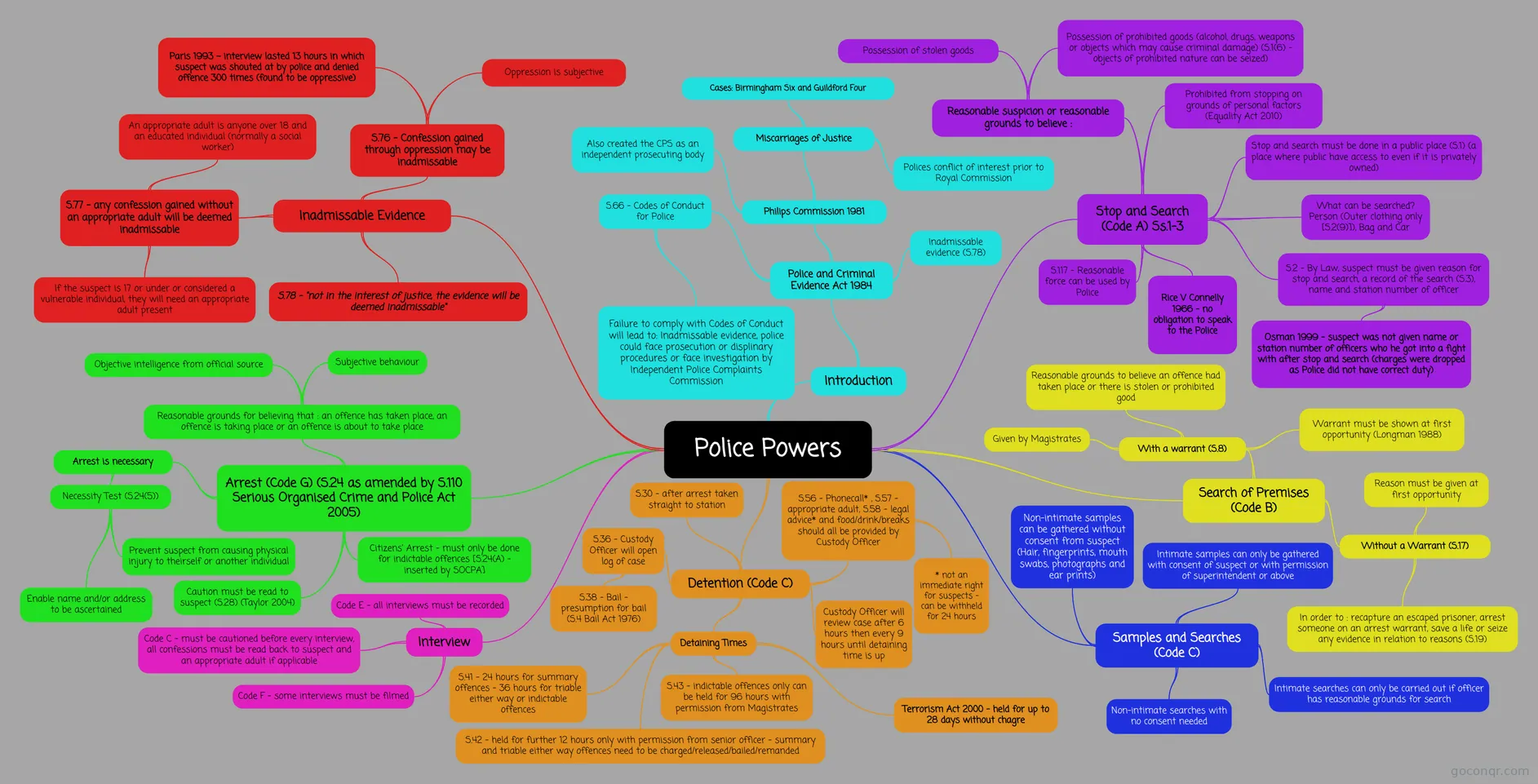
Mind map: Police powers
Conteúdo do mapa
Police Powers
Inadmissable Evidence
- S.76 - Confession gained through oppression may be inadmissable
- Oppression is subjective
- Paris 1993 ~ interview lasted 13 hours in which suspect was shouted at by police and denied offence 300 times (found to be oppressive)
- S.77 - any confession gained without an appropriate adult will be deemed inadmissable
- An appropriate adult is anyone over 18 and an educated individual (normally a social worker)
- If the suspect is 17 or under or considered a vulnerable individual, they will need an appropriate adult present
- S.78 - "not in the interest of justice, the evidence will be deemed inadmissable"
- S.76 - Confession gained through oppression may be inadmissable
Introduction
- Police and Criminal Evidence Act 1984
- S.66 - Codes of Conduct for Police
- Failure to comply with Codes of Conduct will lead to: Inadmissable evidence, police could face prosecution or displinary procedures or face investigation by Independent Police Complaints Commission
- Philips Commission 1981
- Also created the CPS as an independent prosecuting body
- Miscarriages of Justice
- Polices conflict of interest prior to Royal Commission
- Cases: Birmingham Six and Guildford Four
- Inadmissable evidence (S.78)
- S.66 - Codes of Conduct for Police
- Police and Criminal Evidence Act 1984
Stop and Search (Code A) Ss.1-3
- Reasonable suspicion or reasonable grounds to believe :
- Possession of stolen goods
- Possession of prohibited goods (alcohol, drugs, weapons or objects which may cause criminal damage) (S.1(6) - objects of prohibited nature can be seized)
- Prohibited from stopping on grounds of personal factors (Equality Act 2010)
- Stop and search must be done in a public place (S.1) (a place where public have access to even if it is privately owned)
- What can be searched? Person (Outer clothing only [S.2(9)]), Bag and Car
- S.2 - By Law, suspect must be given reason for stop and search, a record of the search (S.3), name and station number of officer
- Osman 1999 - suspect was not given name or station number of officers who he got into a fight with after stop and search (charges were dropped as Police did not have correct duty)
- S.117 - Reasonable force can be used by Police
- Rice V Connelly 1966 - no obligation to speak to the Police
- Reasonable suspicion or reasonable grounds to believe :
Search of Premises (Code B)
- With a warrant (S.8)
- Given by Magistrates
- Reasonable grounds to believe an offence had taken place or there is stolen or prohibited good
- Warrant must be shown at first opportunity (Longman 1988)
- Without a Warrant (S.17)
- Reason must be given at first opportunity
- In order to : recapture an escaped prisoner, arrest someone on an arrest warrant, save a life or seize any evidence in relation to reasons (S.19)
- With a warrant (S.8)
Arrest (Code G) (S.24 as amended by S.110 Serious Organised Crime and Police Act 2005)
- Reasonable grounds for believing that : an offence has taken place, an offence is taking place or an offence is about to take place
- Objective intelligence from official source
- Subjective behaviour
- Arrest is necessary
- Necessity Test (S.24(5))
- Enable name and/or address to be ascertained
- Prevent suspect from causing physical injury to theirself or another individual
- Necessity Test (S.24(5))
- Caution must be read to suspect (S.28) (Taylor 2004)
- Citizens' Arrest - must only be done for indictable offences [S.24(A) - inserted by SOCPA]
- Reasonable grounds for believing that : an offence has taken place, an offence is taking place or an offence is about to take place
Detention (Code C)
- S.30 - after arrest taken straight to station
- S.36 - Custody Officer will open log of case
- S.38 - Bail - presumption for bail (S.4 Bail Act 1976)
- S.56 - Phonecall* , S.57 - appropriate adult, S.58 - legal advice* and food/drink/breaks should all be provided by Custody Officer
- * not an immediate right for suspects - can be withheld for 24 hours
- Detaining Times
- S.41 - 24 hours for summary offences - 36 hours for triable either way or indictable offences
- S.42 - held for further 12 hours only with permission from senior officer - summary and triable either way offences need to be charged/released/bailed/remanded
- S.43 - indictable offences only can be held for 96 hours with permission from Magistrates
- Terrorism Act 2000 - held for up to 28 days without chagre
- Custody Officer will review case after 6 hours then every 9 hours until detaining time is up
Interview
- Code C - must be cautioned before every interview, all confessions must be read back to suspect and an appropriate adult if applicable
- Code E - all interviews must be recorded
- Code F - some interviews must be filmed
Samples and Searches (Code C)
- Non-intimate samples can be gathered without consent from suspect (Hair, fingerprints, mouth swabs, photographs and ear prints)
- Intimate samples can only be gathered with consent of suspect or with permission of superintendent or above
- Non-intimate searches with no consent needed
- Intimate searches can only be carried out if officer has reasonable grounds for search
Informações
- Descrição
- Mapa Mental sobre Police Powers, criado por Catherine Fairweather em 15-12-2015.
- Criado por
- Catherine Fairweather
- Visualizações
- 194
- Tags
- Avaliação