
Mapa mental
7. Financial Objectives and Constraints
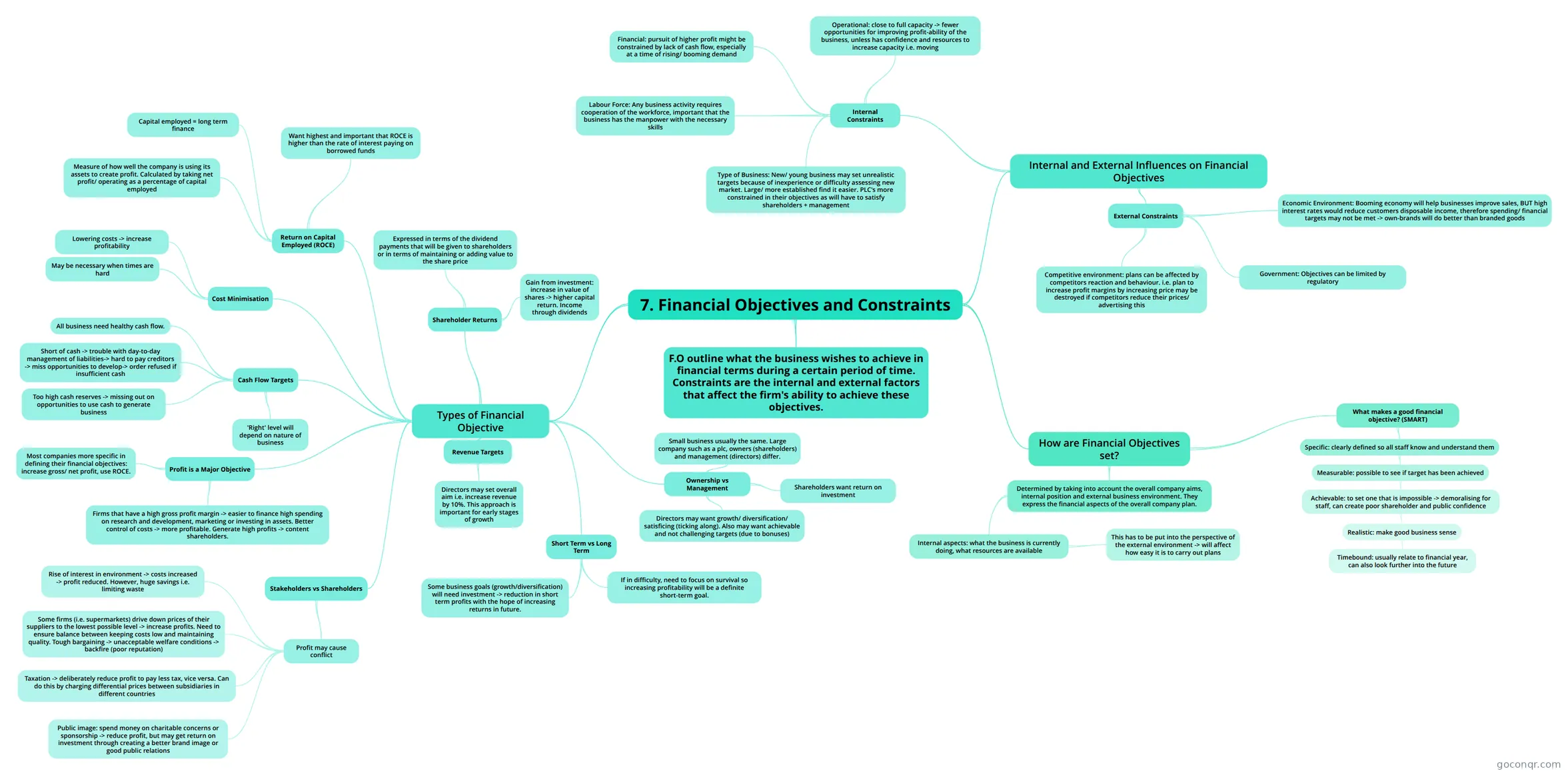
Mind map: Financial objectives and constraints
Conteúdo do mapa
7. Financial Objectives and Constraints
F.O outline what the business wishes to achieve in financial terms during a certain period of time. Constraints are the internal and external factors that affect the firm's ability to achieve these objectives.
Types of Financial Objective
- Ownership vs Management
- Small business usually the same. Large company such as a plc, owners (shareholders) and management (directors) differ.
- Shareholders want return on investment
- Directors may want growth/ diversification/ satisficing (ticking along). Also may want achievable and not challenging targets (due to bonuses)
- Short Term vs Long Term
- Some business goals (growth/diversification) will need investment -> reduction in short term profits with the hope of increasing returns in future.
- If in difficulty, need to focus on survival so increasing profitability will be a definite short-term goal.
- Stakeholders vs Shareholders
- Profit may cause conflict
- Rise of interest in environment -> costs increased -> profit reduced. However, huge savings i.e. limiting waste
- Some firms (i.e. supermarkets) drive down prices of their suppliers to the lowest possible level -> increase profits. Need to ensure balance between keeping costs low and maintaining quality. Tough bargaining -> unacceptable welfare conditions -> backfire (poor reputation)
- Taxation -> deliberately reduce profit to pay less tax, vice versa. Can do this by charging differential prices between subsidiaries in different countries
- Public image: spend money on charitable concerns or sponsorship -> reduce profit, but may get return on investment through creating a better brand image or good public relations
- Profit may cause conflict
- Profit is a Major Objective
- Most companies more specific in defining their financial objectives: increase gross/ net profit, use ROCE.
- Firms that have a high gross profit margin -> easier to finance high spending on research and development, marketing or investing in assets. Better control of costs -> more profitable. Generate high profits -> content shareholders.
- Revenue Targets
- Directors may set overall aim i.e. increase revenue by 10%. This approach is important for early stages of growth
- Cash Flow Targets
- All business need healthy cash flow.
- Short of cash -> trouble with day-to-day management of liabilities-> hard to pay creditors -> miss opportunities to develop-> order refused if insufficient cash
- Too high cash reserves -> missing out on opportunities to use cash to generate business
- 'Right' level will depend on nature of business
- Cost Minimisation
- Lowering costs -> increase profitability
- May be necessary when times are hard
- Return on Capital Employed (ROCE)
- Measure of how well the company is using its assets to create profit. Calculated by taking net profit/ operating as a percentage of capital employed
- Capital employed = long term finance
- Want highest and important that ROCE is higher than the rate of interest paying on borrowed funds
- Shareholder Returns
- Expressed in terms of the dividend payments that will be given to shareholders or in terms of maintaining or adding value to the share price
- Gain from investment: increase in value of shares -> higher capital return. Income through dividends
- Ownership vs Management
How are Financial Objectives set?
- Determined by taking into account the overall company aims, internal position and external business environment. They express the financial aspects of the overall company plan.
- Internal aspects: what the business is currently doing, what resources are available
- This has to be put into the perspective of the external environment -> will affect how easy it is to carry out plans
- Internal aspects: what the business is currently doing, what resources are available
- What makes a good financial objective? (SMART)
- Specific: clearly defined so all staff know and understand them
- Measurable: possible to see if target has been achieved
- Achievable: to set one that is impossible -> demoralising for staff, can create poor shareholder and public confidence
- Realistic: make good business sense
- Timebound: usually relate to financial year, can also look further into the future
- Realistic: make good business sense
- Achievable: to set one that is impossible -> demoralising for staff, can create poor shareholder and public confidence
- Measurable: possible to see if target has been achieved
- Specific: clearly defined so all staff know and understand them
- Determined by taking into account the overall company aims, internal position and external business environment. They express the financial aspects of the overall company plan.
Internal and External Influences on Financial Objectives
- Internal Constraints
- Financial: pursuit of higher profit might be constrained by lack of cash flow, especially at a time of rising/ booming demand
- Labour Force: Any business activity requires cooperation of the workforce, important that the business has the manpower with the necessary skills
- Type of Business: New/ young business may set unrealistic targets because of inexperience or difficulty assessing new market. Large/ more established find it easier. PLC's more constrained in their objectives as will have to satisfy shareholders + management
- Operational: close to full capacity -> fewer opportunities for improving profit-ability of the business, unless has confidence and resources to increase capacity i.e. moving
- External Constraints
- Competitive environment: plans can be affected by competitors reaction and behaviour. i.e. plan to increase profit margins by increasing price may be destroyed if competitors reduce their prices/ advertising this
- Economic Environment: Booming economy will help businesses improve sales, BUT high interest rates would reduce customers disposable income, therefore spending/ financial targets may not be met -> own-brands will do better than branded goods
- Government: Objectives can be limited by regulatory
- Internal Constraints
Informações
- Descrição
- A level Business Studies Mapa Mental sobre 7. Financial Objectives and Constraints, criado por charcrawford em 16-12-2013.
- Criado por
- charcrawford
- Visualizações
- 188
- Tags
- Avaliação