
Mapa mental
ADOLESCENT STUDENTS’ INTERCULTURAL AWARENESS WHEN USING CULTURE-BASED MATERIALS IN THE ENGLISH CLASS
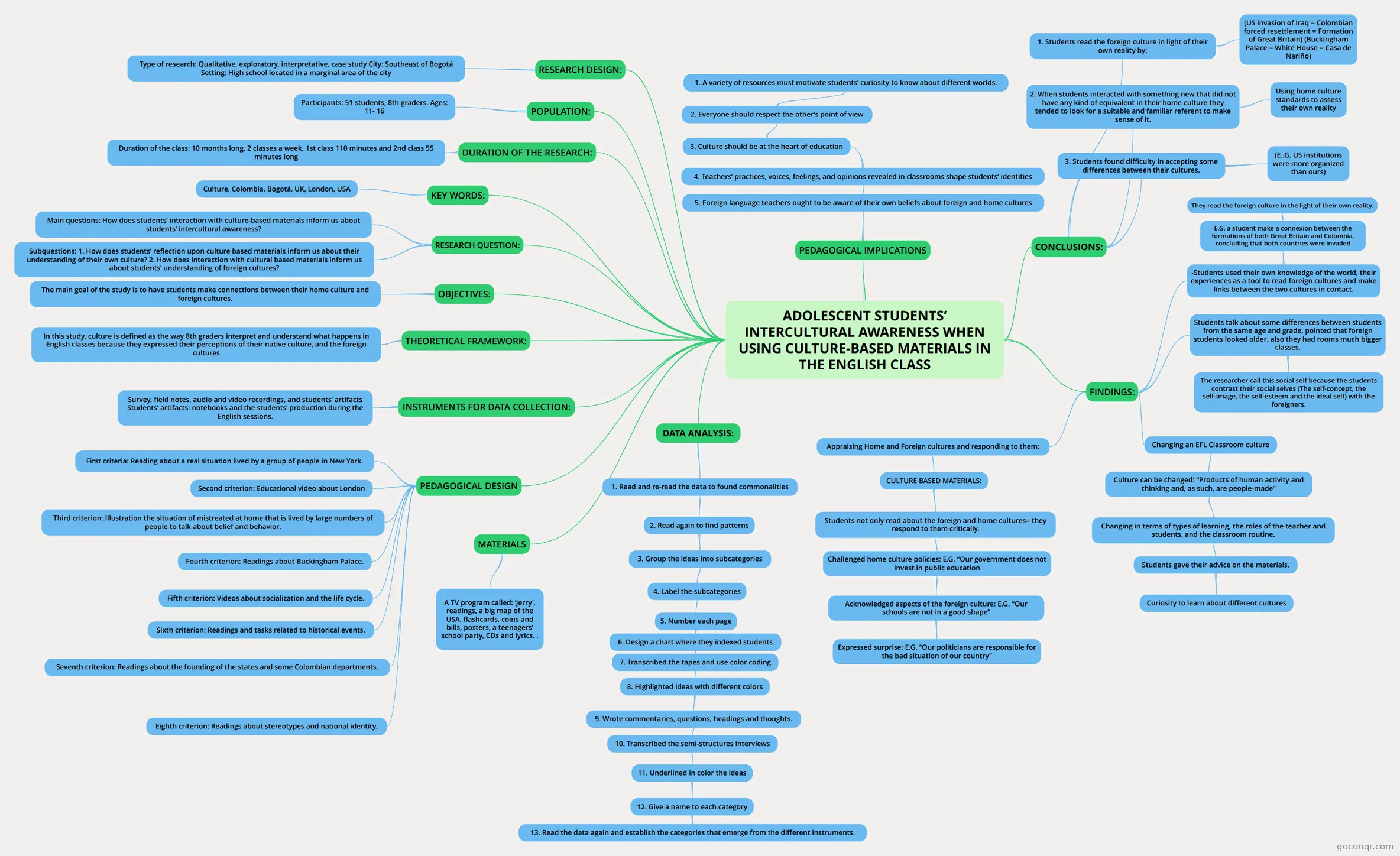
Mind map: adolescent students’ intercultural awareness in the English class
Conteúdo do mapa
ADOLESCENT STUDENTS’ INTERCULTURAL AWARENESS WHEN USING CULTURE-BASED MATERIALS IN THE ENGLISH CLASS
RESEARCH DESIGN:
- Type of research: Qualitative, exploratory, interpretative, case study City: Southeast of Bogotá Setting: High school located in a marginal area of the city
POPULATION:
- Participants: 51 students, 8th graders. Ages: 11- 16
DURATION OF THE RESEARCH:
- Duration of the class: 10 months long, 2 classes a week, 1st class 110 minutes and 2nd class 55 minutes long
KEY WORDS:
- Culture, Colombia, Bogotá, UK, London, USA
RESEARCH QUESTION:
- Main questions: How does students’ interaction with culture-based materials inform us about students’ intercultural awareness?
- Subquestions: 1. How does students’ reflection upon culture based materials inform us about their understanding of their own culture? 2. How does interaction with cultural based materials inform us about students’ understanding of foreign cultures?
OBJECTIVES:
- The main goal of the study is to have students make connections between their home culture and foreign cultures.
THEORETICAL FRAMEWORK:
- In this study, culture is defined as the way 8th graders interpret and understand what happens in English classes because they expressed their perceptions of their native culture, and the foreign cultures
INSTRUMENTS FOR DATA COLLECTION:
- Survey, field notes, audio and video recordings, and students’ artifacts Students’ artifacts: notebooks and the students’ production during the English sessions.
PEDAGOGICAL DESIGN
- First criteria: Reading about a real situation lived by a group of people in New York.
- Second criterion: Educational video about London
- Third criterion: Illustration the situation of mistreated at home that is lived by large numbers of people to talk about belief and behavior.
- Fourth criterion: Readings about Buckingham Palace.
- Fifth criterion: Videos about socialization and the life cycle.
- Sixth criterion: Readings and tasks related to historical events.
- Seventh criterion: Readings about the founding of the states and some Colombian departments.
- Eighth criterion: Readings about stereotypes and national identity.
MATERIALS
- A TV program called: ‘Jerry’, readings, a big map of the USA, flashcards, coins and bills, posters, a teenagers’ school party, CDs and lyrics. .
DATA ANALYSIS:
- 1. Read and re-read the data to found commonalities
- 2. Read again to find patterns
- 3. Group the ideas into subcategories
- 4. Label the subcategories
- 5. Number each page
- 6. Design a chart where they indexed students
- 7. Transcribed the tapes and use color coding
- 8. Highlighted ideas with different colors
- 9. Wrote commentaries, questions, headings and thoughts.
- 10. Transcribed the semi-structures interviews
- 11. Underlined in color the ideas
- 12. Give a name to each category
- 13. Read the data again and establish the categories that emerge from the different instruments.
- 12. Give a name to each category
- 11. Underlined in color the ideas
- 10. Transcribed the semi-structures interviews
- 9. Wrote commentaries, questions, headings and thoughts.
- 8. Highlighted ideas with different colors
- 7. Transcribed the tapes and use color coding
- 6. Design a chart where they indexed students
- 5. Number each page
- 4. Label the subcategories
- 3. Group the ideas into subcategories
- 2. Read again to find patterns
- 1. Read and re-read the data to found commonalities
FINDINGS:
- Appraising Home and Foreign cultures and responding to them:
- CULTURE BASED MATERIALS:
- Students not only read about the foreign and home cultures= they respond to them critically.
- Challenged home culture policies: E.G. “Our government does not invest in public education
- Acknowledged aspects of the foreign culture: E.G. “Our schools are not in a good shape”
- Expressed surprise: E.G. “Our politicians are responsible for the bad situation of our country”
- Acknowledged aspects of the foreign culture: E.G. “Our schools are not in a good shape”
- Challenged home culture policies: E.G. “Our government does not invest in public education
- Students not only read about the foreign and home cultures= they respond to them critically.
- CULTURE BASED MATERIALS:
- Changing an EFL Classroom culture
- Culture can be changed: “Products of human activity and thinking and, as such, are people-made”
- Changing in terms of types of learning, the roles of the teacher and students, and the classroom routine.
- Students gave their advice on the materials.
- Curiosity to learn about different cultures
- Students gave their advice on the materials.
- Changing in terms of types of learning, the roles of the teacher and students, and the classroom routine.
- Culture can be changed: “Products of human activity and thinking and, as such, are people-made”
- -Students used their own knowledge of the world, their experiences as a tool to read foreign cultures and make links between the two cultures in contact.
- E.G. a student make a connexion between the formations of both Great Britain and Colombia, concluding that both countries were invaded
- They read the foreign culture in the light of their own reality.
- E.G. a student make a connexion between the formations of both Great Britain and Colombia, concluding that both countries were invaded
- Students talk about some differences between students from the same age and grade, pointed that foreign students looked older, also they had rooms much bigger classes.
- The researcher call this social self because the students contrast their social selves (The self-concept, the self-image, the self-esteem and the ideal self) with the foreigners.
- Appraising Home and Foreign cultures and responding to them:
CONCLUSIONS:
- 1. Students read the foreign culture in light of their own reality by:
- (US invasion of Iraq = Colombian forced resettlement = Formation of Great Britain) (Buckingham Palace = White House = Casa de Nariño)
- 2. When students interacted with something new that did not have any kind of equivalent in their home culture they tended to look for a suitable and familiar referent to make sense of it.
- Using home culture standards to assess their own reality
- 3. Students found difficulty in accepting some differences between their cultures.
- (E..G. US institutions were more organized than ours)
- 1. Students read the foreign culture in light of their own reality by:
PEDAGOGICAL IMPLICATIONS
- 5. Foreign language teachers ought to be aware of their own beliefs about foreign and home cultures
- 4. Teachers’ practices, voices, feelings, and opinions revealed in classrooms shape students’ identities
- 3. Culture should be at the heart of education
- 2. Everyone should respect the other’s point of view
- 1. A variety of resources must motivate students’ curiosity to know about different worlds.
- 2. Everyone should respect the other’s point of view
- 3. Culture should be at the heart of education
- 4. Teachers’ practices, voices, feelings, and opinions revealed in classrooms shape students’ identities
- 5. Foreign language teachers ought to be aware of their own beliefs about foreign and home cultures
Informações
- Descrição
- Mapa Mental sobre ADOLESCENT STUDENTS’ INTERCULTURAL AWARENESS WHEN USING CULTURE-BASED MATERIALS IN THE ENGLISH CLASS, criado por Jully Ruiz em 15-02-2016.
- Criado por
- Jully Ruiz
- Visualizações
- 34
- Avaliação