
Mapa mental
Mindmap 2- Civil Liberties
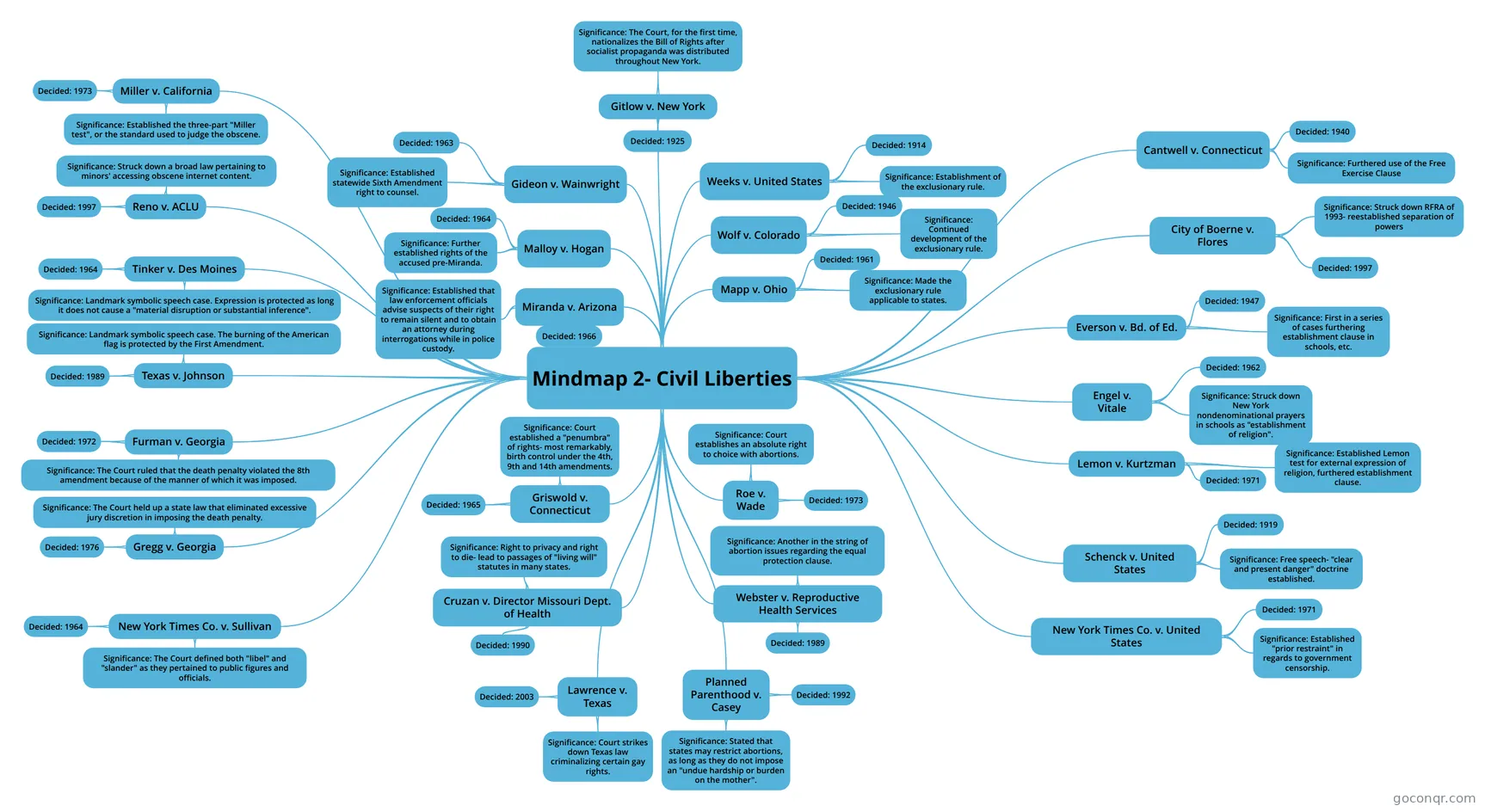
Mind map: Civil liberties Supreme Court cases
Conteúdo do mapa
Mindmap 2- Civil Liberties
Gitlow v. New York
- Decided: 1925
- Significance: The Court, for the first time, nationalizes the Bill of Rights after socialist propaganda was distributed throughout New York.
Weeks v. United States
- Decided: 1914
- Significance: Establishment of the exclusionary rule.
Wolf v. Colorado
- Decided: 1946
- Significance: Continued development of the exclusionary rule.
Mapp v. Ohio
- Decided: 1961
- Significance: Made the exclusionary rule applicable to states.
Gideon v. Wainwright
- Decided: 1963
- Significance: Established statewide Sixth Amendment right to counsel.
Malloy v. Hogan
- Decided: 1964
- Significance: Further established rights of the accused pre-Miranda.
Miranda v. Arizona
- Decided: 1966
- Significance: Established that law enforcement officials advise suspects of their right to remain silent and to obtain an attorney during interrogations while in police custody.
Engel v. Vitale
- Decided: 1962
- Significance: Struck down New York nondenominational prayers in schools as "establishment of religion".
Everson v. Bd. of Ed.
- Decided: 1947
- Significance: First in a series of cases furthering establishment clause in schools, etc.
Lemon v. Kurtzman
- Decided: 1971
- Significance: Established Lemon test for external expression of religion, furthered establishment clause.
City of Boerne v. Flores
- Decided: 1997
- Significance: Struck down RFRA of 1993- reestablished separation of powers
Cantwell v. Connecticut
- Decided: 1940
- Significance: Furthered use of the Free Exercise Clause
Schenck v. United States
- Decided: 1919
- Significance: Free speech- "clear and present danger" doctrine established.
Miller v. California
- Decided: 1973
- Significance: Established the three-part "Miller test", or the standard used to judge the obscene.
Reno v. ACLU
- Decided: 1997
- Significance: Struck down a broad law pertaining to minors' accessing obscene internet content.
Tinker v. Des Moines
- Decided: 1964
- Significance: Landmark symbolic speech case. Expression is protected as long it does not cause a "material disruption or substantial inference".
Texas v. Johnson
- Decided: 1989
- Significance: Landmark symbolic speech case. The burning of the American flag is protected by the First Amendment.
Furman v. Georgia
- Decided: 1972
- Significance: The Court ruled that the death penalty violated the 8th amendment because of the manner of which it was imposed.
Gregg v. Georgia
- Decided: 1976
- Significance: The Court held up a state law that eliminated excessive jury discretion in imposing the death penalty.
New York Times Co. v. Sullivan
- Decided: 1964
- Significance: The Court defined both "libel" and "slander" as they pertained to public figures and officials.
Cruzan v. Director Missouri Dept. of Health
- Decided: 1990
- Significance: Right to privacy and right to die- lead to passages of "living will" statutes in many states.
Planned Parenthood v. Casey
- Decided: 1992
- Significance: Stated that states may restrict abortions, as long as they do not impose an "undue hardship or burden on the mother".
Webster v. Reproductive Health Services
- Decided: 1989
- Significance: Another in the string of abortion issues regarding the equal protection clause.
Griswold v. Connecticut
- Decided: 1965
- Significance: Court established a "penumbra" of rights- most remarkably, birth control under the 4th, 9th and 14th amendments.
Roe v. Wade
- Decided: 1973
- Significance: Court establishes an absolute right to choice with abortions.
Lawrence v. Texas
- Decided: 2003
- Significance: Court strikes down Texas law criminalizing certain gay rights.
New York Times Co. v. United States
- Decided: 1971
- Significance: Established "prior restraint" in regards to government censorship.
Informações
- Descrição
- Note: Due to the sheer volume of civil liberties cases, this mind map will only include the specific facts of a case as they apply to the significance of the case.
- Criado por
- Caroline Finley
- Visualizações
- 136
- Avaliação