
Mapa mental
Intoxication
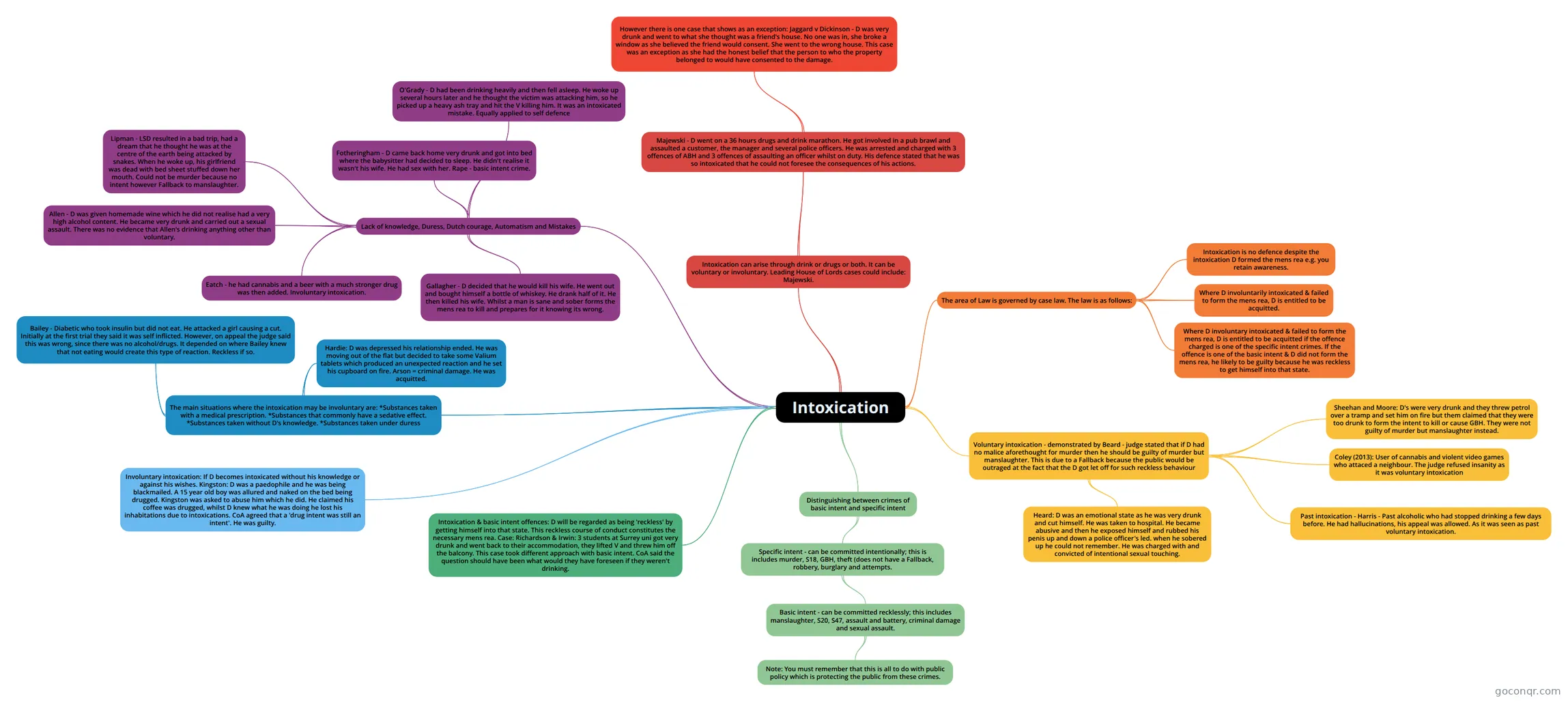
Mind map: Intoxication in criminal law
Conteúdo do mapa
Intoxication
Intoxication can arise through drink or drugs or both. It can be voluntary or involuntary. Leading House of Lords cases could include: Majewski.
- Majewski - D went on a 36 hours drugs and drink marathon. He got involved in a pub brawl and assaulted a customer, the manager and several police officers. He was arrested and charged with 3 offences of ABH and 3 offences of assaulting an officer whilst on duty. His defence stated that he was so intoxicated that he could not foresee the consequences of his actions.
- However there is one case that shows as an exception: Jaggard v Dickinson - D was very drunk and went to what she thought was a friend's house. No one was in, she broke a window as she believed the friend would consent. She went to the wrong house. This case was an exception as she had the honest belief that the person to who the property belonged to would have consented to the damage.
- Majewski - D went on a 36 hours drugs and drink marathon. He got involved in a pub brawl and assaulted a customer, the manager and several police officers. He was arrested and charged with 3 offences of ABH and 3 offences of assaulting an officer whilst on duty. His defence stated that he was so intoxicated that he could not foresee the consequences of his actions.
The area of Law is governed by case law. The law is as follows:
- Intoxication is no defence despite the intoxication D formed the mens rea e.g. you retain awareness.
- Where D involuntarily intoxicated & failed to form the mens rea, D is entitled to be acquitted.
- Where D involuntary intoxicated & failed to form the mens rea, D is entitled to be acquitted if the offence charged is one of the specific intent crimes. If the offence is one of the basic intent & D did not form the mens rea, he likely to be guilty because he was reckless to get himself into that state.
Voluntary intoxication - demonstrated by Beard - judge stated that if D had no malice aforethought for murder then he should be guilty of murder but manslaughter. This is due to a Fallback because the public would be outraged at the fact that the D got let off for such reckless behaviour
- Sheehan and Moore: D's were very drunk and they threw petrol over a tramp and set him on fire but them claimed that they were too drunk to form the intent to kill or cause GBH. They were not guilty of murder but manslaughter instead.
- Coley (2013): User of cannabis and violent video games who attaced a neighbour. The judge refused insanity as it was voluntary intoxication
- Heard: D was an emotional state as he was very drunk and cut himself. He was taken to hospital. He became abusive and then he exposed himself and rubbed his penis up and down a police officer's led. when he sobered up he could not remember. He was charged with and convicted of intentional sexual touching.
- Past intoxication - Harris - Past alcoholic who had stopped drinking a few days before. He had hallucinations, his appeal was allowed. As it was seen as past voluntary intoxication.
Distinguishing between crimes of basic intent and specific intent
- Specific intent - can be committed intentionally; this is includes murder, S18, GBH, theft (does not have a Fallback, robbery, burglary and attempts.
- Basic intent - can be committed recklessly; this includes manslaughter, S20, S47, assault and battery, criminal damage and sexual assault.
- Note: You must remember that this is all to do with public policy which is protecting the public from these crimes.
- Basic intent - can be committed recklessly; this includes manslaughter, S20, S47, assault and battery, criminal damage and sexual assault.
- Specific intent - can be committed intentionally; this is includes murder, S18, GBH, theft (does not have a Fallback, robbery, burglary and attempts.
Intoxication & basic intent offences: D will be regarded as being 'reckless' by getting himself into that state. This reckless course of conduct constitutes the necessary mens rea. Case: Richardson & Irwin: 3 students at Surrey uni got very drunk and went back to their accommodation, they lifted V and threw him off the balcony. This case took different approach with basic intent. CoA said the question should have been what would they have foreseen if they weren't drinking.
Involuntary intoxication: If D becomes intoxicated without his knowledge or against his wishes. Kingston: D was a paedophile and he was being blackmailed. A 15 year old boy was allured and naked on the bed being drugged. Kingston was asked to abuse him which he did. He claimed his coffee was drugged, whilst D knew what he was doing he lost his inhabitations due to intoxications. CoA agreed that a 'drug intent was still an intent'. He was guilty.
The main situations where the intoxication may be involuntary are: *Substances taken with a medical prescription. *Substances that commonly have a sedative effect. *Substances taken without D's knowledge. *Substances taken under duress
- Bailey - Diabetic who took insulin but did not eat. He attacked a girl causing a cut. Initially at the first trial they said it was self inflicted. However, on appeal the judge said this was wrong, since there was no alcohol/drugs. It depended on where Bailey knew that not eating would create this type of reaction. Reckless if so.
- Hardie: D was depressed his relationship ended. He was moving out of the flat but decided to take some Valium tablets which produced an unexpected reaction and he set his cupboard on fire. Arson = criminal damage. He was acquitted.
Lack of knowledge, Duress, Dutch courage, Automatism and Mistakes
- Allen - D was given homemade wine which he did not realise had a very high alcohol content. He became very drunk and carried out a sexual assault. There was no evidence that Allen's drinking anything other than voluntary.
- Eatch - he had cannabis and a beer with a much stronger drug was then added. Involuntary intoxication.
- Gallagher - D decided that he would kill his wife. He went out and bought himself a bottle of whiskey. He drank half of it. He then killed his wife. Whilst a man is sane and sober forms the mens rea to kill and prepares for it knowing its wrong.
- Lipman - LSD resulted in a bad trip, had a dream that he thought he was at the centre of the earth being attacked by snakes. When he woke up, his girlfriend was dead with bed sheet stuffed down her mouth. Could not be murder because no intent however Fallback to manslaughter.
- Fotheringham - D came back home very drunk and got into bed where the babysitter had decided to sleep. He didn't realise it wasn't his wife. He had sex with her. Rape - basic intent crime.
- O'Grady - D had been drinking heavily and then fell asleep. He woke up several hours later and he thought the victim was attacking him, so he picked up a heavy ash tray and hit the V killing him. It was an intoxicated mistake. Equally applied to self defence
Informações
- Descrição
- A2 Law A2 Mapa Mental sobre Intoxication, criado por Charlotte Silvester em 17-04-2016.
- Criado por
- Charlotte Silvester
- Visualizações
- 10
- Avaliação