
Mapa mental
Concept Empiricism
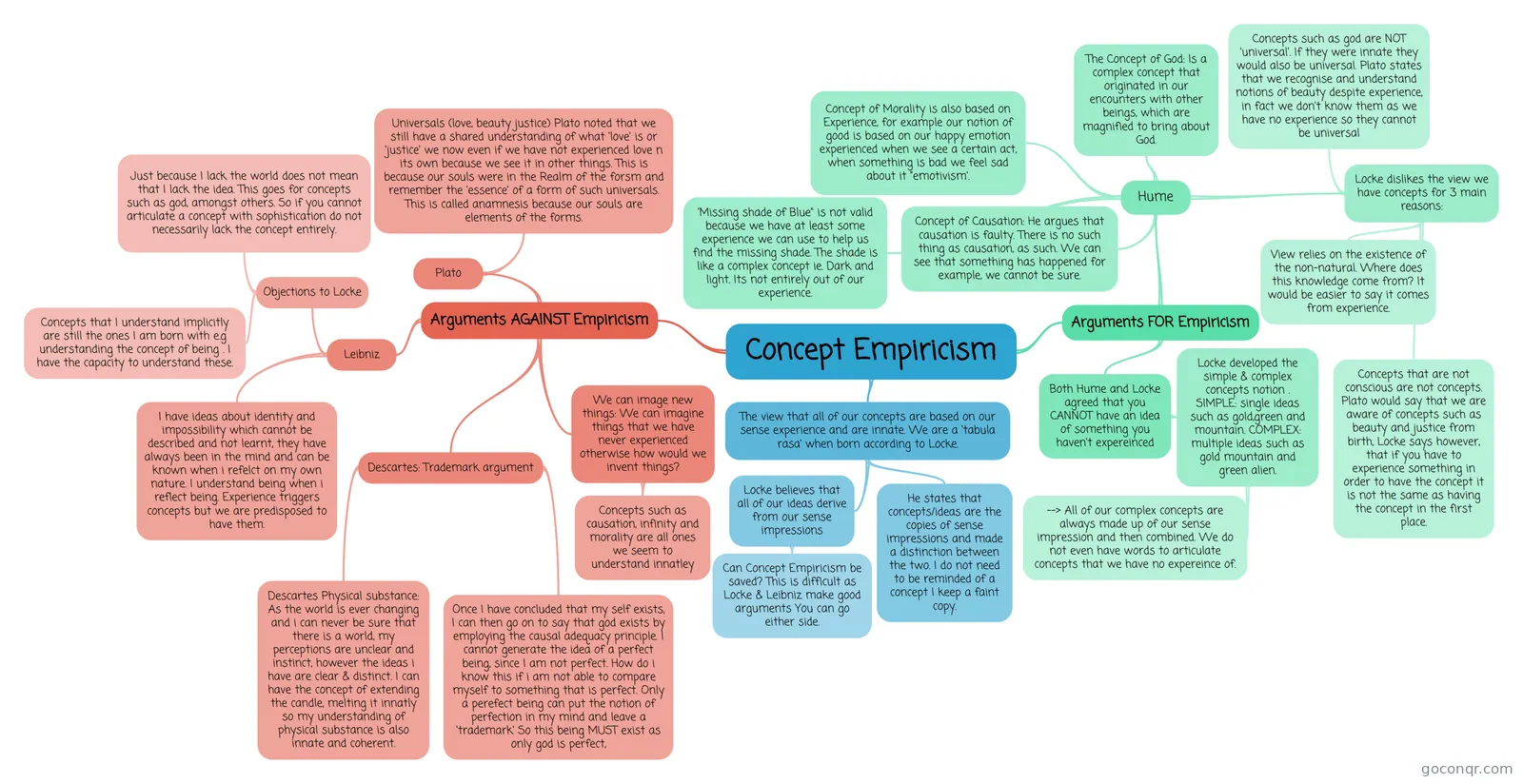
Mind map: Concept empiricism
Conteúdo do mapa
Concept Empiricism
The view that all of our concepts are based on our sense experience and are innate. We are a 'tabula rasa' when born according to Locke.
- Locke believes that all of our ideas derive from our sense impressions
- Can Concept Empiricism be saved? This is difficult as Locke & Leibniz make good arguments You can go either side.
- He states that concepts/ideas are the copies of sense impressions and made a distinction between the two. I do not need to be reminded of a concept I keep a faint copy.
- Locke believes that all of our ideas derive from our sense impressions
Arguments FOR Empiricism
- Both Hume and Locke agreed that you CANNOT have an idea of something you haven't expereinced
- Locke developed the simple & complex concepts notion . SIMPLE: single ideas such as gold,green and mountain. COMPLEX: multiple ideas such as gold mountain and green alien.
- --> All of our complex concepts are always made up of our sense impression and then combined. We do not even have words to articulate concepts that we have no expereince of.
- Locke developed the simple & complex concepts notion . SIMPLE: single ideas such as gold,green and mountain. COMPLEX: multiple ideas such as gold mountain and green alien.
- Hume
- 'Missing shade of Blue" is not valid because we have at least some experience we can use to help us find the missing shade. The shade is like a complex concept ie. Dark and light. Its not entirely out of our experience.
- Concept of Causation: He argues that causation is faulty. There is no such thing as causation, as such. We can see that something has happened for example, we cannot be sure.
- The Concept of God: Is a complex concept that originated in our encounters with other beings, which are magnified to bring about God.
- Concept of Morality is also based on Experience, for example our notion of good is based on our happy emotion experienced when we see a certain act, when something is bad we feel sad about it "emotivism'.
- Locke dislikes the view we have concepts for 3 main reasons:
- View relies on the existence of the non-natural. Where does this knowledge come from? It would be easier to say it comes from experience.
- Concepts that are not conscious are not concepts. Plato would say that we are aware of concepts such as beauty and justice from birth, Locke says however, that if you have to experience something in order to have the concept it is not the same as having the concept in the first place.
- Concepts such as god are NOT 'universal'. If they were innate they would also be universal. Plato states that we recognise and understand notions of beauty despite experience, in fact we don't know them as we have no experience so they cannot be universal
- Both Hume and Locke agreed that you CANNOT have an idea of something you haven't expereinced
Arguments AGAINST Empiricism
- We can image new things: We can imagine things that we have never experienced otherwise how would we invent things?
- Concepts such as causation, infinity and morality are all ones we seem to understand innatley
- Descartes: Trademark argument
- Once I have concluded that my self exists, I can then go on to say that god exists by employing the causal adequacy principle. I cannot generate the idea of a perfect being, since I am not perfect. How do i know this if i am not able to compare myself to something that is perfect. Only a perefect being can put the notion of perfection in my mind and leave a 'trademark' So this being MUST exist as only god is perfect,
- Descartes Physical substance: As the world is ever changing and i can never be sure that there is a world, my perceptions are unclear and instinct, however the ideas i have are clear & distinct. I can have the concept of extending the candle, melting it innatly so my understanding of physical substance is also innate and coherent.
- Leibniz
- I have ideas about identity and impossibility which cannot be described and not learnt, they have always been in the mind and can be known when i refelct on my own nature. I understand being when i reflect being. Experience triggers concepts but we are predisposed to have them.
- Objections to Locke
- Concepts that I understand implicitly are still the ones I am born with e.g understanding the concept of being . I have the capacity to understand these.
- Just because I lack the world does not mean that I lack the idea. This goes for concepts such as god, amongst others. So if you cannot articulate a concept with sophistication do not necessarily lack the concept entirely.
- Plato
- Universals (love, beauty justice) Plato noted that we still have a shared understanding of what 'love' is or 'justice' we now even if we have not experienced love n its own because we see it in other things. This is because our souls were in the Realm of the forsm and remember the 'essence' of a form of such universals. This is called anamnesis because our souls are elements of the forms.
- We can image new things: We can imagine things that we have never experienced otherwise how would we invent things?
Informações
- Descrição
- Mapa Mental sobre Concept Empiricism, criado por megandocherty97 em 27-04-2016.
- Criado por
- megandocherty97
- Visualizações
- 16
- Avaliação