
Mapa mental
Climate Changes & Animals
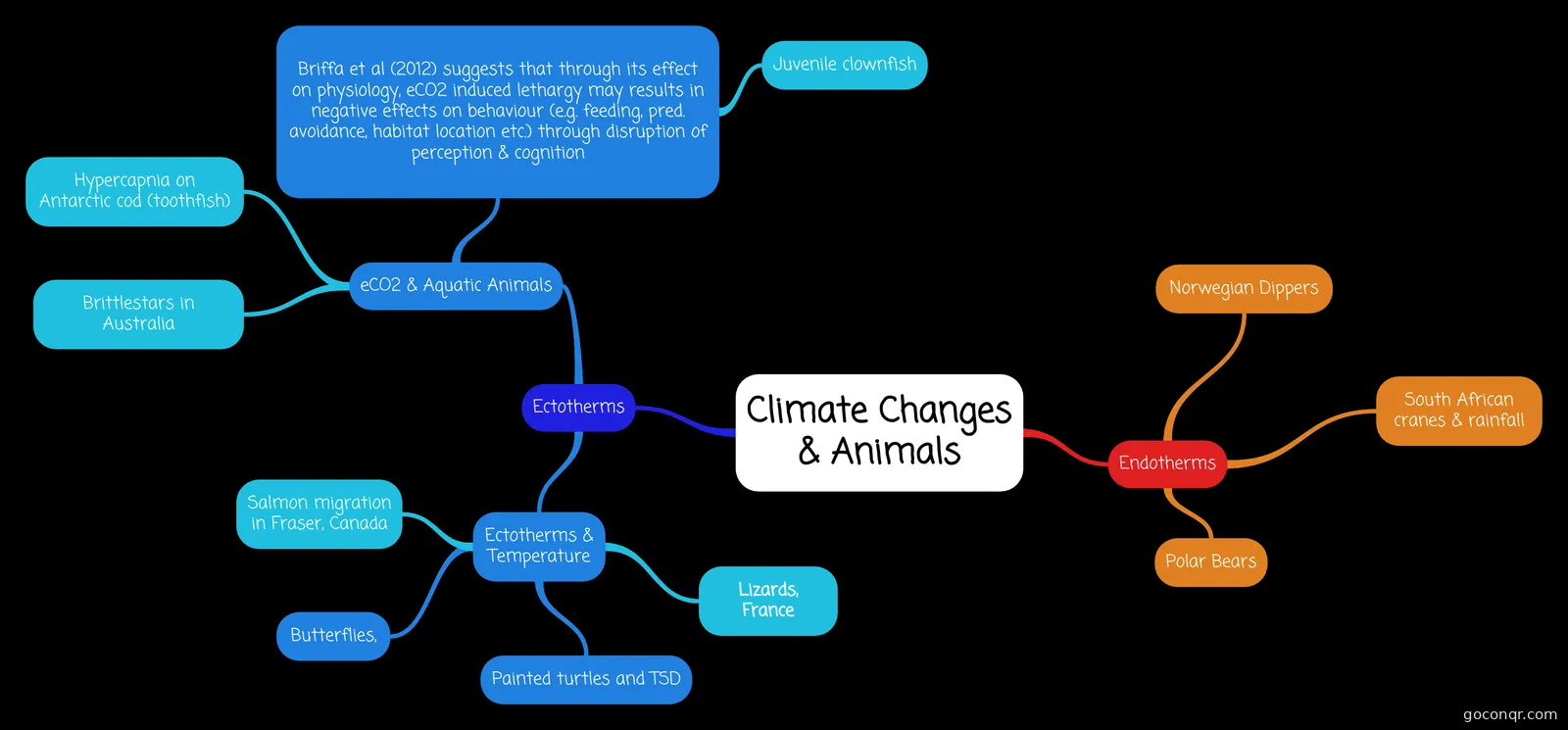
Mind map: Climate changes and animals
Conteúdo do mapa
Climate Changes & Animals
Endotherms
- Endotherms are less likely to be directly impacted by the effects of increased temperatures and CO2 levels, however their physiology may be indirectly impacted by direct impacts on habitat and behaviour.
- South African cranes & rainfall
- Altwegg & Anderson (2009) looked at the effect of rainfall on reproduction & survival of blue cranes in SA. Reproduction was positively associated with early increased rainfall and juvenile survival was positively associated with late season rainfall. The links are probably related to food abundance which is dependent on rainfall timing and quantity. These contrasting effects however, may result in minimal impacts on populations unless rainfall on the whole just decreases.
- Polar Bears
- Polar bears rely on the sea ice to hunt and feed on seals. Consequently, the thinning in sea ice will have a negative impact on bears ability to find food. They are likely to have to travel longer distances to find food. They can cope with long distances if they've fed well but if they haven't then it takes more of their limited energy stores to find the increasingly scarce food but cannot go as long without food due to less energy stored; a vicious circle (Derocher et al 2004). This has been shown to have a detrimental impact on female reproduction success (Molnar et al 2011) where in 1990s 28% of bears aborted pregnancies due to energetic constraints. They then used this data to predict that a 2-month advance in spring ice breakup would result in a 55-100% decrease in reproduction success.
- Norwegian Dippers
- Saether et al (2000) looked at the impacts of increased winter temperatures on Norwegian dippers. Dippers can only forage when ice has melted as they rely on rivers to feed. Therefore, warmer temperatures should favour them as it would increase access to food. Population changes were indeed found to be positively correlated with earlier spring melt (recruitment increased after winter). However, this is reliant on the phenology of the invert food matching the earlier melt and no prey limitation occurring due to increased dipper populations.
Ectotherms
- Climate-linked variation in animal health, growth & reproduction are apparent for invertebrates, fish, amphibians & reptiles
- eCO2 & Aquatic Animals
- eCO2 is unlikely to affect terrestrial organisms to any great extent in regards to their ecophysiology. Aquatic organisms however, may experience deleterious responses to eCO2 (hypercapnia).
- Hypercapnia on Antarctic cod (toothfish)
- (Stroebel et al 2012) Fish acclimated in high CO2 had lower mitochondrial respiration in their livers than individuals kept in low CO2 at both cold and warm temperatures. Reduced mitochondrial respiration could impact energy budgets .
- Brittlestars in Australia
- Christensen et al (2011) They experimentally subjected brittlestars O. schayeri to hypercapnia and low pH. They reported 'narcotic' effects of the above causing lethargy. At lower pH the subjects exhibited a significant increase in O2 uptake associated with copious mucus secretion, a stress response
- Briffa et al (2012) suggests that through its effect on physiology, eCO2 induced lethargy may results in negative effects on behaviour (e.g. feeding, pred. avoidance, habitat location etc.) through disruption of perception & cognition
- Juvenile clownfish
- Munday et al (2009) The pelagic larval phase of clownfish use odour cues to locate settlement sites. Fish raised in experimental conditions in eCO2 selected anemone odours less than fish raised in aCO2. They were also confused by terrestrial plant extracts and became attracted to parental odour. Hypercapnia reduced metabolic performance which directly affected behaviour.
- Juvenile clownfish
- Ectotherms & Temperature
- Salmon migration in Fraser, Canada
- Farrell et al (2008) found that increased temperature is likely to affect aerobic metabolic ability in migrating sockeye Pacific salmon such that it could result in mortality. A 2004 record high temperature saw the death of >100,000 salmon.
- Butterflies,
- Lizards, France
- Chamaille-Jammes et al (2006) found that common lizards actually showed a positive response to an increase in temperature over 18 years. Body size was positively correlated with temperature and subsequently, clutch size (which is strongly related to female body size) also increased, as well as increased adult survival. However, it should be noted that optimal response of morphological and physiological features to temperature is bell-shaped and thus after a certain threshold, we would expect the relationship to become inverse. Additionally, the population survival depends on suitable mountainous humid habitat which may be reduced as a result of continuously increasing temperature.
- Painted turtles and TSD
- Though usually genetic, sex determination in some ectotherms, particularly some reptilian species, is determined by temperature. In many species of turtle, cooler temperatures produce more males and warmer temperatures produce more females (with the opposite relationship in lizards and crocodilians). Janzen (1994) investigated the effect that mean July temperature had on sex ratios in painted turtles in the Mississippi basin. He suggested that even modest temperature increases (<2) would skew sex ratios and an increase of 4degrees would eliminate males. However, Parrott & Logan (2010) investigated the issue in more depth using mathematical modelling, taking into account factors other than just air temperature and found that incubation temperature in nests was highly dependent on materials and soil properties and these can buffer temperatures successfully. Therefore, they argue that unless there are vast increases (in the range of 15) then male development is unlikely to be negatively impacted.
- Salmon migration in Fraser, Canada
Informações
- Descrição
- BSc Degree Conservation Biology (Global Change) Mapa Mental sobre Climate Changes & Animals, criado por Madison Burt em 19-05-2016.
- Criado por
- Madison Burt
- Visualizações
- 0
- Avaliação