
Mapa mental
Climate & Plants
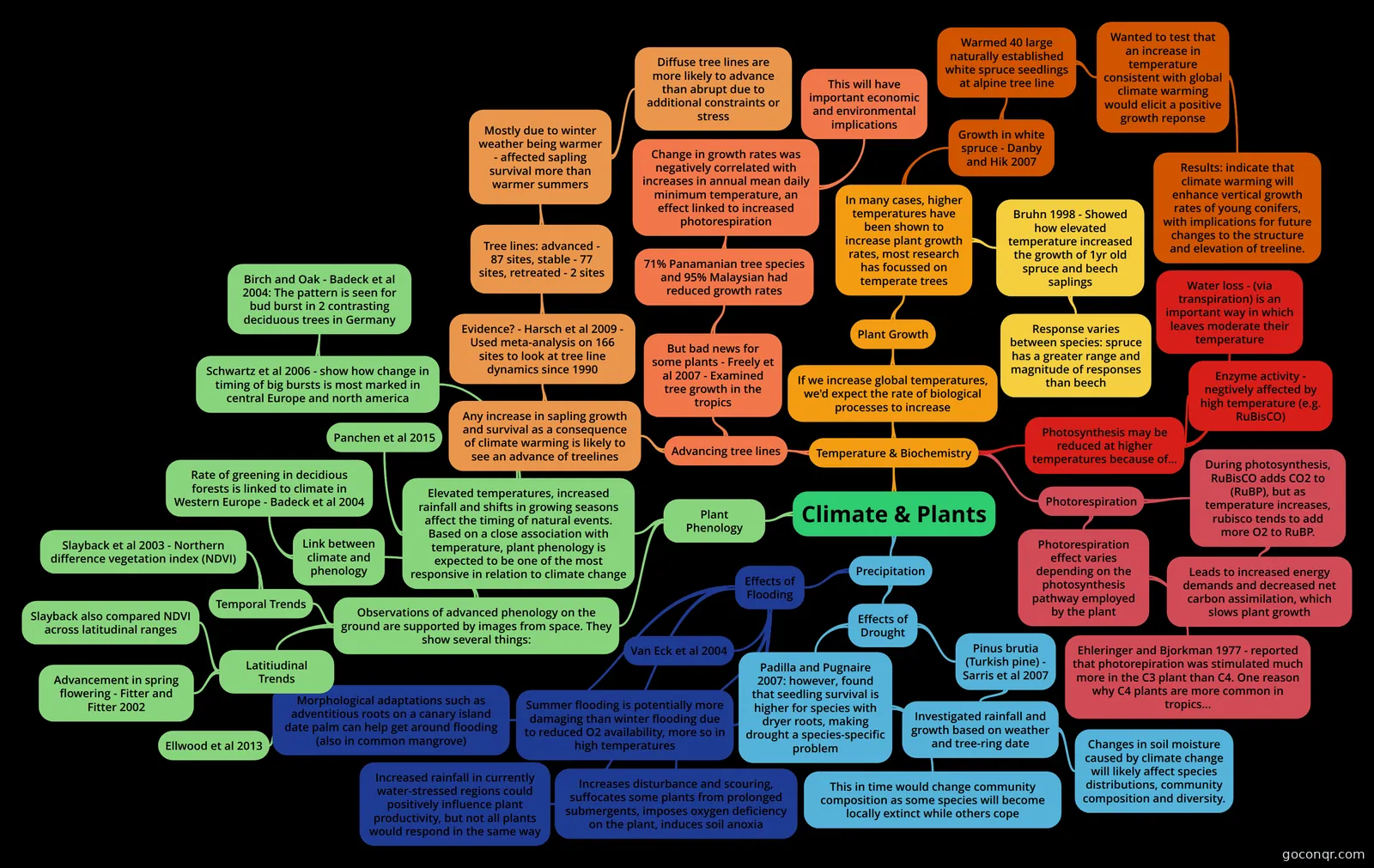
Mind map: Climate and Plants
Conteúdo do mapa
Climate & Plants
Temperature & Biochemistry
- Life depends on biochemical reactions, which are themselves regulated by temperature. Although there is an optimum temperature for most biological reactions; relatively few places on the planet are warm enough for this to be achieved. Therefore if we increase global temperatures, we'd expect the rate of biological processes to increase.
- If we increase global temperatures, we'd expect the rate of biological processes to increase
- Plant Growth
- In many cases, higher temperatures have been shown to increase plant growth rates, most research has focussed on temperate trees
- Growth in white spruce - Danby and Hik 2007
- From 2001-2004, experimentally warmed 40 spruce seedlings Used passive open-top chambers (OTCs) distributed equally between opossing north and south-facing slopes.
- Warmed 40 large naturally established white spruce seedlings at alpine tree line
- Wanted to test that an increase in temperature consistent with global climate warming would elicit a positive growth reponse
- OTCs increased growing season ait temperatures by 1.8°C and annual growing degree-days by one-third. Warmed seedlings grow taller and had higher photosynthetic rates so they grey faster compared to control seedlings. On the South aspect, soil temperatures averaged at 1°C warmer and the snow-free period was nearly 1 month longer. These seedlings grew longer branches and wider annual rings than seedlings on the north aspect.
- Results: indicate that climate warming will enhance vertical growth rates of young conifers, with implications for future changes to the structure and elevation of treeline.
- Wanted to test that an increase in temperature consistent with global climate warming would elicit a positive growth reponse
- Bruhn 1998 - Showed how elevated temperature increased the growth of 1yr old spruce and beech saplings
- Spruce had more to gain by elevated temperature than beech in terms of relative growth rate (RGR). Spruce increased with height, stem diameter and biomass Beech was just height Can conclude that trees do not respond to temperature on a broad genetic basis such as conifers vs. broad leaved trees, but on a more restricted level, such as species or even provenances.
- Response varies between species: spruce has a greater range and magnitude of responses than beech
- Growth in white spruce - Danby and Hik 2007
- In many cases, higher temperatures have been shown to increase plant growth rates, most research has focussed on temperate trees
- Plant Growth
- Advancing tree lines
- Main barrier to forest regeneration is thought to be seedling mortality in exposed, cold conditions. e.g. at high altitudes and latitudes the climate often becomes too cold for trees to survive; at this boundary a tree line occurs.
- Any increase in sapling growth and survival as a consequence of climate warming is likely to see an advance of treelines
- Evidence? - Harsch et al 2009 - Used meta-analysis on 166 sites to look at tree line dynamics since 1990
- Tree lines: advanced - 87 sites, stable - 77 sites, retreated - 2 sites
- Mostly due to winter weather being warmer - affected sapling survival more than warmer summers
- Diffuse tree lines are more likely to advance than abrupt due to additional constraints or stress
- Mostly due to winter weather being warmer - affected sapling survival more than warmer summers
- Tree lines: advanced - 87 sites, stable - 77 sites, retreated - 2 sites
- Evidence? - Harsch et al 2009 - Used meta-analysis on 166 sites to look at tree line dynamics since 1990
- But bad news for some plants - Freely et al 2007 - Examined tree growth in the tropics
- 71% Panamanian tree species and 95% Malaysian had reduced growth rates
- Change in growth rates was negatively correlated with increases in annual mean daily minimum temperature, an effect linked to increased photorespiration
- This will have important economic and environmental implications
- Change in growth rates was negatively correlated with increases in annual mean daily minimum temperature, an effect linked to increased photorespiration
- 71% Panamanian tree species and 95% Malaysian had reduced growth rates
- Photosynthesis may be reduced at higher temperatures because of...
- Enzyme activity - negtively affected by high temperature (e.g. RuBisCO)
- Water loss - (via transpiration) is an important way in which leaves moderate their temperature
- If stomata are open to cool the leaf, excessive water loss may reduce photosynthesis. C4 plants have inheritantly low stomatal conduction (adapted for hot, dry conditions)
- Photorespiration
- During photosynthesis, RuBisCO adds CO2 to (RuBP), but as temperature increases, rubisco tends to add more O2 to RuBP.
- Leads to increased energy demands and decreased net carbon assimilation, which slows plant growth
- Photorespiration effect varies depending on the photosynthesis pathway employed by the plant
- C3 plants evolved when atmospheric CO2 was higher and photrespiration less of a problem C4 plants are more recent and have evolved ways of reducing photorespiration
- Ehleringer and Bjorkman 1977 - reported that photorepiration was stimulated much more in the C3 plant than C4. One reason why C4 plants are more common in tropics...
- During photosynthesis, RuBisCO adds CO2 to (RuBP), but as temperature increases, rubisco tends to add more O2 to RuBP.
Precipitation
- Effects of Drought
- Pinus brutia (Turkish pine) - Sarris et al 2007
- Rainfall declined rapidly after the late 1970s. Following trends of the entire Mediterranean and was associated with reduced tree-ring width. The most recent decline led to the lowest annual radial stem increment after the last 100 years.
- Investigated rainfall and growth based on weather and tree-ring date
- Changes in soil moisture caused by climate change will likely affect species distributions, community composition and diversity.
- Unless seedlings in Mediterranean climate regimes reach water quickly, they surccumb to summer drought.
- Changes in soil moisture caused by climate change will likely affect species distributions, community composition and diversity.
- Padilla and Pugnaire 2007: however, found that seedling survival is higher for species with dryer roots, making drought a species-specific problem
- This in time would change community composition as some species will become locally extinct while others cope
- Pinus brutia (Turkish pine) - Sarris et al 2007
- Effects of Flooding
- Increases disturbance and scouring, suffocates some plants from prolonged submergents, imposes oxygen deficiency on the plant, induces soil anoxia
- Soil Anoxia - limits nutrient availability and increases soil toxinity due to reducing conditions.
- Increased rainfall in currently water-stressed regions could positively influence plant productivity, but not all plants would respond in the same way
- Summer flooding is potentially more damaging than winter flooding due to reduced O2 availability, more so in high temperatures
- Morphological adaptations such as adventitious roots on a canary island date palm can help get around flooding (also in common mangrove)
- Van Eck et al 2004
- showed that flooding during the growing season is an important determination of species distribution along river floodplains and that those plants able to survive severe flooding do so through a variety of physiological mechanisms. Distrbutions are dictated by flooding scenarios
- Increases disturbance and scouring, suffocates some plants from prolonged submergents, imposes oxygen deficiency on the plant, induces soil anoxia
- Effects of Drought
Plant Phenology
- Elevated temperatures, increased rainfall and shifts in growing seasons affect the timing of natural events. Based on a close association with temperature, plant phenology is expected to be one of the most responsive in relation to climate change
- Panchen et al 2015
- Results suggest that in contrast to the broader temperature effects that determine left out times, leaf senescence times are probably determined by a larger or different suit of local environmental effects, including temperature, soil moisture, frost and wind. Advanced bud bursts (leaf emergence) is seen across the Northern hemisphere, but there are important differences
- Schwartz et al 2006 - show how change in timing of big bursts is most marked in central Europe and north america
- There are weaker, but still significant trends for East Asia and Eastern Europe Central Asia shows no noticeable trend. The acceleration in CO2 emission during the latter part of the 20thC has been linked with a clear trend of rapid advancement in spring phenologies since 1985.
- Birch and Oak - Badeck et al 2004: The pattern is seen for bud burst in 2 contrasting deciduous trees in Germany
- 1950-1984 - slight advance in birch but not in oak 1984-1999 - strong advance for both species
- Panchen et al 2015
- Observations of advanced phenology on the ground are supported by images from space. They show several things:
- Link between climate and phenology
- Rate of greening in decidious forests is linked to climate in Western Europe - Badeck et al 2004
- Satellite data from 1992 illustrated how the rate of greening in deciduous forests is linked to climate in Western Europe. The growing season starts earlier in oceanic portugal, but later in cold continental poland. Later emergence at altitude is also clear. This confirms ground observations that emergence is temperature driven
- Rate of greening in decidious forests is linked to climate in Western Europe - Badeck et al 2004
- Temporal Trends
- Slayback et al 2003 - Northern difference vegetation index (NDVI)
- Recent rapid increases in temperature are mirrored in advanced greening. Looked at NDVI in northern hemisphere and showed that the rate of change in NDVI was greater in 1990s than in 80s. This confirms ground observations that the rate of change has increased.
- Slayback et al 2003 - Northern difference vegetation index (NDVI)
- Latitiudinal Trends
- Slayback also compared NDVI across latitudinal ranges
- Significant trends between NDVI and year weaken and disappear at latitude decreases. spring is getting even earlier in high latitudes of the Northern hemisphere where observed phenological changes are greatest/
- Advancement in spring flowering - Fitter and Fitter 2002
- describe how average first flowering of 385 British plant species advanced by 4.5 days during the 1990’s compared with the previous four decades. The effect was most marked for insect-pollinated, spring species that responded most to temperatures experienced during the previous month
- Ellwood et al 2013
- More recently, used historical records back to 1850s to show that the record springs of 2010 and 2012 resulted in the earliest flowering on record for a number of species. This observation is important because it suggests that there is a physiological constraint on earlier flowering has yet to be achieved
- Slayback also compared NDVI across latitudinal ranges
- Link between climate and phenology
- Elevated temperatures, increased rainfall and shifts in growing seasons affect the timing of natural events. Based on a close association with temperature, plant phenology is expected to be one of the most responsive in relation to climate change
Informações
- Descrição
- Undergraduate Global Change Biology Mapa Mental sobre Climate & Plants, criado por samanthaamcneil em 23-05-2016.
- Criado por
- samanthaamcneil
- Visualizações
- 0
- Avaliação
Mais sobre Human Impacts on Ecosystems