
Mapa mental
Neurons (1)
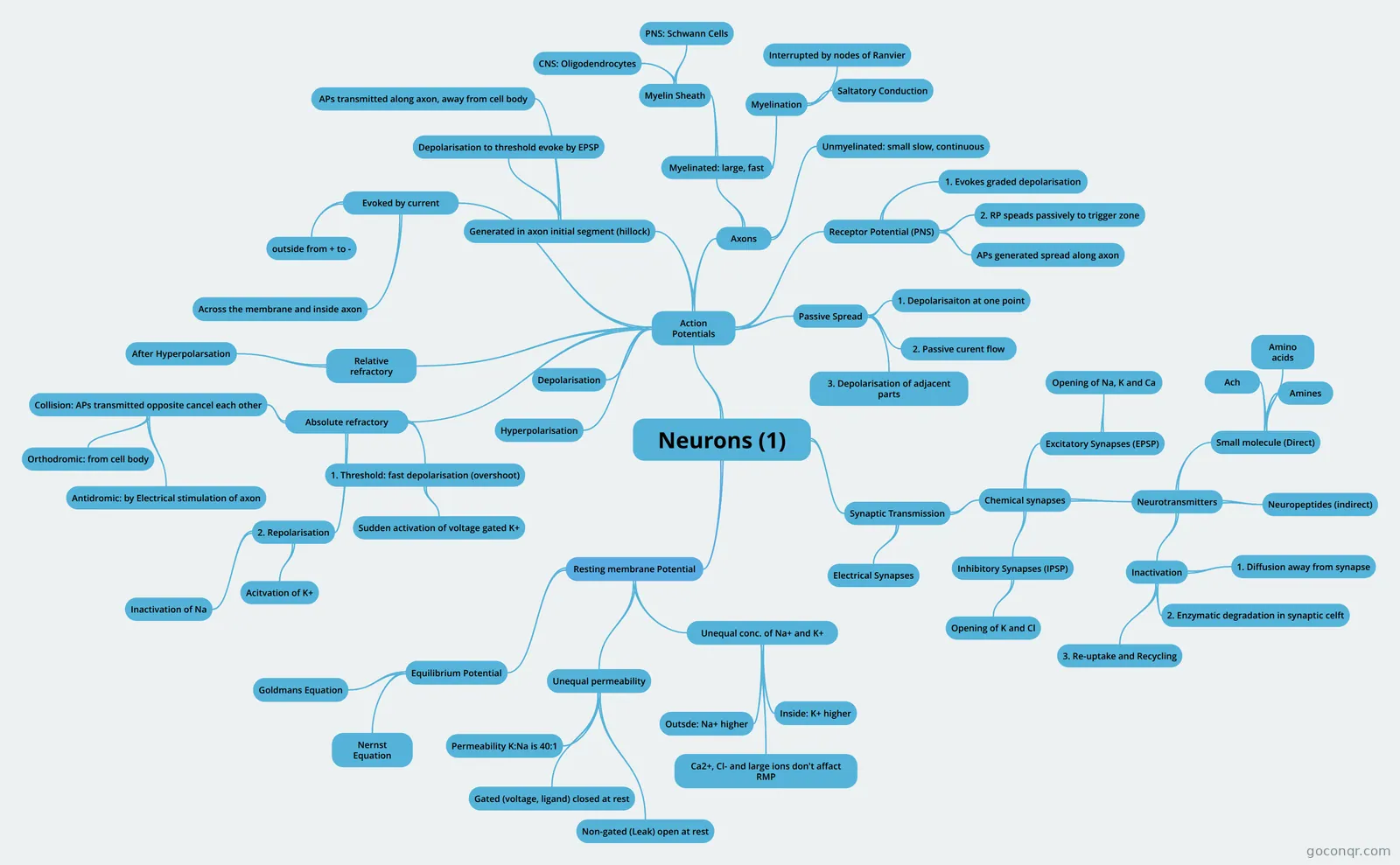
Mind map: Neurons, Resting Membrane Potential, Action Potentials, Synaptic Transmission
Conteúdo do mapa
Neurons (1)
Resting membrane Potential
- Electrical potential difference across the cell membrane which results from separation of charge
- There is more negative charges inside the cell in comparision to the extracellular fluid
- Unequal conc. of Na+ and K+
- Outsde: Na+ higher
- Inside: K+ higher
- Ca2+, Cl- and large ions don't affact RMP
- Unequal permeability
- Non-gated (Leak) open at rest
- Gated (voltage, ligand) closed at rest
- Permeability K:Na is 40:1
- Equilibrium Potential
- An intracellular potential at which the net flow of ions is zero, inspite of a concentration gradient and permeabiltiy.
- The higher the permeability of the cell membrane to a particular ion, the greater the ability of this ion to shift to RMP towards its equilibrium potential
- At rest the RMP is closer to the equilibrium potential for K+
- Nernst Equation
- When cell membrane is permeable to only one ion
- Goldmans Equation
- Takes account of both concentration gradient and relative permeability
Action Potentials
- Hyperpolarisation
- Potential inside neurons becomes more negative, move closer to K+
- Depolarisation
- Potential inside neurons becomes less negative, move closer to Na+
- Absolute refractory
- 1. MP reaches threshold: fast depolarisation (overshoot) 2. Repolarisation
- 1. Threshold: fast depolarisation (overshoot)
- Sudden activation of voltage gated K+
- 2. Repolarisation
- Inactivation of Na
- Acitvation of K+
- Collision: APs transmitted opposite cancel each other
- Orthodromic: from cell body
- Antidromic: by Electrical stimulation of axon
- Relative refractory
- 3. After Hyperpolarisation
- After Hyperpolarsation
- Evoked by current
- RULE #2: When the current generated by an outside source flows through the cell membrane from outside to inside= hyperpolarisation. And when current flows from inside to outside= depolarisation.
- outside from + to -
- Across the membrane and inside axon
- Generated in axon initial segment (hillock)
- Depolarisation to threshold evoke by EPSP
- APs transmitted along axon, away from cell body
- Axons
- Myelinated: large, fast
- Myelin Sheath
- CNS: Oligodendrocytes
- PNS: Schwann Cells
- Myelination
- Increases passive spread of current due to the insulating properties of myelin, there is less current dissipation as it flows along the axon.
- Interrupted by nodes of Ranvier
- Saltatory Conduction
- Myelin Sheath
- Unmyelinated: small slow, continuous
- AP must be regenerated at every point on the membrane. This takes time and therefore conduction velocity is slow.
- Myelinated: large, fast
- Passive Spread
- 1. Depolarisaiton at one point
- 2. Passive curent flow
- 3. Depolarisation of adjacent parts
- Receptor Potential (PNS)
- Information about the strength of the stimulus is coded in the amplitude of the receptor potential and the frequency of APs
- 1. Evokes graded depolarisation
- 2. RP speads passively to trigger zone
- APs generated spread along axon
- Hyperpolarisation
Synaptic Transmission
- Messages are transmitted from one excitable cell to another
- Chemical synapses
- Excitatory Synapses (EPSP)
- Depolarisation of postsynaptic mebrane
- Opening of Na, K and Ca
- Inhibitory Synapses (IPSP)
- Hyperpolarisation of postsynaptic mebrane
- Opening of K and Cl
- Neurotransmitters
- Small molecule (Direct)
- Ach
- Amino acids
- Amines
- Neuropeptides (indirect)
- Inactivation
- 1. Diffusion away from synapse
- 2. Enzymatic degradation in synaptic celft
- 3. Re-uptake and Recycling
- Small molecule (Direct)
- Excitatory Synapses (EPSP)
- Electrical Synapses
Informações
- Descrição
- First year Biosci107 Mapa Mental sobre Neurons (1), criado por aimee_su em 25-05-2016.
- Criado por
- aimee_su
- Visualizações
- 0
- Avaliação