
Mapa mental
Science and Religion
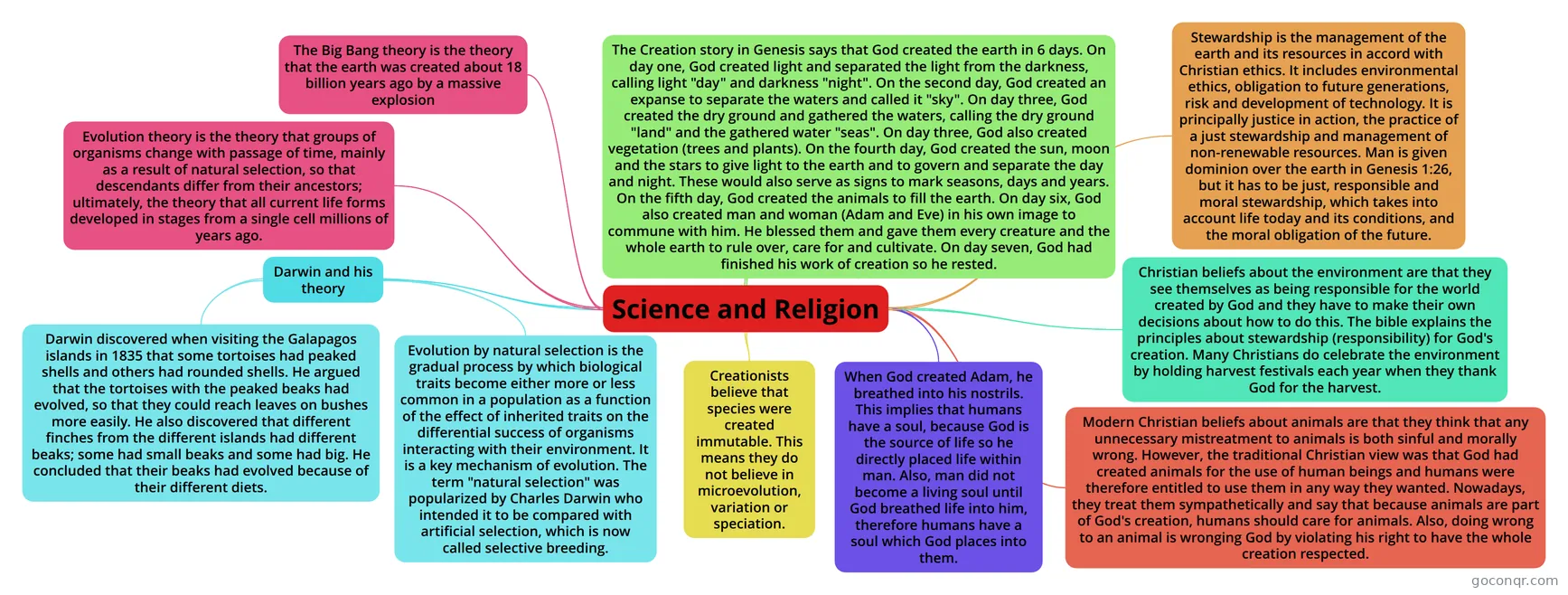
Mind map: Science and Religion
Conteúdo do mapa
Science and Religion
The Big Bang theory is the theory that the earth was created about 18 billion years ago by a massive explosion
Evolution theory is the theory that groups of organisms change with passage of time, mainly as a result of natural selection, so that descendants differ from their ancestors; ultimately, the theory that all current life forms developed in stages from a single cell millions of years ago.
Darwin and his theory
- Darwin discovered when visiting the Galapagos islands in 1835 that some tortoises had peaked shells and others had rounded shells. He argued that the tortoises with the peaked beaks had evolved, so that they could reach leaves on bushes more easily. He also discovered that different finches from the different islands had different beaks; some had small beaks and some had big. He concluded that their beaks had evolved because of their different diets.
- Evolution by natural selection is the gradual process by which biological traits become either more or less common in a population as a function of the effect of inherited traits on the differential success of organisms interacting with their environment. It is a key mechanism of evolution. The term "natural selection" was popularized by Charles Darwin who intended it to be compared with artificial selection, which is now called selective breeding.
Religion
- The Creation story in Genesis says that God created the earth in 6 days. On day one, God created light and separated the light from the darkness, calling light "day" and darkness "night". On the second day, God created an expanse to separate the waters and called it "sky". On day three, God created the dry ground and gathered the waters, calling the dry ground "land" and the gathered water "seas". On day three, God also created vegetation (trees and plants). On the fourth day, God created the sun, moon and the stars to give light to the earth and to govern and separate the day and night. These would also serve as signs to mark seasons, days and years. On the fifth day, God created the animals to fill the earth. On day six, God also created man and woman (Adam and Eve) in his own image to commune with him. He blessed them and gave them every creature and the whole earth to rule over, care for and cultivate. On day seven, God had finished his work of creation so he rested.
Creationists believe that species were created immutable. This means they do not believe in microevolution, variation or speciation.
Stewardship is the management of the earth and its resources in accord with Christian ethics. It includes environmental ethics, obligation to future generations, risk and development of technology. It is principally justice in action, the practice of a just stewardship and management of non-renewable resources. Man is given dominion over the earth in Genesis 1:26, but it has to be just, responsible and moral stewardship, which takes into account life today and its conditions, and the moral obligation of the future.
When God created Adam, he breathed into his nostrils. This implies that humans have a soul, because God is the source of life so he directly placed life within man. Also, man did not become a living soul until God breathed life into him, therefore humans have a soul which God places into them.
Christian beliefs about the environment are that they see themselves as being responsible for the world created by God and they have to make their own decisions about how to do this. The bible explains the principles about stewardship (responsibility) for God's creation. Many Christians do celebrate the environment by holding harvest festivals each year when they thank God for the harvest.
Modern Christian beliefs about animals are that they think that any unnecessary mistreatment to animals is both sinful and morally wrong. However, the traditional Christian view was that God had created animals for the use of human beings and humans were therefore entitled to use them in any way they wanted. Nowadays, they treat them sympathetically and say that because animals are part of God's creation, humans should care for animals. Also, doing wrong to an animal is wronging God by violating his right to have the whole creation respected.
Informações
- Descrição
- Mapa Mental sobre Science and Religion, criado por emma.ingram17 em 24-02-2014.
- Criado por
- emma.ingram17
- Visualizações
- 19
- Avaliação