
Mapa mental
LEPROSY
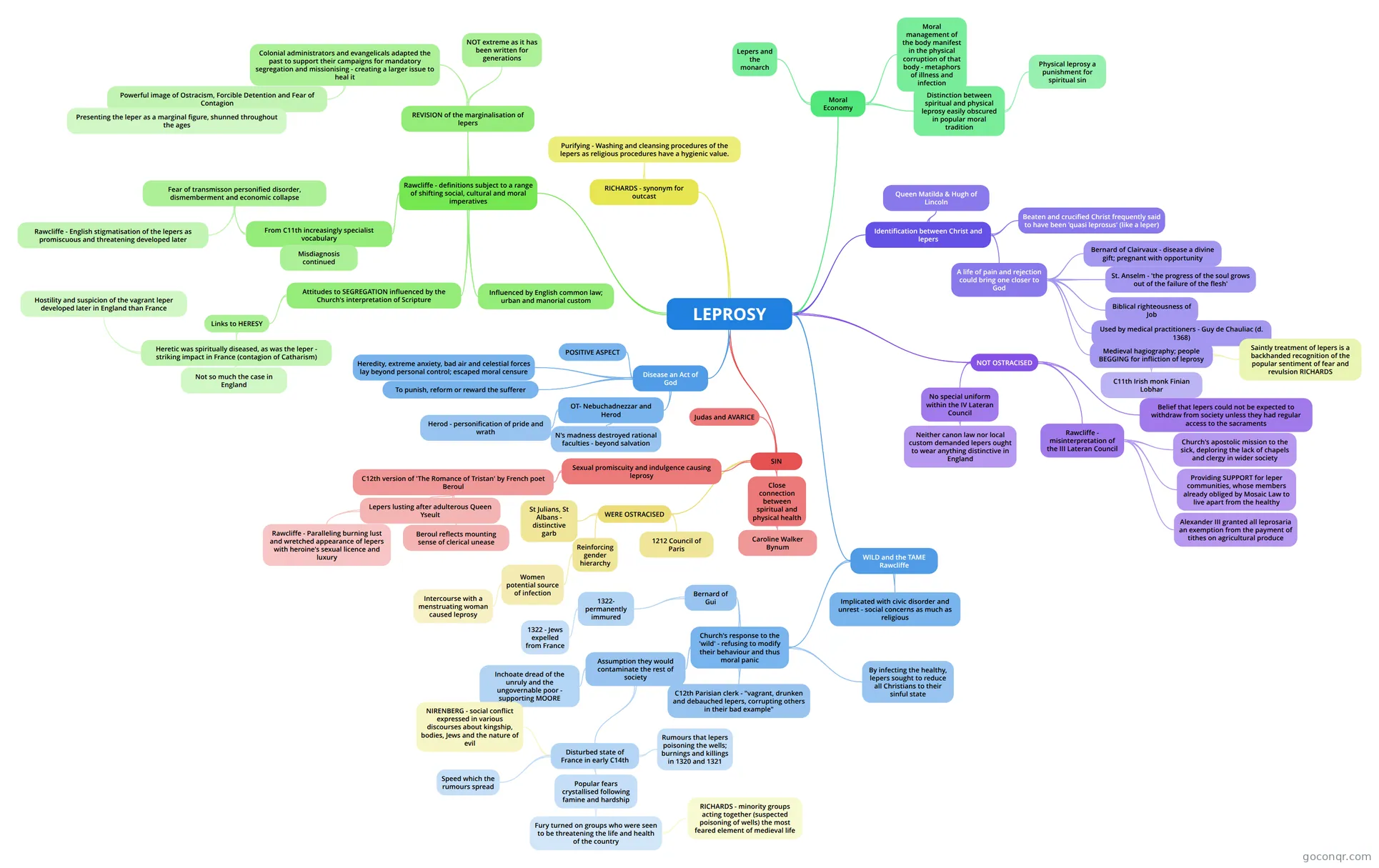
Mind map: Leprosy
Conteúdo do mapa
LEPROSY
Rawcliffe - definitions subject to a range of shifting social, cultural and moral imperatives
- Attitudes to SEGREGATION influenced by the Church's interpretation of Scripture
- Links to HERESY
- Heretic was spiritually diseased, as was the leper - striking impact in France (contagion of Catharism)
- Not so much the case in England
- Nirenberg - local context and the need for specific cases to be emphasised rather than a homogenous outlook towards lepers across w. Europe
- Hostility and suspicion of the vagrant leper developed later in England than France
- Not so much the case in England
- Heretic was spiritually diseased, as was the leper - striking impact in France (contagion of Catharism)
- Links to HERESY
- Influenced by English common law; urban and manorial custom
- From C11th increasingly specialist vocabulary
- More rigorous and systematic approach to the identification of suspects
- Popular dissemination of scientific theories about public health and the environment during the latter Middle Ages
- Cases of physicians reluctant to label every skin disease leprosy, and seek greater categorisation of skin afflictions, and the ambiguity of the disease and its effects
- Misdiagnosis continued
- In towns and villages where fear of pestilence and mistrust of the rootless poor escalated during periods of crisis - supports COHN
- Fear of transmisson personified disorder, dismemberment and economic collapse
- Rawcliffe - English stigmatisation of the lepers as promiscuous and threatening developed later
- Response to growing fears of vagrancy and social unrest from the early C14th onwards - largely URBAN phenomenon
- Rawcliffe - English stigmatisation of the lepers as promiscuous and threatening developed later
- REVISION of the marginalisation of lepers
- Colonial administrators and evangelicals adapted the past to support their campaigns for mandatory segregation and missionising - creating a larger issue to heal it
- Powerful image of Ostracism, Forcible Detention and Fear of Contagion
- Seized the imagination of poets and writers both sides of the Channel - permeating the pages of scholarly and popular studies of Leprosy
- Presenting the leper as a marginal figure, shunned throughout the ages
- Powerful image of Ostracism, Forcible Detention and Fear of Contagion
- NOT extreme as it has been written for generations
- Colonial administrators and evangelicals adapted the past to support their campaigns for mandatory segregation and missionising - creating a larger issue to heal it
- Attitudes to SEGREGATION influenced by the Church's interpretation of Scripture
Disease an Act of God
- To punish, reform or reward the sufferer
- Reward = remitting the pains of purgatory through the patient acceptance of earthly torments
- Heredity, extreme anxiety, bad air and celestial forces lay beyond personal control; escaped moral censure
- OT- Nebuchadnezzar and Herod
- Herod - personification of pride and wrath
- Familiar to medieval audiences both from the stage and the pulpit
- N's madness destroyed rational faculties - beyond salvation
- Herod - personification of pride and wrath
- POSITIVE ASPECT
- English devotional conviction that illness 'pacientlye and gladly' endured would purify the soul and facilitate its journey through purgatory
- Lepers living out purgatory on earth - God's favoured
- To punish, reform or reward the sufferer
SIN
- Sexual promiscuity and indulgence causing leprosy
- THE MANIFESTATION OF SIN
- Lepers as lecherous, and filled with sexual lust - Richards
- C12th version of 'The Romance of Tristan' by French poet Beroul
- Lepers lusting after adulterous Queen Yseult
- "Give us Yseult, so that we can share her in common. No lady ever endured such an end. Sire, we burn with so much lust!"
- Rawcliffe - Paralleling burning lust and wretched appearance of lepers with heroine's sexual licence and luxury
- Her soul is as leprous as the bodies of her potential abductors
- Beroul reflects mounting sense of clerical unease
- Leading clergy in Paris see the bands of lepers and misfits, living outside the norms of society, as a THREAT - social order and power
- Lepers lusting after adulterous Queen Yseult
- Close connection between spiritual and physical health
- Caroline Walker Bynum
- "something profoundly alien to modern sensibilities about the role of the body in medieval piety"
- Body and the soul interwoven in theology and medieval medicine - Aristotelian
- Caroline Walker Bynum
- WERE OSTRACISED
- St Julians, St Albans - distinctive garb
- Sober habit of black and russet, with long sleeves, ankle-length overcoat and hooded cape, would have made them immediately visible long before their deformed features
- Black - colour of sin and darkness, spiritual symbolism of their dress - to be abhorred
- 1212 Council of Paris
- Ruled inmates of leprosaria should assume a habit and follow a rule - visible sign of their 'othering'
- Reinforcing gender hierarchy
- Leprosy and sex had the effect of reinforcing the generally held view of the inferiority and potential immorality of women - RICHARDS
- Women potential source of infection
- Intercourse with a menstruating woman caused leprosy
- St Julians, St Albans - distinctive garb
- Judas and AVARICE
- His death had infected Judea and hence all Jews, and AVARICE was most evident in its manifestation of leprosy - Nirenberg
- Judas reputed to have revaled Jesus' location for a bag of money, and when he hung himself, his excrement polluted Judea
- Sexual promiscuity and indulgence causing leprosy
Identification between Christ and lepers
- Queen Matilda & Hugh of Lincoln
- Prompted a fashion for conspicuous acts of abasement before the most physically repugnant individuals.
- Beaten and crucified Christ frequently said to have been 'quasi leprosus' (like a leper)
- A life of pain and rejection could bring one closer to God
- St. Anselm - 'the progress of the soul grows out of the failure of the flesh'
- Bernard of Clairvaux - disease a divine gift; pregnant with opportunity
- Biblical righteousness of Job
- Medieval depictions teemed with the severity of his disease and the humility of his response to unbearable suffering. 'Cult of Job' flourished
- Used by medical practitioners - Guy de Chauliac (d. 1368)
- Affliction shows election rather than a curse.
- Incautious words about sin might plunge the victim into despair, whereas a message of divine love would help him to 'stand in pees'.
- Medieval hagiography; people BEGGING for infliction of leprosy
- C11th Irish monk Finian Lobhar
- Miraculously cured a blind, mute and leprous child by assuming the disease himself and suffering patiently under the lash of God.
- Saintly treatment of lepers is a backhanded recognition of the popular sentiment of fear and revulsion RICHARDS
- C11th Irish monk Finian Lobhar
- Queen Matilda & Hugh of Lincoln
NOT OSTRACISED
- Belief that lepers could not be expected to withdraw from society unless they had regular access to the sacraments
- Louis VI of France's (d. 1137) instructions to the clergy of Compiegne
- Rawcliffe - misinterpretation of the III Lateran Council
- Providing SUPPORT for leper communities, whose members already obliged by Mosaic Law to live apart from the healthy
- Leprosaria across England and Europe - catering for noble cases (Walsingham), or some with as few as two or three beds in rural areas
- Church's apostolic mission to the sick, deploring the lack of chapels and clergy in wider society
- Alexander III granted all leprosaria an exemption from the payment of tithes on agricultural produce
- Papal endorsement of the relief towards lepers
- Providing SUPPORT for leper communities, whose members already obliged by Mosaic Law to live apart from the healthy
- No special uniform within the IV Lateran Council
- Neither canon law nor local custom demanded lepers ought to wear anything distinctive in England
- Belief that lepers could not be expected to withdraw from society unless they had regular access to the sacraments
WILD and the TAME Rawcliffe
- Common categorisation among ecclesiastical and urban authorities
- Church's response to the 'wild' - refusing to modify their behaviour and thus moral panic
- Assumption they would contaminate the rest of society
- Inchoate dread of the unruly and the ungovernable poor - supporting MOORE
- Disturbed state of France in early C14th
- Speed which the rumours spread
- Popular fears crystallised following famine and hardship
- Fury turned on groups who were seen to be threatening the life and health of the country
- RICHARDS - minority groups acting together (suspected poisoning of wells) the most feared element of medieval life
- Jews and heretics implicated in the rumours
- RICHARDS - minority groups acting together (suspected poisoning of wells) the most feared element of medieval life
- Fury turned on groups who were seen to be threatening the life and health of the country
- Rumours that lepers poisoning the wells; burnings and killings in 1320 and 1321
- NIRENBERG - social conflict expressed in various discourses about kingship, bodies, Jews and the nature of evil
- C12th Parisian clerk - "vagrant, drunken and debauched lepers, corrupting others in their bad example"
- Bernard of Gui
- "unhealthy in body and insane in mind"
- 1322- permanently immured
- were enclosed in places from which they could never come out, but wither away and languish in perpetuity, so that they would not do harm or multiply
- 1322 - Jews expelled from France
- By infecting the healthy, lepers sought to reduce all Christians to their sinful state
- REMOVAL OF THE SIN REQUIRED - Nirenberg
- Assumption they would contaminate the rest of society
- Implicated with civic disorder and unrest - social concerns as much as religious
- Mounting tensions awareness - combating the sexual license of the C12th and the 'rise of the individual'
RICHARDS - synonym for outcast
- Purifying - Washing and cleansing procedures of the lepers as religious procedures have a hygienic value.
Moral Economy
- Lepers and the monarch
- Moral management of the body manifest in the physical corruption of that body - metaphors of illness and infection
- Distinction between spiritual and physical leprosy easily obscured in popular moral tradition
- Physical leprosy a punishment for spiritual sin
Informações
- Descrição
- Constructing the Other Mapa Mental sobre LEPROSY, criado por tompoad em 27-04-2013.
- Criado por
- tompoad
- Visualizações
- 177
- Tags
- Avaliação