
Mapa mental
Differential Equations
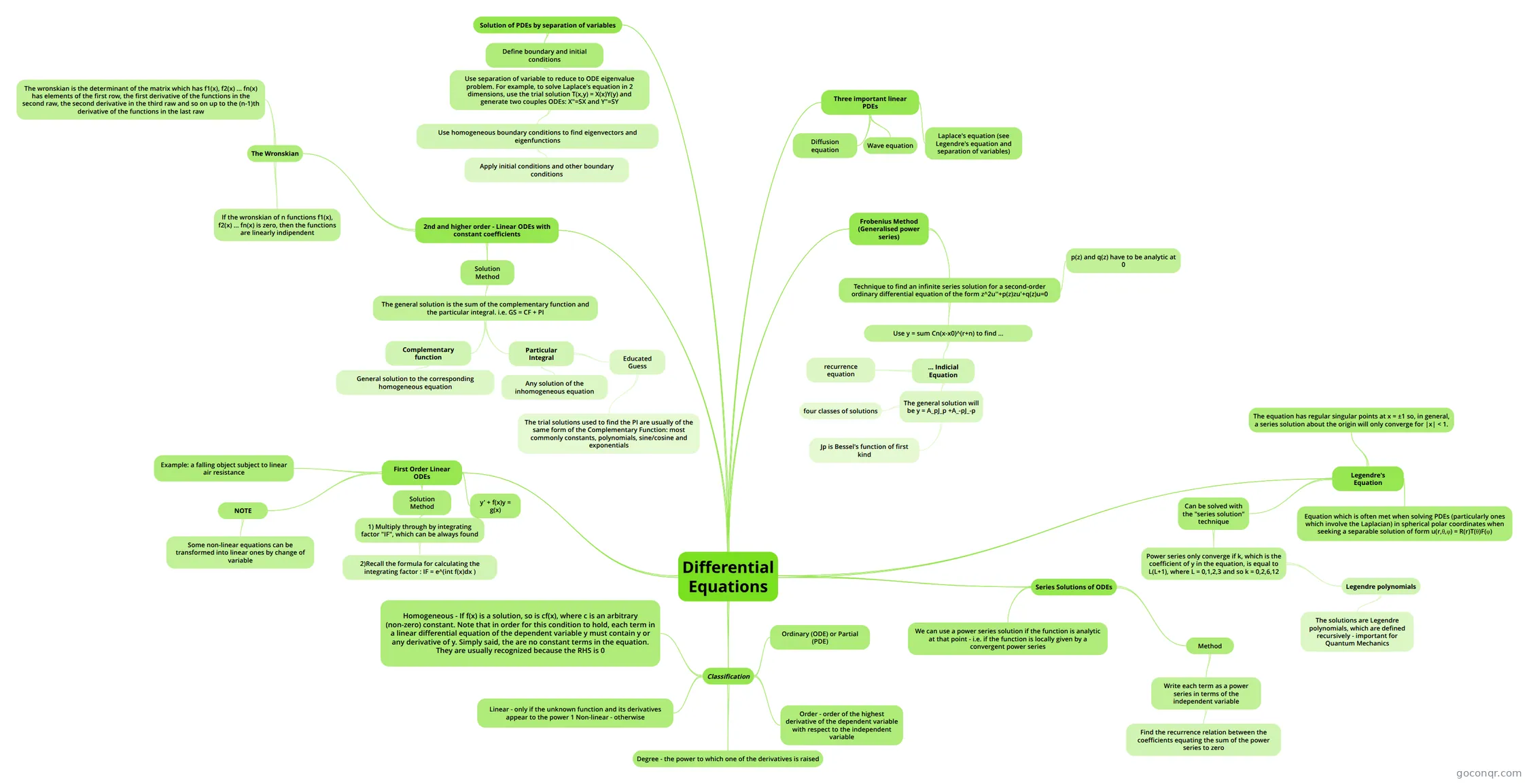
Mind map: differential equations
Conteúdo do mapa
Differential Equations
Classification
- Ordinary (ODE) or Partial (PDE)
- Order - order of the highest derivative of the dependent variable with respect to the independent variable
- Linear - only if the unknown function and its derivatives appear to the power 1 Non-linear - otherwise
- Homogeneous - If f(x) is a solution, so is cf(x), where c is an arbitrary (non-zero) constant. Note that in order for this condition to hold, each term in a linear differential equation of the dependent variable y must contain y or any derivative of y. Simply said, the are no constant terms in the equation. They are usually recognized because the RHS is 0
- Degree - the power to which one of the derivatives is raised
First Order Linear ODEs
- Example: a falling object subject to linear air resistance
- Solution Method
- 1) Multiply through by integrating factor "IF", which can be always found
- 2)Recall the formula for calculating the integrating factor : IF = e^(int f(x)dx )
- 1) Multiply through by integrating factor "IF", which can be always found
- NOTE
- Some non-linear equations can be transformed into linear ones by change of variable
- y' + f(x)y = g(x)
2nd and higher order - Linear ODEs with constant coefficients
- Solution Method
- The general solution is the sum of the complementary function and the particular integral. i.e. GS = CF + PI
- Complementary function
- General solution to the corresponding homogeneous equation
- Particular Integral
- Any solution of the inhomogeneous equation
- Educated Guess
- The trial solutions used to find the PI are usually of the same form of the Complementary Function: most commonly constants, polynomials, sine/cosine and exponentials
- Complementary function
- The general solution is the sum of the complementary function and the particular integral. i.e. GS = CF + PI
- The Wronskian
- If the wronskian of n functions f1(x), f2(x) ... fn(x) is zero, then the functions are linearly indipendent
- The wronskian is the determinant of the matrix which has f1(x), f2(x) ... fn(x) has elements of the first row, the first derivative of the functions in the second raw, the second derivative in the third raw and so on up to the (n-1)th derivative of the functions in the last raw
- Solution Method
Series Solutions of ODEs
- We can use a power series solution if the function is analytic at that point - i.e. if the function is locally given by a convergent power series
- Method
- Write each term as a power series in terms of the independent variable
- Find the recurrence relation between the coefficients equating the sum of the power series to zero
- Write each term as a power series in terms of the independent variable
Legendre's Equation
- Equation which is often met when solving PDEs (particularly ones which involve the Laplacian) in spherical polar coordinates when seeking a separable solution of form u(r,θ,φ) = R(r)T(θ)F(φ)
- Can be solved with the "series solution" technique
- Power series only converge if k, which is the coefficient of y in the equation, is equal to L(L+1), where L = 0,1,2,3 and so k = 0,2,6,12
- Legendre polynomials
- The solutions are Legendre polynomials, which are defined recursively - important for Quantum Mechanics
- Legendre polynomials
- Power series only converge if k, which is the coefficient of y in the equation, is equal to L(L+1), where L = 0,1,2,3 and so k = 0,2,6,12
- The equation has regular singular points at x = ±1 so, in general, a series solution about the origin will only converge for |x| < 1.
Frobenius Method (Generalised power series)
- Technique to find an infinite series solution for a second-order ordinary differential equation of the form z^2u''+p(z)zu'+q(z)u=0
- p(z) and q(z) have to be analytic at 0
- Use y = sum Cn(x-x0)^(r+n) to find ...
- ... Indicial Equation
- recurrence equation
- The general solution will be y = A_pJ_p +A_-pJ_-p
- Jp is Bessel's function of first kind
- four classes of solutions
- ... Indicial Equation
- Technique to find an infinite series solution for a second-order ordinary differential equation of the form z^2u''+p(z)zu'+q(z)u=0
Three important linear PDEs
- Laplace's equation (see Legendre's equation and separation of variables)
- Wave equation
- Diffusion equation
Solution of PDEs by separation of variables
- Define boundary and initial conditions
- Use separation of variable to reduce to ODE eigenvalue problem. For example, to solve Laplace's equation in 2 dimensions, use the trial solution T(x,y) = X(x)Y(y) and generate two couples ODEs: X"=SX and Y"=SY
- Use homogeneous boundary conditions to find eigenvectors and eigenfunctions
- Apply initial conditions and other boundary conditions
- Use homogeneous boundary conditions to find eigenvectors and eigenfunctions
- Use separation of variable to reduce to ODE eigenvalue problem. For example, to solve Laplace's equation in 2 dimensions, use the trial solution T(x,y) = X(x)Y(y) and generate two couples ODEs: X"=SX and Y"=SY
- Define boundary and initial conditions
Informações
- Descrição
- Mapa Mental sobre Differential Equations, criado por lucio_milanese em 22-03-2014.
- Criado por
- lucio_milanese
- Visualizações
- 1.032
- Avaliação