
Mapa mental
Purposeful Writing to Learn
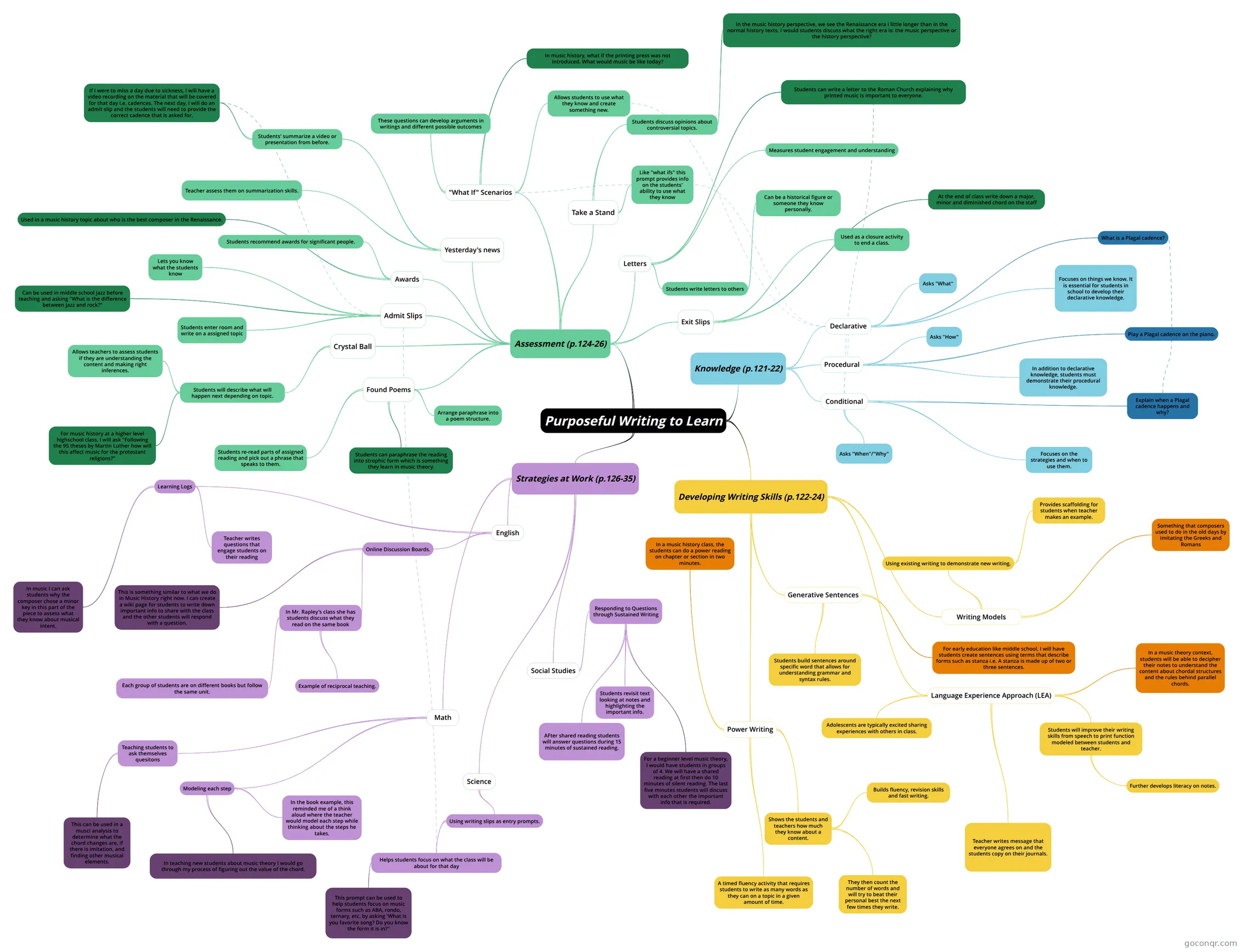
Mind map: Purposeful writing to learn
Conteúdo do mapa
Purposeful Writing to Learn
Developing Writing Skills (p.122-24)
- Language Experience Approach (LEA)
- Adolescents are typically excited sharing experiences with others in class.
- Teacher writes message that everyone agrees on and the students copy on their journals.
- Students will improve their writing skills from speech to print function modeled between students and teacher.
- Further develops literacy on notes.
- In a music theory context, students will be able to decipher their notes to understand the content about chordal structures and the rules behind parallel chords.
- Writing Models
- Using existing writing to demonstrate new writing.
- Provides scaffolding for students when teacher makes an example.
- Something that composers used to do in the old days by imitating the Greeks and Romans
- Using existing writing to demonstrate new writing.
- Generative Sentences
- Students build sentences around specific word that allows for understanding grammar and syntax rules.
- For early education like middle school, I will have students create sentences using terms that describe forms such as stanza i.e. A stanza is made up of two or three sentences.
- Power Writing
- A timed fluency activity that requires students to write as many words as they can on a topic in a given amount of time.
- Shows the students and teachers how much they know about a content.
- They then count the number of words and will try to beat their personal best the next few times they write.
- Builds fluency, revision skills and fast writing.
- In a music history class, the students can do a power reading on chapter or section in two minutes.
- Language Experience Approach (LEA)
Knowledge (p.121-22)
- Declarative
- Asks "What"
- Focuses on things we know. It is essential for students in school to develop their declarative knowledge.
- What is a Plagal cadence?
- Procedural
- Asks "How"
- In addition to declarative knowledge, students must demonstrate their procedural knowledge.
- Play a Plagal cadence on the piano.
- Conditional
- Asks "When"/"Why"
- Focuses on the strategies and when to use them.
- Explain when a Plagal cadence happens and why?
- Declarative
Assessment (p.124-26)
- Admit Slips
- Students enter room and write on a assigned topic
- Lets you know what the students know
- Can be used in middle school jazz before teaching and asking "What is the difference between jazz and rock?"
- Found Poems
- Students re-read parts of assigned reading and pick out a phrase that speaks to them.
- Arrange paraphrase into a poem structure.
- Students can paraphrase the reading into strophic form which is something they learn in music theory.
- Awards
- Students recommend awards for significant people.
- Used in a music history topic about who is the best composer in the Renaissance.
- Yesterday's news
- Students' summarize a video or presentation from before.
- If I were to miss a day due to sickness, I will have a video recording on the material that will be covered for that day i.e. cadences. The next day, I will do an admit slip and the students will need to provide the correct cadence that is asked for.
- Teacher assess them on summarization skills.
- Students' summarize a video or presentation from before.
- "What If" Scenarios
- These questions can develop arguments in writings and different possible outcomes
- Allows students to use what they know and create something new.
- In music history, what if the printing press was not introduced. What would music be like today?
- Take a Stand
- Students discuss opinions about controversial topics.
- In the music history perspective, we see the Renaissance era i little longer than in the normal history texts. I would students discuss what the right era is: the music perspective or the history perspective?
- Like "what ifs" this prompt provides info on the students' ability to use what they know
- Students discuss opinions about controversial topics.
- Crystal Ball
- Students will describe what will happen next depending on topic.
- Allows teachers to assess students if they are understanding the content and making right inferences.
- For music history at a higher level highschool class, I will ask "Following the 95 theses by Martin Luther how will this affect music for the protestant religions?"
- Students will describe what will happen next depending on topic.
- Letters
- Students write letters to others
- Can be a historical figure or someone they know personally.
- Measures student engagement and understanding
- Students can write a letter to the Roman Church explaining why printed music is important to everyone.
- Students write letters to others
- Exit Slips
- Used as a closure activity to end a class.
- At the end of class write down a major, minor and diminished chord on the staff
- Admit Slips
Strategies at Work (p.126-35)
- English
- Learning Logs
- Teacher writes questions that engage students on their reading
- In music I can ask students why the composer chose a minor key in this part of the piece to assess what they know about musical intent.
- Online Discussion Boards.
- In Mr. Rapley's class she has students discuss what they read on the same book
- Each group of students are on different books but follow the same unit.
- Example of reciprocal teaching.
- This is something similar to what we do in Music History right now. I can create a wiki page for students to write down important info to share with the class and the other students will respond with a question.
- In Mr. Rapley's class she has students discuss what they read on the same book
- Learning Logs
- Math
- Teaching students to ask themselves quesitons
- This can be used in a musci analysis to determine what the chord changes are, if there is imitation, and finding other musical elements.
- Modeling each step
- In the book example, this reminded me of a think aloud where the teacher would model each step while thinking about the steps he takes.
- In teaching new students about music theory I would go through my process of figuring out the value of the chord.
- Teaching students to ask themselves quesitons
- Social Studies
- Responding to Questions through Sustained Writing
- AFter shared reading students will answer questions during 15 minutes of sustained reading.
- Students revisit text looking at notes and highlighting the important info.
- For a beginner level music theory, I would have students in groups of 4. We will have a shared reading at first then do 10 minutes of silent reading. The last five minutes students will discuss with each other the important info that is required.
- Responding to Questions through Sustained Writing
- Science
- Using writing slips as entry prompts.
- Helps students focus on what the class will be about for that day
- This prompt can be used to help students focus on music forms such as ABA, rondo, ternary, etc. by asking 'What is you favorite song? Do you know the form it is in?"
- Helps students focus on what the class will be about for that day
- Using writing slips as entry prompts.
- English
Informações
- Descrição
- Mapa Mental sobre Purposeful Writing to Learn, criado por Eric Galvan em 07-11-2016.
- Criado por
- Eric Galvan
- Visualizações
- 1
- Avaliação