
Mapa mental
CH 23 - Operations Planning
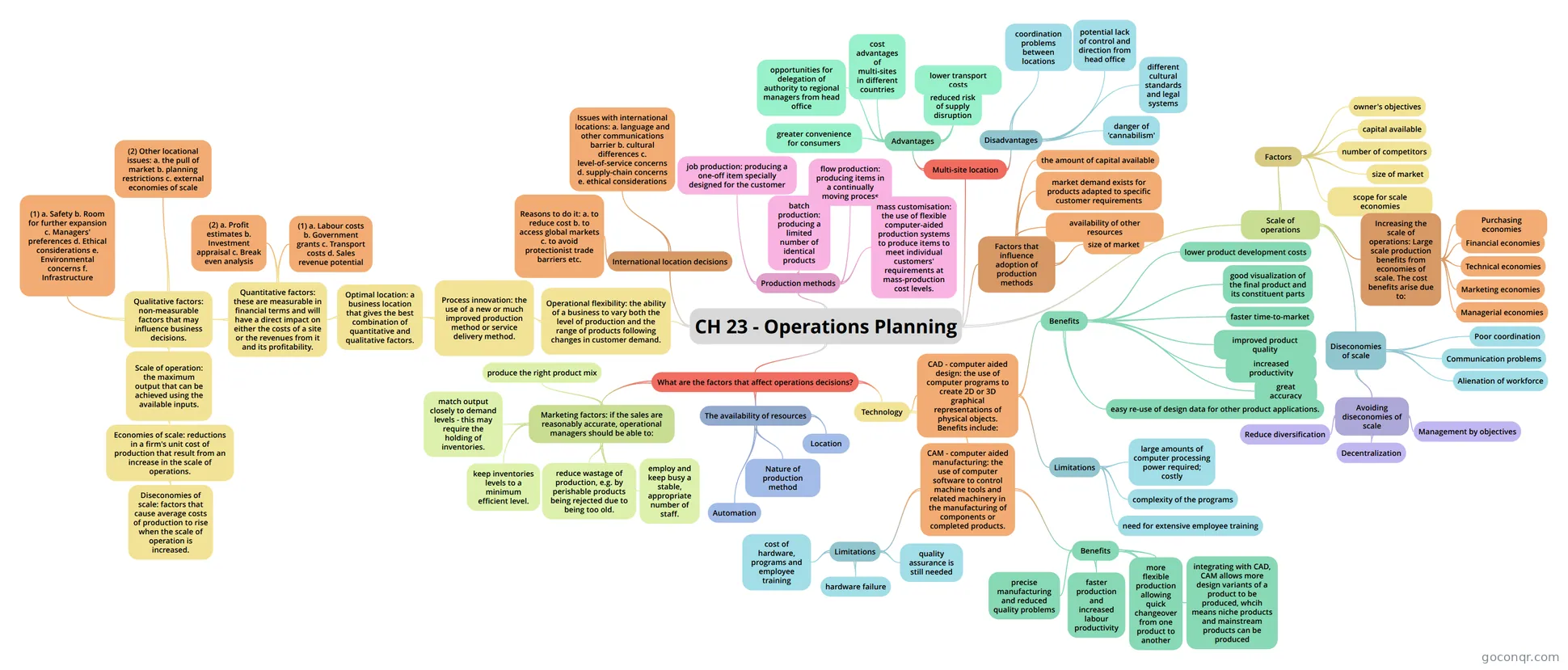
Mind map: Operations planning
Conteúdo do mapa
CH 23 - Operations Planning
What are the factors that affect operations decisions?
- Marketing factors: if the sales are reasonably accurate, operational managers should be able to:
- match output closely to demand levels - this may require the holding of inventories.
- keep inventories levels to a minimum efficient level.
- reduce wastage of production, e.g. by perishable products being rejected due to being too old.
- employ and keep busy a stable, appropriate number of staff.
- produce the right product mix
- The availability of resources
- Location
- Nature of production method
- Automation
- Technology
- CAD - computer aided design: the use of computer programs to create 2D or 3D graphical representations of physical objects. Benefits include:
- Benefits
- lower product development costs
- increased productivity
- improved product quality
- faster time-to-market
- good visualization of the final product and its constituent parts
- great accuracy
- easy re-use of design data for other product applications.
- Limitations
- complexity of the programs
- need for extensive employee training
- large amounts of computer processing power required; costly
- Benefits
- CAM - computer aided manufacturing: the use of computer software to control machine tools and related machinery in the manufacturing of components or completed products.
- Benefits
- precise manufacturing and reduced quality problems
- faster production and increased labour productivity
- more flexible production allowing quick changeover from one product to another
- integrating with CAD, CAM allows more design variants of a product to be produced, whcih means niche products and mainstream products can be produced
- Limitations
- cost of hardware, programs and employee training
- hardware failure
- quality assurance is still needed
- Benefits
- CAD - computer aided design: the use of computer programs to create 2D or 3D graphical representations of physical objects. Benefits include:
- Marketing factors: if the sales are reasonably accurate, operational managers should be able to:
Operational flexibility: the ability of a business to vary both the level of production and the range of products following changes in customer demand.
- Process innovation: the use of a new or much improved production method or service delivery method.
- Optimal location: a business location that gives the best combination of quantitative and qualitative factors.
- Quantitative factors: these are measurable in financial terms and will have a direct impact on either the costs of a site or the revenues from it and its profitability.
- Qualitative factors: non-measurable factors that may influence business decisions.
- (1) a. Safety b. Room for further expansion c. Managers' preferences d. Ethical considerations e. Environmental concerns f. Infrastructure
- (2) Other locational issues: a. the pull of market b. planning restrictions c. external economies of scale
- Scale of operation: the maximum output that can be achieved using the available inputs.
- Economies of scale: reductions in a firm's unit cost of production that result from an increase in the scale of operations.
- Diseconomies of scale: factors that cause average costs of production to rise when the scale of operation is increased.
- Economies of scale: reductions in a firm's unit cost of production that result from an increase in the scale of operations.
- (1) a. Labour costs b. Government grants c. Transport costs d. Sales revenue potential
- (2) a. Profit estimates b. Investment appraisal c. Break even analysis
- Qualitative factors: non-measurable factors that may influence business decisions.
- Quantitative factors: these are measurable in financial terms and will have a direct impact on either the costs of a site or the revenues from it and its profitability.
- Optimal location: a business location that gives the best combination of quantitative and qualitative factors.
- Process innovation: the use of a new or much improved production method or service delivery method.
Production methods
- job production: producing a one-off item specially designed for the customer
- batch production: producing a limited number of identical products
- flow production: producing items in a continually moving process
- mass customisation: the use of flexible computer-aided production systems to produce items to meet individual customers' requirements at mass-production cost levels.
Factors that influence adoption of production methods
- size of market
- the amount of capital available
- availability of other resources
- market demand exists for products adapted to specific customer requirements
Multi-site location
- Advantages
- greater convenience for consumers
- lower transport costs
- reduced risk of supply disruption
- opportunities for delegation of authority to regional managers from head office
- cost advantages of multi-sites in different countries
- Disadvantages
- coordination problems between locations
- potential lack of control and direction from head office
- different cultural standards and legal systems
- danger of 'cannabilism'
- Advantages
International location decisions
- Reasons to do it: a. to reduce cost b. to access global markets c. to avoid protectionist trade barriers etc.
- Issues with international locations: a. language and other communications barrier b. cultural differences c. level-of-service concerns d. supply-chain concerns e. ethical considerations
Scale of operations
- Factors
- owner's objectives
- capital available
- size of market
- number of competitors
- scope for scale economies
- Increasing the scale of operations: Large scale production benefits from economies of scale. The cost benefits arise due to:
- Purchasing economies
- Technical economies
- Financial economies
- Marketing economies
- Managerial economies
- Diseconomies of scale
- Communication problems
- Alienation of workforce
- Poor coordination
- Avoiding diseconomies of scale
- Management by objectives
- Decentralization
- Reduce diversification
- Factors
Informações
- Descrição
- Mapa Mental sobre CH 23 - Operations Planning, criado por Tara Allegra Fermanto em 24-01-2017.
- Criado por
- Tara Allegra Fermanto
- Visualizações
- 0
- Avaliação
Mais sobre Operations Planning and Forecasting