
Mapa mental
Dancing at Lughnasa: Background
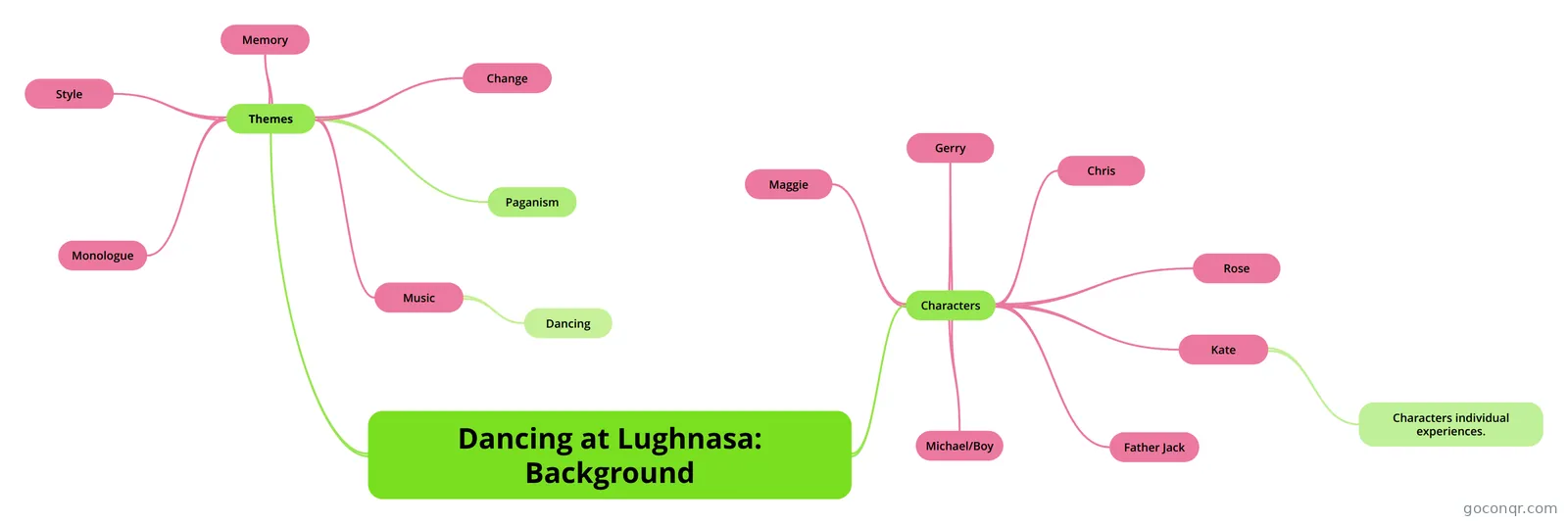
Mind map: Dancing at Lughnasa background
Conteúdo do mapa
Dancing at Lughnasa: Background
Characters
- Kate
- Kate is the oldest of the five sisters. She is forty years old, and was once a schoolteacher. Kate is the most resistant to the changes taking place around her, and is especially critical of the "pagan'' singing and dancing that the radio has brought into her household.
- Characters individual experiences.
- Kate objects to levity, playfulness and novelty for they are threats to her fragile order. The hair cracks, we recognise early on, are caused not just by external forces over which the sisters have no control, but by equally unruly forces within the family itself, within consciousness (even Kate’s).
- The greater the effort of repression, it would seem, the stronger the insurrectionary pressures. The great merit of the play is the unmistakable tension which we feel between the very human desire for order and stability and the equally strong desire for excitement and new experience. This tension has various forms.
- Father Jack
- Jack, fifty−three, also referred to by Michael as Uncle Jack, is the brother of the five women, and uncle of Michael. He spent twenty−five years as a missionary priest in a leper colony in Uganda, and has recently returned to Ireland, sick with malaria. It turns out that Jack was asked to leave the priesthood for participating in local, non−Christian ceremonies and rituals in Uganda. In Ireland, he seems mentally confused, as well as physically ill. He cannot keep the names of his five sisters straight, and has trouble remembering English words, having spoken mostly Swahili during his years in Uganda.
- he character of Uncle Jack highlights Friel's theme of paganism, as he frequently refers to local spiritual practices in Uganda, and seems to have strayed far from his Christian faith. Kate helps Uncle Jack to reinvigorate his health with long walks several times a day. Michael explains in a monologue toward the end of the play that Jack died suddenly of a heart attack within a year of returning to Ireland.
- Rose
- Rose, thirty−two, is the second youngest of the sisters, and works knitting mittens to support the family. Rose is in love with Danny Bradley, a married man with three children, with whom she sneaks off for a boat ride one afternoon. Rose is referred to as 'simple' in the play and her sisters worry about her vulnerability.
- Chris
- Chris, twenty−six, is the youngest of the five sisters. Her son, Michael, was born out of wedlock, her love child with Gerry Evans. When Gerry returns after more than a year's absence, he charms Chris all over again, despite herself and her sister's disapproval. Gerry jokes with her, makes her laugh, and frequently breaks into a dance with her.
- Chris is repeatedly taken in by Gerry's unreliable promises, believing him when he says he will return soon, and that he has purchased a bicycle for Michael. Three weeks later, Gerry does return briefly, during which time he and Chris enjoy a rejuvenation of their romance before he leaves for military work in Spain. Chris never learns of Gerry's legitimate family in Wales.
- Gerry
- Gerry Evans, thirty−three, is the father of the illegitimate son Michael, whose mother is Chris. Gerry and Chris were never married, and Gerry had abandoned her with their child years earlier. Gerry appears unexpectedly every year or so, and Chris, despite herself, is charmed by him all over again each time.
- But Gerry is unreliable, and has a new idea for a career path with each visit. He does leave to fight in Spain, where he is injured in a motorbike accident that leaves him with a limp. He continues to visit Chris and Michael every year or so, but disappears around the time of World War II. After Gerry's death, Michael learns that his father had a wife and three children in Wales throughout all those years, unbeknownst to Chris.
- Maggie
- Maggie, thirty−eight, is the second oldest of the five sisters, and works as the cook and housekeeper of their home. Michael describes his Aunt Maggie as ‘‘the joker of the family.’’ She is the one who suggests naming the new wireless radio Lugh, after the "old Celtic god of the Harvest.’’
- Michael/Boy
- Michael, as a young man, functions as a narrator and describes the action of the play through direct monologue to the audience, in the form of a nostalgic reminiscence of a time of his childhood when he was only seven years old. Michael is the illegitimate child of Chris and Gerry, and only sees his father about once a year. The child Michael in the flashbacks is primarily intent on making and painting a series of kites; only toward the end of the play are his paintings displayed to the audience, when they reveal a series of faces expressing strong emotions.
- Kate
Themes
- Change
- Friel's play is concerned with the theme of change. The acquisition of the wireless radio in the Mundy household represents a turning point in the make−up of the family, as well as in rural Irish cultural history. The radio in 1936 is a newfangled technology that brings mass−produced popular culture into the home. The entry of this variety of music into the Mundy home unleashes repressed urges in the five single women who live there. The radio is also a harbinger of more significant historical and socioeconomic changes; namely, the Industrial Revolution. The opening of a knitting factory replaces the cottage industry by which Rose and Agnes had supported themselves by hand knitting at home. Kate, the oldest of the five sisters, expresses her anxiety at the realization that change is in the air.
- Quote from Kate: You work hard at your job. You try to keep the home together. You perform your duties as best you can— because you believe in responsibilities and obligations and good order. And then suddenly, suddenly you realize that hair cracks are appearing everywhere; that control is slipping away; that the whole thing is so fragile it can't be held together much longer. It's all about to collapse.
- This anxiety over change is also raised by the introduction of pagan practices and ideas into the Mundy home. Because she is the most resistant to change, Kate is especially dubious of the singing of pagan songs, and the explanations of pagan rituals from Uganda, which Uncle Jack describes at length.
- Paganism
- Paganism and pagan ritual are central themes of Friel's play. The play is set during the festival of Lughnasa, a local pagan harvest ritual of which Kate is disdainful. Furthermore, Friel presents all dancing and singing, which permeate the action of the play, as a form of pagan ritual. Uncle Jack brings back from Uganda a wealth of experiences with non−Christian ceremonies and rituals, including sacrifice of animals and native dances.
- Kate makes the connection between paganism, or non−Christian belief, and the music brought into the household by the radio when she exclaims: ‘‘D'you know what that thing has done? Killed all Christian conversation in this country.’’
- In an Act II monologue, Michael explains that Jack's recollections of his experiences in Uganda continued to bring more "revelations" regarding pagan rituals and ceremonies. Michael explains that ‘‘each new revelation startled— shocked—stunned poor Aunt Kate.’’
- But Kate makes some peace with Jack's expressions of paganism when she "finally hit on the phrase that appeased her: 'his own distinctive spiritual search.'’’ Friel seems to be celebrating such a personal"distinctive spiritual search,’’ as expressed through the pagan rituals of music, song, and dance by the various characters.
- Memory
- A central theme of Friel's play is memory. The action of the play, which takes place in the later summer of 1936, is framed as a depiction of Michael's memories of his childhood. In his closing monologue, the character of Michael as a young man explains the significance of these memories: And so, when I cast my mind back to that summer of 1936, different kinds of memories offer themselves to me. But there is one memory of that Lughnasa time that visits me most often; and what fascinates me about that memory is that it owes nothing to fact. In that memory atmosphere is more real than incident and everything is simultaneously actual and illusory. In that memory, too, the air is nostalgic with the music of the thirties.
- Friel is interested in personal memory not as a means of reproducing factual incidents, but as a means of recapturing the atmosphere of the memory. Thus, for Friel, memory is ‘‘simultaneously actual and illusory,’’ because it is true to the emotional content of the memory without necessarily being true to the actual events that took place. Music is central to Friel's play because of the extent to which he associates nostalgic memories with ‘‘the music of the thirties.’’
- Style
- Friel's play is set in ‘‘the home of the Mundy family, two miles outside the village of Ballybeg, County Donegal, Ireland, in 1936.’’ While County Donegal is a real geographic location (where Friel himself resides), the village of Ballybeg is Friel's fictional creation, utilized as a setting in many of his plays. Act I takes place in early August, and Act II takes place three weeks later, in early September. The historical setting of 1936 is significant for several reasons.
- The family's acquisition of their first wireless radio provides the novelty of modern technology and popular culture during that time. The historical setting is also relevant to the intrusion of the Industrial Revolution on rural Ireland.
- At the beginning of the play, Agnes and Rose support the family by knitting at home. A knitting factory, however, is opened nearby, and the supplier for whom they work loses all of her business to the larger company. The cottage industry by which Agnes and Rose had earned their living becomes obsolete before their very eyes.
- As Michael explains in monologue, ‘‘the Industrial Revolution had finally caught up with Ballybeg.'' This event is significant to Friel's theme of nostalgia for the rural Ireland of his childhood, as well as the theme of historical changes in Irish culture.
- Monologue
- The character of Michael as a young man appears in the play addressing the audience directly in a series of monologues that introduce, explain, and conclude the play.
- The entire play is thus presented as a depiction of Michael's nostalgic memories of this particular period in his childhood. Through this monologue, Michael explains to the audience the circumstances and history of his family, the eventual fate of each of the characters, and the significance of these memories.
- Music
- Music is a central theme of this play, in which the new wireless radio in the Mundy household represents an agent of change. The dialogue is thus interspersed with music coming from the radio, as well as the musical outbursts of the various characters. Specific song lyrics and types of music are therefore significant to the meaning of the play.
- Friel provides very specific descriptions of the radio music in the stage directions. For example, at one point the radio is turned on while the Mundy sisters do chores in the kitchen: ‘‘The music, at first scarcely audible, is Irish dance music—'The Mason's Apron,' played by a ceili band. Very fast; very heavy beat; a raucous sound. At first we are aware of the beat only. Then, as the volume increases slowly, we hear the melody.’’
- The Mundy sisters then slowly break into a frenzied dance that only partially matches the music, and is expressive of their repressed desires. At other points, characters break into snatches of popular songs, as well as folk songs, which Kate refers to disdainfully as "pagan songs.’’
- Music is associated with "pagan," or non−Christian, ritual again when Uncle Jack breaks into a rhythmic dance he learned in Uganda, beating two sticks together for musical accompaniment; the stage directions state that: ‘‘Jack picks up two pieces of wood . .. and strikes them together. The sound they make pleases him. He does it again— and again—and again. Now he begins to beat out a structured beat whose rhythm gives him pleasure.''
- Dancing
- Dancing is the play’s central image for a contravention and violation of ‘normal’ reality.
- The dancing is the play’s chief ‘opening’ activity which is disturbing because it represents a break in the acknowledged order, an irruption of the inadmissible within the usual routine, a ritualised suspension of everyday law and order.
- When Agnes suggests that the sisters all go to the harvest dance, Rose quickly launches into ’a bizarre and abandoned dance’ while Kate ‘panics’.
- ‘Just look at yourselves!’ she shouts at her sisters, ‘Dancing at your time of day. That’s for young people with no duties and no responsibilities and nothing in their heads but pleasure’
- The five sisters dancing as a family but still preserving their own distinctive personalities. Maggie’s features ‘become animated by a look of defiance’ and she emits ‘a wild, raucous ‘‘Yaaaah!’’’. She draws her flour−covered hand down her cheek, patterning her face ‘with an instant mask’. Described as a ‘white−faced, frantic dervish’.
- Change
Informações
- Descrição
- Mapa Mental sobre Dancing at Lughnasa: Background, criado por Amelia Fearon em 22-04-2014.
- Criado por
- Amelia Fearon
- Visualizações
- 37
- Avaliação
Mais sobre Dancing at Lughnasa