
Mapa mental
Primary Angle-Closure Glaucoma

Conteúdo do mapa
Primary Angle-Closure Glaucoma
group of disorders characterized by high intracular pressure
- GLAUCOMA
- Primary Open -Angled Glaucoma
- Primary Angle-Closure Glaucoma
- OCULAR EMERGENCY
- requires immediate management to avoid blindness
- (Weinreb, Aung, Medeiros, 2014)
- requires immediate management to avoid blindness
- OCULAR EMERGENCY
- consequences of elevated pressure
- optic nerve atrophy
- peripheral visual field loss
- (Smith and Neely, 2014, p.520)
- peripheral visual field loss
- optic nerve atrophy
- GLAUCOMA
EPIDEMIOLOGY
- In 2013, the number of people of from agse 40-80 with PACG was 20.17 M and is expected to increase to 32.04 M in 2040
- Highest rates: Inuit, and other Asian population
- (Marchini, Chemello, Berzaghi & Zampieri, 2015) ;Sun etal, 2016
- Common in women, female:male is 2:1
- Caucasians: 0.1-0.6%, Inuits: 2.6-6.2%, Asians: 0.3-3%
PATHOPHYSIOLOGY
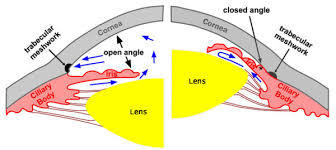
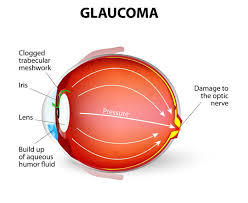
- Aqueous humor
- produced in posterior chamber
- flows into anterior chamber through pupil
- aqueous humor drains in trabecular meshwork
- ( Marchini, Chemello, Berzaghi & Zampieri, 2015; Weinreb, Aung, Medeiros, 2014)
- "Pupillary block"
- aqueous humor outflow blocked
- increased intro-ocular pressure
- SIGNS AND SYMPTOMS
- Red painful eyes
- Nausea and vomiting
- Haloes around lights
- Blurry vision
- Headache
- Cornea edema
- Hazy cornea
- Photophobia
- Pupil midilated and non-reactive
- (Marchini, Chemello, Berzaghi & Zampieri, 2015; Weinreb, Aung, Medeiros, 2014)
- Pupil midilated and non-reactive
- Photophobia
- SIGNS AND SYMPTOMS
- Anterior chamber is narrow
- iris is pushed forward
- iris covers trabecular meshwork
- iris is pushed forward
- aqueous humor drains in trabecular meshwork
- flows into anterior chamber through pupil
- produced in posterior chamber
- Aqueous humor
DIAGNOSTICS
- Gonioscopy
- most important diagnostic method for assessing the presence of angle closure
- The van Herick angle
- used to screen for the depth of the anterior chamber angle prior to dilation
- Penlight shadow test
- screening method for assessing anterior chamber depth and iris convexity
- (Anwar & Turalba, 2017; Jackson et al, 1997)
- screening method for assessing anterior chamber depth and iris convexity
- patient History
- family history of primary ACG.
- S/S of attacks
- Normal IOP : 10-21 mmHG
- Angle closure IOP : >50 mmHG
- (Smith and Neely, 2014,)
- Angle closure IOP : >50 mmHG
- Gonioscopy
Client- Centred-Care
- Use touch if appropriate to offer reassurance to the person
- Be reassuring when they are expressing their fears
- (RNAO, 2015)
- Encourage the person to voice any questions they may have about their health needs and care.
PHARMOLOGICAL
- Drugs
- Indication
- will decrease formation of aqueous humor, as well as decrease the posterior–anterior chamber pressure gradient
- works by constricting the pupil and removing the iris from the trabecular region.
- (Marchini, Chemello, Berzaghi & Zampieri, 2015; Anwar & Turalba, 2016)
- works by constricting the pupil and removing the iris from the trabecular region.
- will decrease formation of aqueous humor, as well as decrease the posterior–anterior chamber pressure gradient
- Aqueous suppressants
- Alpha Agonist, Carbonic anhydrase inhibitors, and Adrengeric antogonists,
- Micotics
- pilocarpine dapriprazole
- Micotics
- Alpha Agonist, Carbonic anhydrase inhibitors, and Adrengeric antogonists,
- Indication
- topical, oral, and intravenous agents
- GOALS
- Performance of laser peripheral iridotomy or surgical iridectomy
- (Jackson et al, 1997)
- Evaluation of treatment
- Relief of the attack and avoiding vision loss using medical therapy, laser therapy, or surgery
- Performance of laser peripheral iridotomy or surgical iridectomy
- Drugs
HEALTH PROMOTION
- eye exam every 3-5 years until 40 yrs and every 2-4 years until 65 yrs
- older adults should have an eye exam every two years
- eye exam yearly for people of african descent and those with a history of glaucoma
- (Smith and Neely, 2014, p.524)
NON PHARMOLOGICAL
- Patient may feel uncomfortable
- providing a quiet and private space
- applying cool compreses to the patients forhead
- darkening the environment
- Reduce safety hazards
- reducing clutter
- (Smith and Neely, 2014)
- Patient may feel uncomfortable
RISK FACTORS
- Older age
- female sex
- Asian ethnicities
- shorter axial length
- shorter axial length
- dense iris volume
- increase choroidal thickness
- (Marchini, Chemello, Berzaghi & Zampieri, 2015; Anwar & Turalba 2017)
SURGERY
- Laser Iridotomy
- heals pupil block
- for patients with narrow angles
- allows aqueous humor to flow in a new opening
- preventative measure against an acute attack
- if acute attack occurs,iridotomy must be done immediately
- heals pupil block
- Laser Iridoplasty
- the iris is thick, so the laser will burn reduce the thickness of it
- the iris becomes smaller and is detached from the trabecular meshwork
- the angle is wide and the IOP decreases
- (Sun et al, 2016; Anwar & Turalba 2017 ; Marchini, Chemello, Berzaghi & Zampieri, 2015
- the angle is wide and the IOP decreases
- the iris becomes smaller and is detached from the trabecular meshwork
- iridoplasty done when iridotomy fails
- the iris is thick, so the laser will burn reduce the thickness of it
- Laser Iridotomy
COLLABORATIVE CARE
Imagens e arquivos do mapa


Informações
- Descrição
- Mapa Mental sobre Primary Angle-Closure Glaucoma, criado por ladan kite em 04-03-2017.
- Criado por
- ladan kite
- Visualizações
- 34
- Avaliação