
Mapa mental
Januarie
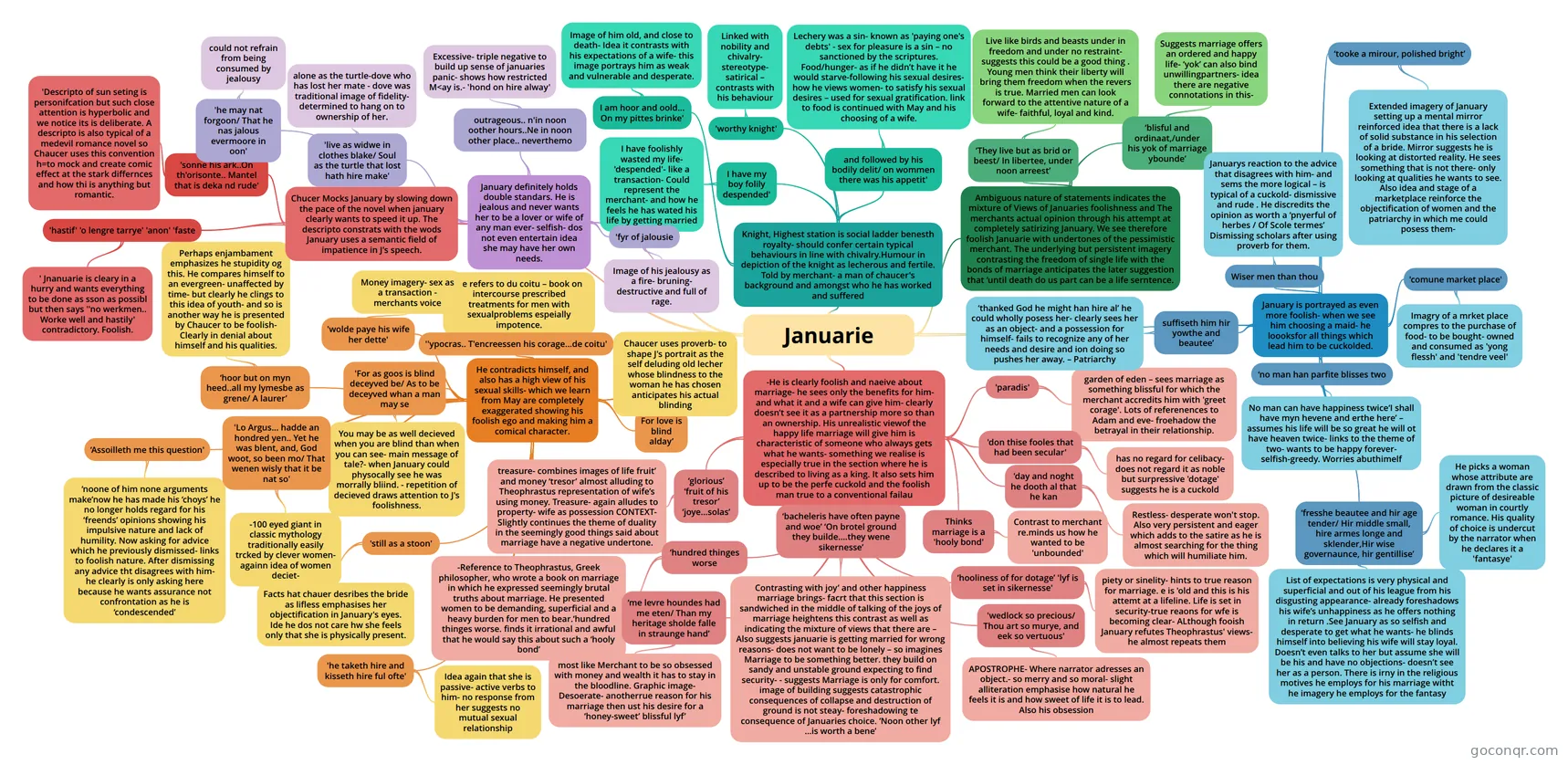
Mind map: January in The Merchant's Tale
Conteúdo do mapa
Januarie
Knight, Highest station is social ladder benesth royalty- should confer certain typical behaviours in line with chivalry.Humour in depiction of the knight as lecherous and fertile. Told by merchant- a man of chaucer's background and amongst who he has worked and suffered
- and followed by his bodily delit/ on wommen there was his appetit'
- Lechery was a sin- known as 'paying one's debts' - sex for pleasure is a sin – no sanctioned by the scriptures. Food/hunger- as if he didn’t have it he would starve-following his sexual desires- how he views women- to satisfy his sexual desires – used for sexual gratification. link to food is continued with May and his choosing of a wife.
- 'worthy knight'
- Linked with nobility and chivalry- stereotype- satirical – contrasts with his behaviour
- I am hoor and oold... On my pittes brinke'
- Image of him old, and close to death- Idea it contrasts with his expectations of a wife- this image portrays him as weak and vulnerable and desperate.
- I have my boy folily despended'
- I have foolishly wasted my life- 'despended'- like a transaction- Could represent the merchant- and how he feels he has wated his life by getting married
- and followed by his bodily delit/ on wommen there was his appetit'
-He is clearly foolish and naeive about marriage- he sees only the benefits for him- and what it and a wife can give him- clearly doesn’t see it as a partnership more so than an ownership. His unrealistic viewof the happy life marriage will give him is characteristic of someone who always gets what he wants- something we realise is especially true in the section where he is described to living as a king. It also sets him up to be the perfe cuckold and the foolish man true to a conventional failau
- 'paradis'
- garden of eden – sees marriage as something blissful for which the merchant accredits him with 'greet corage'. Lots of referenences to Adam and eve- froehadow the betrayal in their relationship.
- 'don thise fooles that had been secular'
- has no regard for celibacy- does not regard it as noble but surpressive 'dotage' suggests he is a cuckold
- 'day and noght he dooth al that he kan
- Restless- desperate won't stop. Also very persistent and eager which adds to the satire as he is almost searching for the thing which will humiliate him.
- Thinks marriage is a 'hooly bond'
- Contrast to merchant re.minds us how he wanted to be 'unbounded'
- ‘hooliness of for dotage’ 'lyf is set in sikernesse'
- piety or sinelity- hints to true reason for marriage. e is 'old and this is his attemt at a lifeline. Life is set in security-true reaons for wfe is becoming clear- ALthough fooish January refutes Theophrastus' views- he almost repeats them
- ‘glorious’ ‘fruit of his tresor’ ‘joye…solas’
- treasure- combines images of life fruit’ and money ‘tresor’ almost alluding to Theophrastus representation of wife’s using money. Treasure- again alludes to property- wife as possession CONTEXT- Slightly continues the theme of duality in the seemingly good things said about marriage have a negative undertone.
- ‘bacheleris have often payne and woe’ ‘On brotel ground they builde….they wene sikernesse’
- Contrasting with joy’ and other happiness marriage brings- facrt that this section is sandwiched in the middle of talking of the joys of marriage heightens this contrast as well as indicating the mixture of views that there are – Also suggests januarie is getting married for wrong reasons- does not want to be lonely – so imagines Marriage to be something better. they build on sandy and unstable ground expecting to find security- - suggests Marriage is only for comfort. image of building suggests catastrophic consequences of collapse and destruction of ground is not steay- foreshadowing te consequence of Januaries choice. ‘Noon other lyf …is worth a bene’
- ‘hundred thinges worse
- -Reference to Theophrastus, Greek philosopher, who wrote a book on marriage in which he expressed seemingly brutal truths about marriage. He presented women to be demanding, superficial and a heavy burden for men to bear.‘hundred thinges worse. finds it irrational and awful that he would say this about such a ‘hooly bond’
- 'wedlock so precious/ Thou art so murye, and eek so vertuous'
- APOSTROPHE- Where narrator adresses an object.- so merry and so moral- slight alliteration emphasise how natural he feels it is and how sweet of life it is to lead. Also his obsession
- ‘me levre houndes had me eten/ Than my heritage sholde falle in straunge hand’
- most like Merchant to be so obsessed with money and wealth it has to stay in the bloodline. Graphic image- Desoerate- anotherrue reason for his marriage then ust his desire for a ‘honey-sweet’ blissful lyf’
- 'paradis'
Ambiguous nature of statements indicates the mixture of Views of Januaries foolishness and The merchants actual opinion through his attempt at completely satirizing January. We see therefore foolish Januarie with undertones of the pessimistic merchant. The underlying but persistent imagery contrasting the freedom of single life with the bonds of marriage anticipates the later suggestion that ‘until death do us part can be a life serntence.
- ‘They live but as brid or beest/ In libertee, under noon arreest’
- Live like birds and beasts under in freedom and under no restraint- suggests this could be a good thing . Young men think their liberty will bring them freedom when the revers is true. Married men can look forward to the attentive nature of a wife- faithful, loyal and kind.
- ‘blisful and ordinaat,/under his yok of marriage ybounde’
- Suggests marriage offers an ordered and happy life- ‘yok’ can also bind unwillingpartners- idea there are negative connotations in this-
- ‘They live but as brid or beest/ In libertee, under noon arreest’
He contradicts himself, and also has a high view of his sexual skills- which we learn from May are completely exaggerated showing his foolish ego and making him a comical character.
- ‘hoor but on myn heed..all my lymesbe as grene/ A laurer’
- Perhaps enjambament emphasizes he stupidity og this. He compares himself to an evergreen- unaffected by time- but clearly he clings to this idea of youth- and so is another way he is presented by Chaucer to be foolish- Clearly in denial about himself and his qualities.
- For love is blind alday’
- Chaucer uses proverb- to shape J's portrait as the self deluding old lecher whose blindness to the woman he has chosen anticipates his actual blinding
- ‘Assoilleth me this question'
- ‘noone of him none arguments make’now he has made his ‘choys’ he no longer holds regard for his ‘freends’ opinions showing his impulsive nature and lack of humility. Now asking for advice which he previously dismissed- links to foolish nature. After dismissing any advice tht disagrees with him- he clearly is only asking here because he wants assurance not confrontation as he is ‘condescended’
- ''ypocras.. T'encreessen his corage...de coitu'
- He refers to du coitu – book on intercourse prescribed treatments for men with sexualproblems espeially impotence.
- 'still as a stoon'
- Facts hat chauer desribes the bride as lifless emphasises her objectification in January's eyes. Ide he dos not care hw she feels only that she is physically present.
- 'he taketh hire and kisseth hire ful ofte'
- Idea again that she is passive- active verbs to him- no response from her suggests no mutual sexual relationship
- 'wolde paye his wife her dette'
- Money imagery- sex as a transaction - merchants voice
- 'For as goos is blind deceyved be/ As to be deceyved whan a man may se
- You may be as well decieved when you are blind than when you can see- main message of tale?- when January could physocally see he was morrally bliind. - repetition of decieved draws attention to J's foolishness.
- 'Lo Argus... hadde an hondred yen.. Yet he was blent, and, God woot, so been mo/ That wenen wisly that it be nat so'
- -100 eyed giant in classic mythology traditionally easily trcked by clever women- againn idea of women deciet-
- ‘hoor but on myn heed..all my lymesbe as grene/ A laurer’
January is portrayed as even more foolish- when we see him choosing a maid- he loooksfor all things which lead him to be cuckolded.
- Wiser men than thou
- Januarys reaction to the advice that disagrees with him- and sems the more logical – is typical of a cuckold- dismissive and rude . He discredits the opinion as worth a ‘pnyerful of herbes / Of Scole termes’ Dismissing scholars after using proverb for them.
- ‘tooke a mirour, polished bright’
- Extended imagery of January setting up a mental mirror reinforced idea that there is a lack of solid substance in his selection of a bride. Mirror suggests he is looking at distorted reality. He sees something that is not there- only looking at qualities he wants to see. Also idea and stage of a marketplace reinforce the objectification of women and the patriarchy in which me could posess them-
- ‘fresshe beautee and hir age tender/ Hir middle small, hire armes longe and sklender,Hir wise governaunce, hir gentillise’
- List of expectations is very physical and superficial and out of his league from his disgusting appearance- already foreshadows his wife’s unhappiness as he offers nothing in return .See January as so selfish and desperate to get what he wants- he blinds himself into believing his wife will stay loyal. Doesn’t even talks to her but assume she will be his and have no objections- doesn’t see her as a person. There is irny in the religious motives he employs for his marriage witht he imagery he employs for the fantasy
- He picks a woman whose attribute are drawn from the classic picture of desireable woman in courtly romance. His quality of choice is undercut by the narrator when he declares it a 'fantasye'
- suffiseth him hir yowthe and beautee’
- ‘thanked God he might han hire al’ he could wholly posess her- clearly sees her as an object- and a possession for himself- fails to recognize any of her needs and desire and ion doing so pushes her away. – Patriarchy
- 'comune market place'
- Imagry of a mrket place compres to the purchase of food- to be bought- owned and consumed as 'yong flessh' and 'tendre veel'
- ‘no man han parfite blisses two
- No man can have happiness twice‘I shall have myn hevene and erthe here’ – assumes his life will be so great he will ot have heaven twice- links to the theme of two- wants to be happy forever- selfish-greedy. Worries abuthimelf
- Wiser men than thou
Chucer Mocks January by slowing down the pace of the novel when january clearly wants to speed it up. The descripto constrats with the wods January uses a semantic field of impatience in J's speech.
- 'sonne his ark..On th'orisonte.. Mantel that is deka nd rude'
- 'Descripto of sun seting is personifcation but such close attention is hyperbolic and we notice its is deliberate. A descripto is also typical of a medevil romance novel so Chaucer uses this convention h=to mock and create comic effect at the stark differnces and how thi is anything but romantic.
- 'hastif' 'o lengre tarrye' 'anon' 'faste
- ' Jnanuarie is cleary in a hurry and wants everything to be done as sson as possibl but then says ''no werkmen.. Worke well and hastily' contradictory. Foolish.
- 'sonne his ark..On th'orisonte.. Mantel that is deka nd rude'
January definitely holds double standars. He is jealous and never wants her to be a lover or wife of any man ever- selfish- dos not even entertain idea she may have her own needs.
- 'fyr of jalousie
- Image of his jealousy as a fire- bruning- destructive and full of rage.
- 'live as widwe in clothes blake/ Soul as the turtle that lost hath hire make'
- alone as the turtle-dove who has lost her mate - dove was traditional image of fidelity- determined to hang on to ownership of her.
- 'he may nat forgoon/ That he nas jalous evermoore in oon'
- could not refrain from being consumed by jealousy
- outrageous.. n'in noon oother hours..Ne in noon other place.. neverthemo
- Excessive- triple negative to build up sense of januaries panic- shows how restricted M<ay is.- 'hond on hire alway'
- 'fyr of jalousie
Informações
- Descrição
- Mapa Mental sobre Januarie, criado por Saheefa Ishaq em 16-04-2017.
- Criado por
- Saheefa Ishaq
- Visualizações
- 2
- Avaliação
Mais sobre The Merchant's Tale