
Mapa mental
Successful Project Management
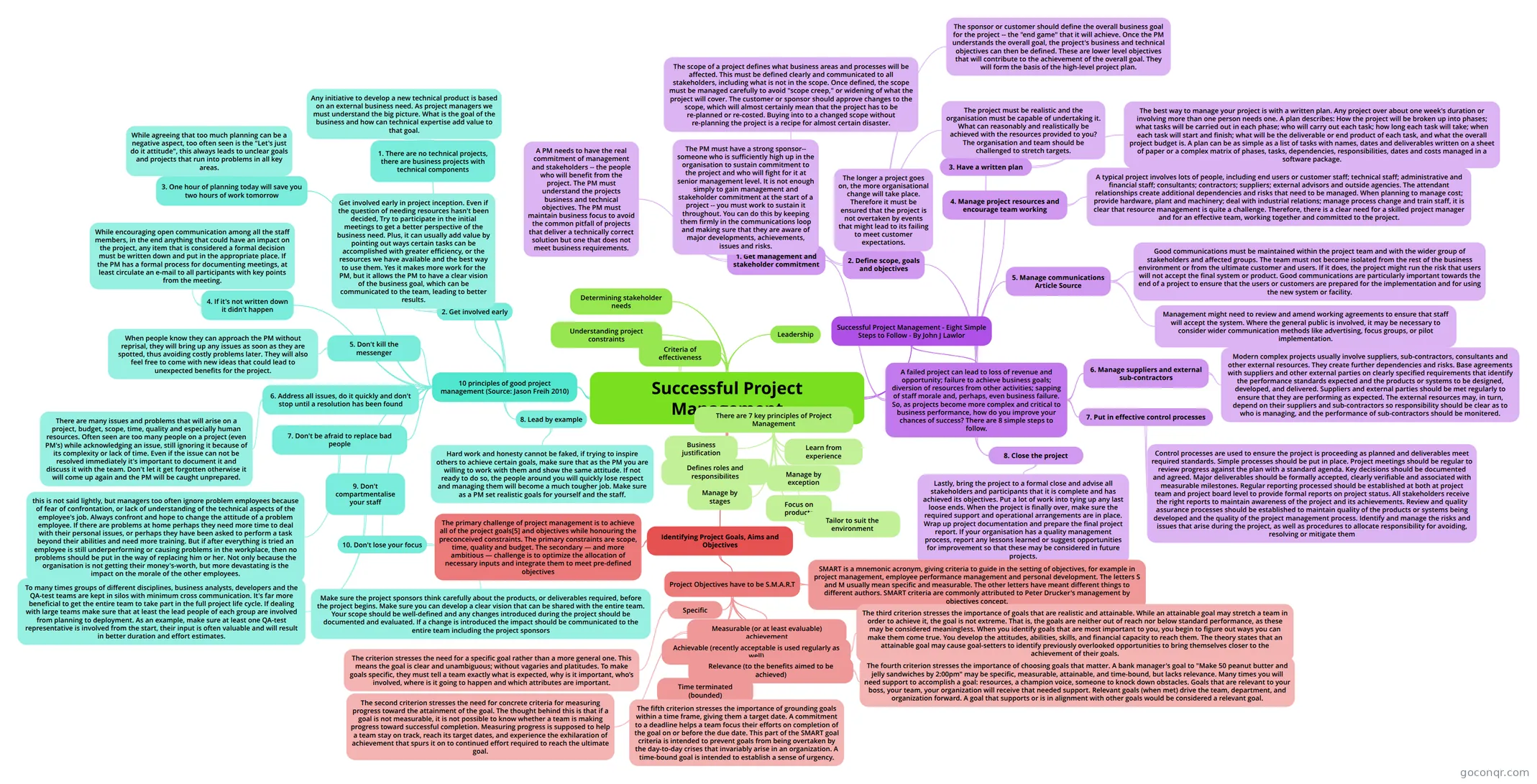
Mind map: Successful Project Management
Conteúdo do mapa
Successful Project Management
Criteria of effectiveness
- There are 7 key principles of Project Management
- Business justification
- Defines roles and responsibilites
- Manage by exception
- Manage by stages
- Focus on products
- Learn from experience
- Tailor to suit the environment
- There are 7 key principles of Project Management
Leadership
Determining stakeholder needs
Understanding project constraints
Identifying Project Goals, Aims and Objectives
- Project Objectives have to be S.M.A.R.T
- SMART is a mnemonic acronym, giving criteria to guide in the setting of objectives, for example in project management, employee performance management and personal development. The letters S and M usually mean specific and measurable. The other letters have meant different things to different authors. SMART criteria are commonly attributed to Peter Drucker's management by objectives concept.
- Specific
- The criterion stresses the need for a specific goal rather than a more general one. This means the goal is clear and unambiguous; without vagaries and platitudes. To make goals specific, they must tell a team exactly what is expected, why is it important, who’s involved, where is it going to happen and which attributes are important.
- Measurable (or at least evaluable) achievement
- The second criterion stresses the need for concrete criteria for measuring progress toward the attainment of the goal. The thought behind this is that if a goal is not measurable, it is not possible to know whether a team is making progress toward successful completion. Measuring progress is supposed to help a team stay on track, reach its target dates, and experience the exhilaration of achievement that spurs it on to continued effort required to reach the ultimate goal.
- Achievable (recently acceptable is used regularly as well)
- The third criterion stresses the importance of goals that are realistic and attainable. While an attainable goal may stretch a team in order to achieve it, the goal is not extreme. That is, the goals are neither out of reach nor below standard performance, as these may be considered meaningless. When you identify goals that are most important to you, you begin to figure out ways you can make them come true. You develop the attitudes, abilities, skills, and financial capacity to reach them. The theory states that an attainable goal may cause goal-setters to identify previously overlooked opportunities to bring themselves closer to the achievement of their goals.
- Relevance (to the benefits aimed to be achieved)
- The fourth criterion stresses the importance of choosing goals that matter. A bank manager's goal to "Make 50 peanut butter and jelly sandwiches by 2:00pm" may be specific, measurable, attainable, and time-bound, but lacks relevance. Many times you will need support to accomplish a goal: resources, a champion voice, someone to knock down obstacles. Goals that are relevant to your boss, your team, your organization will receive that needed support. Relevant goals (when met) drive the team, department, and organization forward. A goal that supports or is in alignment with other goals would be considered a relevant goal.
- Time terminated (bounded)
- The fifth criterion stresses the importance of grounding goals within a time frame, giving them a target date. A commitment to a deadline helps a team focus their efforts on completion of the goal on or before the due date. This part of the SMART goal criteria is intended to prevent goals from being overtaken by the day-to-day crises that invariably arise in an organization. A time-bound goal is intended to establish a sense of urgency.
- The primary challenge of project management is to achieve all of the project goals[5] and objectives while honouring the preconceived constraints. The primary constraints are scope, time, quality and budget. The secondary — and more ambitious — challenge is to optimize the allocation of necessary inputs and integrate them to meet pre-defined objectives
- Project Objectives have to be S.M.A.R.T
Successful Project Management - Eight Simple Steps to Follow - By John J Lawlor
- A failed project can lead to loss of revenue and opportunity; failure to achieve business goals; diversion of resources from other activities; sapping of staff morale and, perhaps, even business failure. So, as projects become more complex and critical to business performance, how do you improve your chances of success? There are 8 simple steps to follow.
- 1. Get management and stakeholder commitment
- A PM needs to have the real commitment of management and stakeholders -- the people who will benefit from the project. The PM must understand the projects business and technical objectives. The PM must maintain business focus to avoid the common pitfall of projects that deliver a technically correct solution but one that does not meet business requirements.
- The PM must have a strong sponsor-- someone who is sufficiently high up in the organisation to sustain commitment to the project and who will fight for it at senior management level. It is not enough simply to gain management and stakeholder commitment at the start of a project -- you must work to sustain it throughout. You can do this by keeping them firmly in the communications loop and making sure that they are aware of major developments, achievements, issues and risks.
- 2. Define scope, goals and objectives
- The scope of a project defines what business areas and processes will be affected. This must be defined clearly and communicated to all stakeholders, including what is not in the scope. Once defined, the scope must be managed carefully to avoid "scope creep," or widening of what the project will cover. The customer or sponsor should approve changes to the scope, which will almost certainly mean that the project has to be re-planned or re-costed. Buying into to a changed scope without re-planning the project is a recipe for almost certain disaster.
- The sponsor or customer should define the overall business goal for the project -- the "end game" that it will achieve. Once the PM understands the overall goal, the project's business and technical objectives can then be defined. These are lower level objectives that will contribute to the achievement of the overall goal. They will form the basis of the high-level project plan.
- The longer a project goes on, the more organisational change will take place. Therefore it must be ensured that the project is not overtaken by events that might lead to its failing to meet customer expectations.
- The project must be realistic and the organisation must be capable of undertaking it. What can reasonably and realistically be achieved with the resources provided to you? The organisation and team should be challenged to stretch targets.
- 3. Have a written plan
- The best way to manage your project is with a written plan. Any project over about one week's duration or involving more than one person needs one. A plan describes: How the project will be broken up into phases; what tasks will be carried out in each phase; who will carry out each task; how long each task will take; when each task will start and finish; what will be the deliverable or end product of each task, and what the overall project budget is. A plan can be as simple as a list of tasks with names, dates and deliverables written on a sheet of paper or a complex matrix of phases, tasks, dependencies, responsibilities, dates and costs managed in a software package.
- 4. Manage project resources and encourage team working
- A typical project involves lots of people, including end users or customer staff; technical staff; administrative and financial staff; consultants; contractors; suppliers; external advisors and outside agencies. The attendant relationships create additional dependencies and risks that need to be managed. When planning to manage cost; provide hardware, plant and machinery; deal with industrial relations; manage process change and train staff, it is clear that resource management is quite a challenge. Therefore, there is a clear need for a skilled project manager and for an effective team, working together and committed to the project.
- 5. Manage communications Article Source
- Good communications must be maintained within the project team and with the wider group of stakeholders and affected groups. The team must not become isolated from the rest of the business environment or from the ultimate customer and users. If it does, the project might run the risk that users will not accept the final system or product. Good communications are particularly important towards the end of a project to ensure that the users or customers are prepared for the implementation and for using the new system or facility.
- Management might need to review and amend working agreements to ensure that staff will accept the system. Where the general public is involved, it may be necessary to consider wider communication methods like advertising, focus groups, or pilot implementation.
- 6. Manage suppliers and external sub-contractors
- Modern complex projects usually involve suppliers, sub-contractors, consultants and other external resources. They create further dependencies and risks. Base agreements with suppliers and other external parties on clearly specified requirements that identify the performance standards expected and the products or systems to be designed, developed, and delivered. Suppliers and external parties should be met regularly to ensure that they are performing as expected. The external resources may, in turn, depend on their suppliers and sub-contractors so responsibility should be clear as to who is managing, and the performance of sub-contractors should be monitered.
- 7. Put in effective control processes
- Control processes are used to ensure the project is proceeding as planned and deliverables meet required standards. Simple processes should be put in place. Project meetings should be regular to review progress against the plan with a standard agenda. Key decisions should be documented and agreed. Major deliverables should be formally accepted, clearly verifiable and associated with measurable milestones. Regular reporting processed should be established at both at project team and project board level to provide formal reports on project status. All stakeholders receive the right reports to maintain awareness of the project and its achievements. Review and quality assurance processes should be established to maintain quality of the products or systems being developed and the quality of the project management process. Identify and manage the risks and issues that arise during the project, as well as procedures to allocate responsibility for avoiding, resolving or mitigate them
- 8. Close the project
- Lastly, bring the project to a formal close and advise all stakeholders and participants that it is complete and has achieved its objectives. Put a lot of work into tying up any last loose ends. When the project is finally over, make sure the required support and operational arrangements are in place. Wrap up project documentation and prepare the final project report. If your organisation has a quality management process, report any lessons learned or suggest opportunities for improvement so that these may be considered in future projects.
- 1. Get management and stakeholder commitment
- A failed project can lead to loss of revenue and opportunity; failure to achieve business goals; diversion of resources from other activities; sapping of staff morale and, perhaps, even business failure. So, as projects become more complex and critical to business performance, how do you improve your chances of success? There are 8 simple steps to follow.
10 principles of good project management (Source: Jason Freih 2010)
- 1. There are no technical projects, there are business projects with technical components
- Any initiative to develop a new technical product is based on an external business need. As project managers we must understand the big picture. What is the goal of the business and how can technical expertise add value to that goal.
- 2. Get involved early
- Get involved early in project inception. Even if the question of needing resources hasn't been decided, Try to participate in the initial meetings to get a better perspective of the business need. Plus, it can usually add value by pointing out ways certain tasks can be accomplished with greater efficiency, or the resources we have available and the best way to use them. Yes it makes more work for the PM, but it allows the PM to have a clear vision of the business goal, which can be communicated to the team, leading to better results.
- 3. One hour of planning today will save you two hours of work tomorrow
- While agreeing that too much planning can be a negative aspect, too often seen is the "Let's just do it attitude", this always leads to unclear goals and projects that run into problems in all key areas.
- 4. If it's not written down it didn't happen
- While encouraging open communication among all the staff members, in the end anything that could have an impact on the project, any item that is considered a formal decision must be written down and put in the appropriate place. If the PM has a formal process for documenting meetings, at least circulate an e-mail to all participants with key points from the meeting.
- 5. Don't kill the messenger
- When people know they can approach the PM without reprisal, they will bring up any issues as soon as they are spotted, thus avoiding costly problems later. They will also feel free to come with new ideas that could lead to unexpected benefits for the project.
- 6. Address all issues, do it quickly and don't stop until a resolution has been found
- There are many issues and problems that will arise on a project, budget, scope, time, quality and especially human resources. Often seen are too many people on a project (even PM's) while acknowledging an issue, still ignoring it because of its complexity or lack of time. Even if the issue can not be resolved immediately it's important to document it and discuss it with the team. Don't let it get forgotten otherwise it will come up again and the PM will be caught unprepared.
- 7. Don't be afraid to replace bad people
- this is not said lightly, but managers too often ignore problem employees because of fear of confrontation, or lack of understanding of the technical aspects of the employee's job. Always confront and hope to change the attitude of a problem employee. If there are problems at home perhaps they need more time to deal with their personal issues, or perhaps they have been asked to perform a task beyond their abilities and need more training. But if after everything is tried an employee is still underperforming or causing problems in the workplace, then no problems should be put in the way of replacing him or her. Not only because the organisation is not getting their money's-worth, but more devastating is the impact on the morale of the other employees.
- 8. Lead by example
- Hard work and honesty cannot be faked, if trying to inspire others to achieve certain goals, make sure that as the PM you are willing to work with them and show the same attitude. If not ready to do so, the people around you will quickly lose respect and managing them will become a much tougher job. Make sure as a PM set realistic goals for yourself and the staff.
- 9. Don't compartmentalise your staff
- To many times groups of different disciplines, business analysts, developers and the QA-test teams are kept in silos with minimum cross communication. It's far more beneficial to get the entire team to take part in the full project life cycle. If dealing with large teams make sure that at least the lead people of each group are involved from planning to deployment. As an example, make sure at least one QA-test representative is involved from the start, their input is often valuable and will result in better duration and effort estimates.
- 10. Don't lose your focus
- Make sure the project sponsors think carefully about the products, or deliverables required, before the project begins. Make sure you can develop a clear vision that can be shared with the entire team. Your scope should be well-defined and any changes introduced during the project should be documented and evaluated. If a change is introduced the impact should be communicated to the entire team including the project sponsors
- 1. There are no technical projects, there are business projects with technical components
Informações
- Descrição
- Mapa Mental sobre Successful Project Management, criado por juliajchesher em 12-05-2014.
- Criado por
- juliajchesher
- Visualizações
- 29
- Avaliação