
Mapa mental
The Help
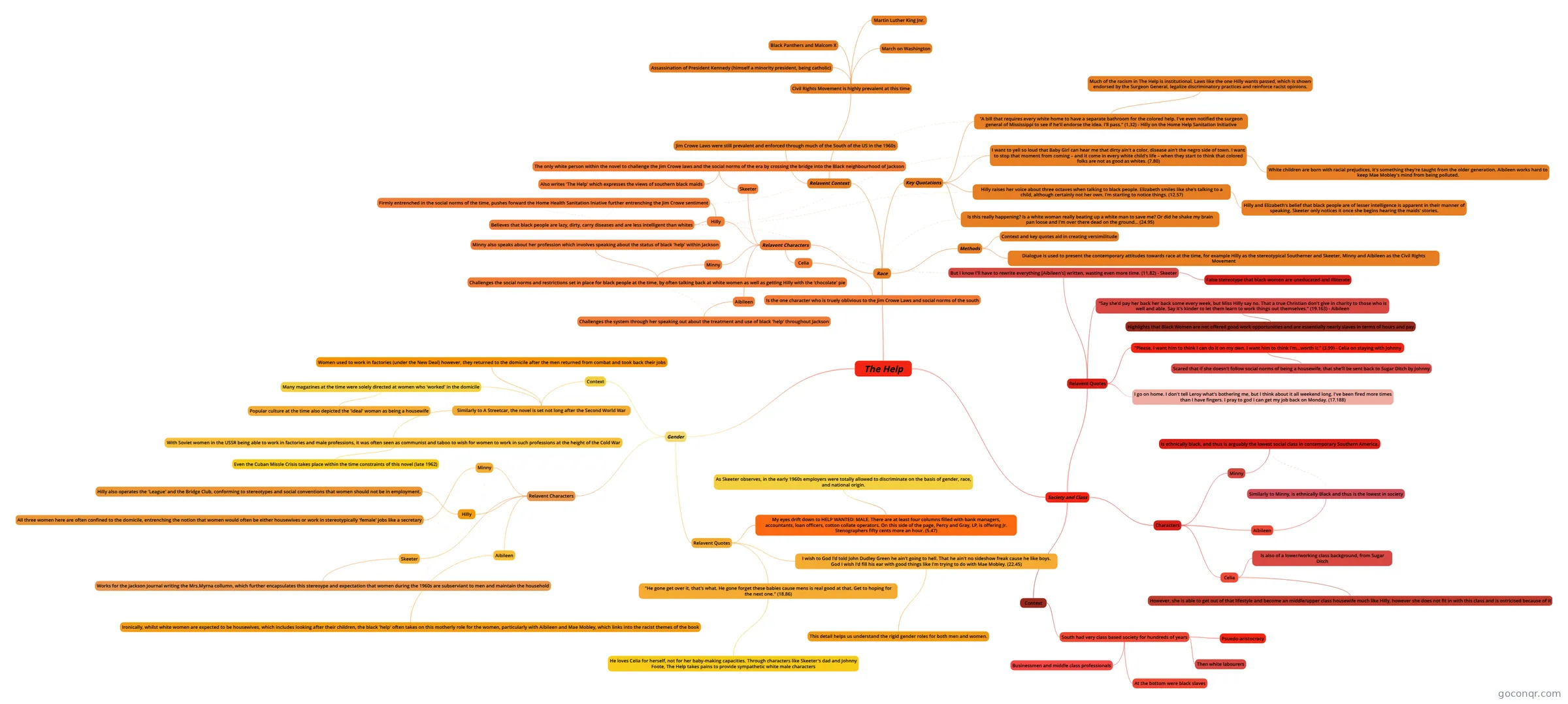
Mind map: The Help
Conteúdo do mapa
The Help
Gender
- Relavent Quotes
- My eyes drift down to HELP WANTED: MALE. There are at least four columns filled with bank managers, accountants, loan officers, cotton collate operators. On this side of the page, Percy and Gray, LP, is offering Jr. Stenographers fifty cents more an hour. (5.47)
- As Skeeter observes, in the early 1960s employers were totally allowed to discriminate on the basis of gender, race, and national origin.
- "He gone get over it, that's what. He gone forget these babies cause mens is real good at that. Get to hoping for the next one." (18.86)
- He loves Celia for herself, not for her baby-making capacities. Through characters like Skeeter's dad and Johnny Foote, The Help takes pains to provide sympathetic white male characters
- I wish to God I'd told John Dudley Green he ain't going to hell. That he ain't no sideshow freak cause he like boys. God I wish I'd fill his ear with good things like I'm trying to do with Mae Mobley. (22.45)
- This detail helps us understand the rigid gender roles for both men and women.
- My eyes drift down to HELP WANTED: MALE. There are at least four columns filled with bank managers, accountants, loan officers, cotton collate operators. On this side of the page, Percy and Gray, LP, is offering Jr. Stenographers fifty cents more an hour. (5.47)
- Relavent Characters
- Minny
- All three women here are often confined to the domicile, entrenching the notion that women would often be either housewives or work in stereotypically 'female' jobs like a secretary
- Hilly
- Hilly also operates the 'League' and the Bridge Club, conforming to stereotypes and social conventions that women should not be in employment.
- Aibileen
- Ironically, whilst white women are expected to be housewives, which includes looking after their children, the black 'help' often takes on this motherly role for the women, particularly with Aibileen and Mae Mobley, which links into the racist themes of the book
- Skeeter
- Works for the Jackson Journal writing the Mrs.Myrna collumn, which further encapsulates this stereoype and expectation that women during the 1960s are subserviant to men and maintain the household
- Minny
- Context
- Similarly to A Streetcar, the novel is set not long after the Second World War
- Women used to work in factories (under the New Deal) however, they returned to the domicile after the men returned from combat and took back their jobs
- Many magazines at the time were solely directed at women who 'worked' in the domicile
- Popular culture at the time also depicted the 'ideal' woman as being a housewife
- With Soviet women in the USSR being able to work in factories and male professions, it was often seen as communist and taboo to wish for women to work in such professions at the height of the Cold War
- Even the Cuban Missle Crisis takes place within the time constraints of this novel (late 1962)
- Similarly to A Streetcar, the novel is set not long after the Second World War
- Relavent Quotes
Society and Class
- Relavent Quotes
- "Please, I want him to think I can do it on my own. I want him to think I'm…worth it." (3.99) - Celia on staying with Johnny
- Scared that if she doesn't follow social norms of being a housewife, that she'll be sent back to Sugar Ditch by Johnny
- "Say she'd pay her back her back some every week, but Miss Hilly say no. That a true Christian don't give in charity to those who is well and able. Say it's kinder to let them learn to work things out themselves." (19.163) - Aibileen
- Highlights that Black Women are not offered good work opportunities and are essentially nearly slaves in terms of hours and pay
- But I know I'll have to rewrite everything [Aibileen's] written, wasting even more time. (11.82) - Skeeter
- False stereotype that black women are uneducated and illiterate
- I go on home. I don't tell Leroy what's bothering me, but I think about it all weekend long. I've been fired more times than I have fingers. I pray to god I can get my job back on Monday. (17.188)
- "Please, I want him to think I can do it on my own. I want him to think I'm…worth it." (3.99) - Celia on staying with Johnny
- Characters
- Minny
- Is ethnically black, and thus is arguably the lowest social class in contemporary Southern America.
- Aibileen
- Similarly to Minny, is ethnically Black and thus is the lowest in society
- Celia
- Is also of a lower/working class background, from Sugar Ditch
- However, she is able to get out of that lifestyle and become an middle/upper class housewife much like Hilly, however she does not fit in with this class and is ostricised because of it
- Minny
- Context
- South had very class based society for hundreds of years
- At the bottom were black slaves
- Then white labourers
- Businessmen and middle class professionals
- Psuedo-aristocracy
- South had very class based society for hundreds of years
- Relavent Quotes
Race
- Methods
- Context and key quotes aid in creating versimilitude
- Dialogue is used to present the contemporary attitudes towards race at the time, for example Hilly as the stereotypical Southerner and Skeeter, Minny and Aibileen as the Civil Rights Movement
- Key Quotations
- "A bill that requires every white home to have a separate bathroom for the colored help. I've even notified the surgeon general of Mississippi to see if he'll endorse the idea. I'll pass." (1.32) - Hilly on the Home Help Sanitation Initiative
- Much of the racism in The Help is institutional. Laws like the one Hilly wants passed, which is shown endorsed by the Surgeon General, legalize discriminatory practices and reinforce racist opinions.
- I want to yell so loud that Baby Girl can hear me that dirty ain't a color, disease ain't the negro side of town. I want to stop that moment from coming – and it come in every white child's life – when they start to think that colored folks are not as good as whites. (7.80)
- White children are born with racial prejudices, it's something they're taught from the older generation. Aibileen works hard to keep Mae Mobley's mind from being polluted.
- Hilly raises her voice about three octaves when talking to black people. Elizabeth smiles like she's talking to a child, although certainly not her own. I'm starting to notice things. (12.57)
- Hilly and Elizabeth's belief that black people are of lesser intelligence is apparent in their manner of speaking. Skeeter only notices it once she begins hearing the maids' stories.
- Is this really happening? Is a white woman really beating up a white man to save me? Or did he shake my brain pan loose and I'm over there dead on the ground… (24.95)
- "A bill that requires every white home to have a separate bathroom for the colored help. I've even notified the surgeon general of Mississippi to see if he'll endorse the idea. I'll pass." (1.32) - Hilly on the Home Help Sanitation Initiative
- Relavent Context
- Jim Crowe Laws were still prevalent and enforced through much of the South of the US in the 1960s
- Civil Rights Movement is highly prevalent at this time
- Black Panthers and Malcom X
- Martin Luther King Jnr.
- March on Washington
- Assassination of President Kennedy (himself a minority president, being catholic)
- Relavent Characters
- Minny
- Challenges the social norms and restrictions set in place for black people at the time, by often talking back at white women as well as getting Hilly with the 'chocolate' pie
- Minny also speaks about her profession which involves speaking about the status of black 'help' within Jackson
- Challenges the social norms and restrictions set in place for black people at the time, by often talking back at white women as well as getting Hilly with the 'chocolate' pie
- Hilly
- Firmly entrenched in the social norms of the time, pushes forward the Home Health Sanitation Iniative further entrenching the Jim Crowe sentiment
- Believes that black people are lazy, dirty, carry diseases and are less intelligent than whites
- Aibileen
- Challenges the system through her speaking out about the treatment and use of black 'help' throughout Jackson
- Skeeter
- The only white person within the novel to challenge the Jim Crowe laws and the social norms of the era by crossing the bridge into the Black neighbourhood of Jackson
- Also writes 'The Help' which expresses the views of southern black maids
- The only white person within the novel to challenge the Jim Crowe laws and the social norms of the era by crossing the bridge into the Black neighbourhood of Jackson
- Celia
- Is the one character who is truely oblivious to the Jim Crowe Laws and social norms of the south
- Minny
- Methods
Informações
- Descrição
- Mapa Mental sobre The Help, criado por spanish inquistion em 25-04-2017.
- Criado por
- spanish inquistion
- Visualizações
- 1
- Avaliação