
Mapa mental
Star Spectra
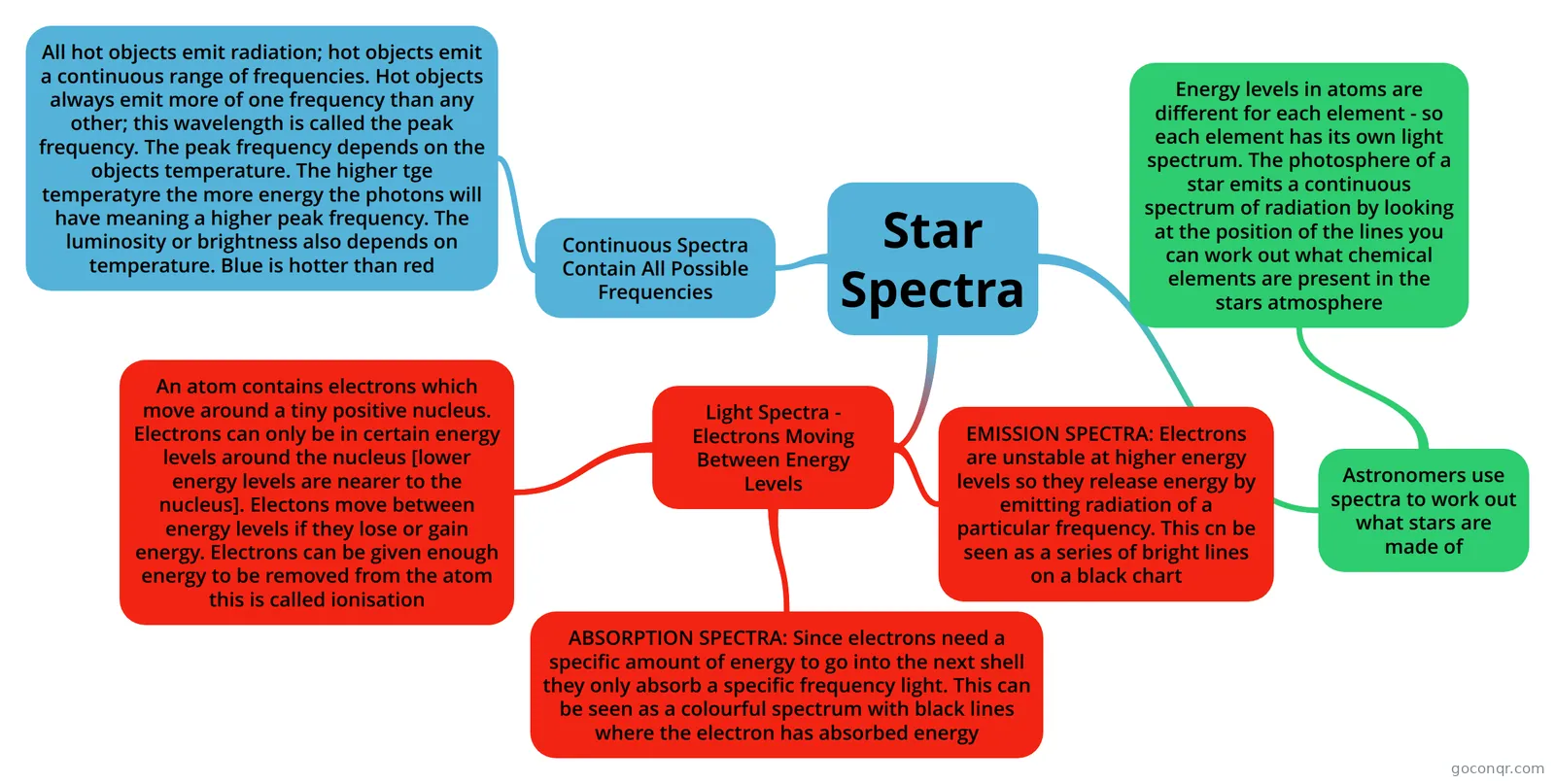
Mind map: star spectra
Conteúdo do mapa
Star Spectra
Continuous Spectra Contain All Possible Frequencies
- All hot objects emit radiation; hot objects emit a continuous range of frequencies. Hot objects always emit more of one frequency than any other; this wavelength is called the peak frequency. The peak frequency depends on the objects temperature. The higher tge temperatyre the more energy the photons will have meaning a higher peak frequency. The luminosity or brightness also depends on temperature. Blue is hotter than red
Light Spectra - Electrons Moving Between Energy Levels
- An atom contains electrons which move around a tiny positive nucleus. Electrons can only be in certain energy levels around the nucleus [lower energy levels are nearer to the nucleus]. Electons move between energy levels if they lose or gain energy. Electrons can be given enough energy to be removed from the atom this is called ionisation
- ABSORPTION SPECTRA: Since electrons need a specific amount of energy to go into the next shell they only absorb a specific frequency light. This can be seen as a colourful spectrum with black lines where the electron has absorbed energy
- EMISSION SPECTRA: Electrons are unstable at higher energy levels so they release energy by emitting radiation of a particular frequency. This cn be seen as a series of bright lines on a black chart
Astronomers use spectra to work out what stars are made of
- Energy levels in atoms are different for each element - so each element has its own light spectrum. The photosphere of a star emits a continuous spectrum of radiation by looking at the position of the lines you can work out what chemical elements are present in the stars atmosphere
Informações
- Descrição
- GCSE Physics (P7) Mapa Mental sobre Star Spectra, criado por Mayibongwe Chivizhe em 01-05-2017.
- Criado por
- Mayibongwe Chivizhe
- Visualizações
- 17
- Avaliação