
Mapa mental
Eating Behaviour
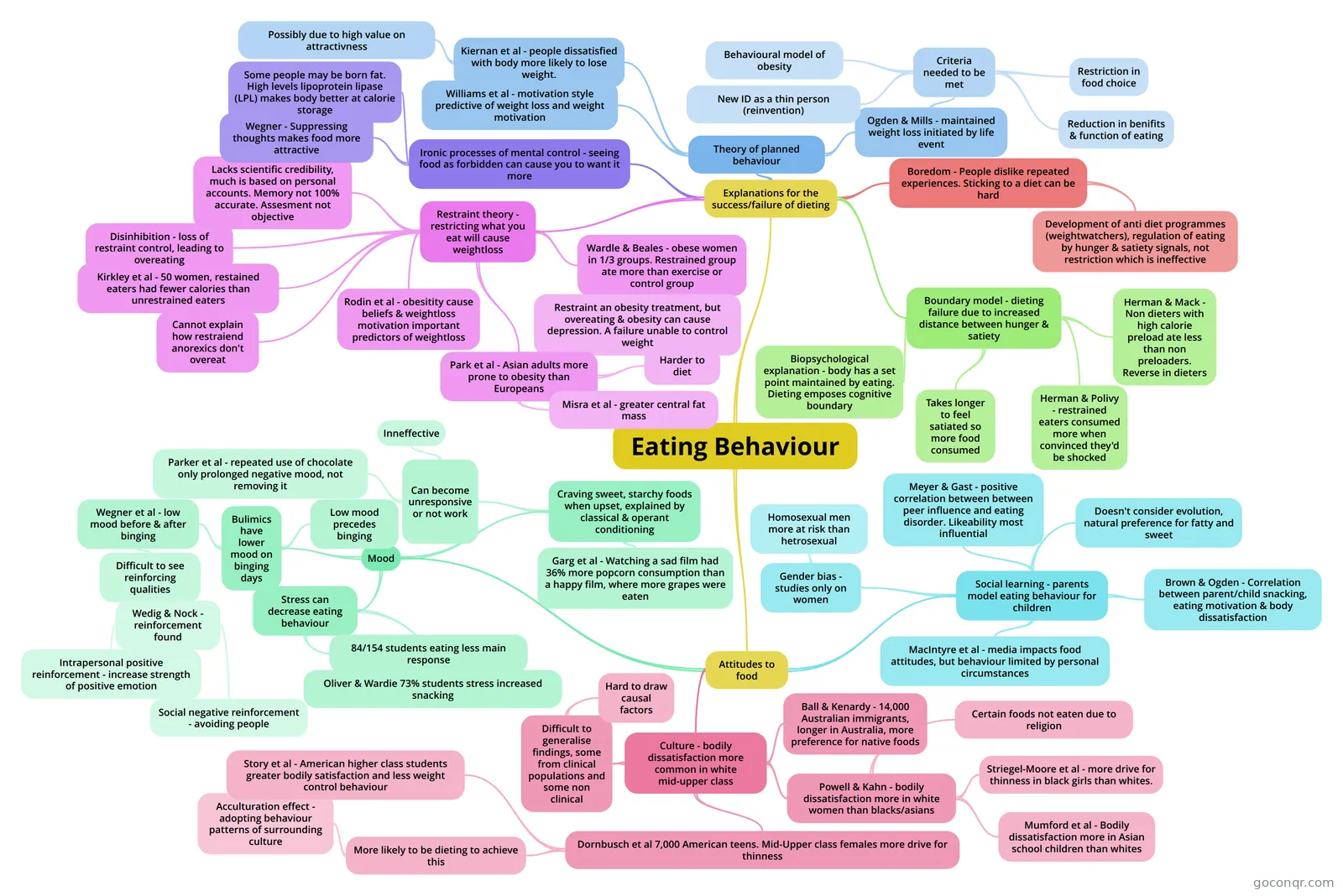
Mind map: Eating behaviour
Conteúdo do mapa
Eating Behaviour
Attitudes to food
- Social learning - parents model eating behaviour for children
- Brown & Ogden - Correlation between parent/child snacking, eating motivation & body dissatisfaction
- MacIntyre et al - media impacts food attitudes, but behaviour limited by personal circumstances
- Meyer & Gast - positive correlation between between peer influence and eating disorder. Likeability most influential
- Doesn't consider evolution, natural preference for fatty and sweet
- Gender bias - studies only on women
- Homosexual men more at risk than hetrosexual
- Culture - bodily dissatisfaction more common in white mid-upper class
- Powell & Kahn - bodily dissatisfaction more in white women than blacks/asians
- Certain foods not eaten due to religion
- Striegel-Moore et al - more drive for thinness in black girls than whites.
- Mumford et al - Bodily dissatisfaction more in Asian school children than whites
- Ball & Kenardy - 14,000 Australian immigrants, longer in Australia, more preference for native foods
- Dornbusch et al 7,000 American teens. Mid-Upper class females more drive for thinness
- More likely to be dieting to achieve this
- Acculturation effect - adopting behaviour patterns of surrounding culture
- Story et al - American higher class students greater bodily satisfaction and less weight control behaviour
- More likely to be dieting to achieve this
- Difficult to generalise findings, some from clinical populations and some non clinical
- Hard to draw causal factors
- Powell & Kahn - bodily dissatisfaction more in white women than blacks/asians
- Mood
- Craving sweet, starchy foods when upset, explained by classical & operant conditioning
- Garg et al - Watching a sad film had 36% more popcorn consumption than a happy film, where more grapes were eaten
- Can become unresponsive or not work
- Parker et al - repeated use of chocolate only prolonged negative mood, not removing it
- Inneffective
- Bulimics have lower mood on binging days
- Wegner et al - low mood before & after binging
- Difficult to see reinforcing qualities
- Wedig & Nock - reinforcement found
- Social negative reinforcement - avoiding people
- Intrapersonal positive reinforcement - increase strength of positive emotion
- Wedig & Nock - reinforcement found
- Difficult to see reinforcing qualities
- Low mood precedes binging
- Wegner et al - low mood before & after binging
- Stress can decrease eating behaviour
- 84/154 students eating less main response
- Oliver & Wardie 73% students stress increased snacking
- Craving sweet, starchy foods when upset, explained by classical & operant conditioning
- Social learning - parents model eating behaviour for children
Explanations for the success/failure of dieting
- Restraint theory - restricting what you eat will cause weightloss
- Kirkley et al - 50 women, restained eaters had fewer calories than unrestrained eaters
- Rodin et al - obesitity cause beliefs & weightloss motivation important predictors of weightloss
- Disinhibition - loss of restraint control, leading to overeating
- Wardle & Beales - obese women in 1/3 groups. Restrained group ate more than exercise or control group
- Restraint an obesity treatment, but overeating & obesity can cause depression. A failure unable to control weight
- Cannot explain how restraiend anorexics don't overeat
- Park et al - Asian adults more prone to obesity than Europeans
- Harder to diet
- Misra et al - greater central fat mass
- Lacks scientific credibility, much is based on personal accounts. Memory not 100% accurate. Assesment not objective
- Boundary model - dieting failure due to increased distance between hunger & satiety
- Biopsychological explanation - body has a set point maintained by eating. Dieting emposes cognitive boundary
- Takes longer to feel satiated so more food consumed
- Herman & Polivy - restrained eaters consumed more when convinced they'd be shocked
- Herman & Mack - Non dieters with high calorie preload ate less than non preloaders. Reverse in dieters
- Ironic processes of mental control - seeing food as forbidden can cause you to want it more
- Wegner - Suppressing thoughts makes food more attractive
- Some people may be born fat. High levels lipoprotein lipase (LPL) makes body better at calorie storage
- Boredom - People dislike repeated experiences. Sticking to a diet can be hard
- Development of anti diet programmes (weightwatchers), regulation of eating by hunger & satiety signals, not restriction which is ineffective
- Theory of planned behaviour
- Williams et al - motivation style predictive of weight loss and weight motivation
- Kiernan et al - people dissatisfied with body more likely to lose weight.
- Possibly due to high value on attractivness
- Ogden & Mills - maintained weight loss initiated by life event
- Criteria needed to be met
- Behavioural model of obesity
- Restriction in food choice
- Reduction in benifits & function of eating
- New ID as a thin person (reinvention)
- Criteria needed to be met
- Restraint theory - restricting what you eat will cause weightloss
Informações
- Descrição
- Mindmap for AQA-A psychology unit 3 eating behaviour
- Criado por
- Brendan Williams
- Visualizações
- 248
- Tags
- Histórico
-
- Criado por Brendan Williams · 14 mai 2014
- Copiado por Brendan Williams · 14 mai 2014
- Avaliação