Hormones of the kidney

Descrição

AHS1. Renal physiology. Hormones of the kidney. Frankie 5/6
Florence Papworth
Mapa Mental por Florence Papworth, atualizado more than 1 year ago
Florence Papworth
Criado por Florence Papworth mais de 9 anos atrás
266
0

Resumo de Recurso

Hormones of the kidney
  1. Learning objectives
    1. Antidiuretic hormone
      1. Renin-angiotensin-aldosterone system
      2. Antidiuretic hormone (ADH/vasopressin)
        1. released in response to osmolarity changes in plasma
          1. plasma osmolarity detected by osmoreceptors
            1. osmoreceptors - located in hypothalamus
            2. osmoreceptors regulate release of ADH from neuroendocrine cells
              1. ADH released from posterior pituitary
              2. ADH function
                1. excess fluid lowers body fluid osmolarity
                  1. fluid deprivation increases fluid osmolarity
                  2. changes in osmolarity lead to appropriate changes in ADH release
                    1. At normal plasma osmolarity - ADH present in blood
                    2. Increase in osmolarity = increases circulating levels of ADH -> increase water reabsorption
                      1. Decrease in osmolarity = reduced circulating levels of ADH -> decreased water reabsorption
                        1. Acts on collecting duct
                        2. ADH and blood pressure
                          1. ADH release also under influence of blood pressure
                            1. Negative feedback from BARORECPETORS via MEDULLA
                              1. pathway = baroreceptor -> medulla -> hypothalamus -> posterior pituitary -> ADH!
                              2. Increase in arterial BP -> reduction of ADH release
                                1. higher water concentration increases the volume and pressure blood
                                2. not as an effective stimulus as osmolarity changes
                                3. Role of ADH
                                  1. normal osmolarity ~ 290 mosmol/L
                                    1. excess fluid ingestion
                                      1. decreased ECF osmolarity
                                        1. HYPOTHALAMIC OSMORECEPTOR
                                          1. reduced ADH release
                                            1. collecting ducts impermeable to water
                                              1. water reabsorption decreased
                                            2. increased ADH release
                                              1. collecting ducts permeable to water (using urea)
                                                1. water reabsorbtion increased
                                        2. water deprivation
                                          1. increased ECF osmolarity
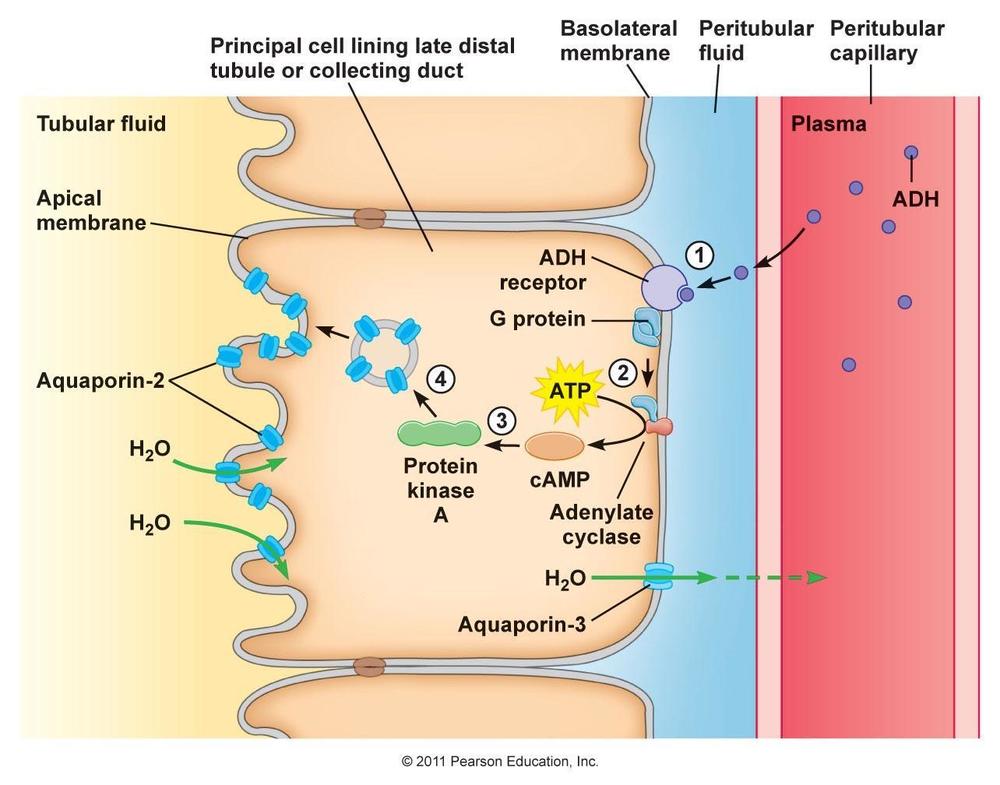
                                      2. ADH on principal cells
                                        1. ADH receptor detects ADH in peritubular fluid/capillary
                                          1. ADH channels internalised
                                            1. Urea brought into the cell using proteins
                                              1. increased aquaporin expression - increased water reabsorption
                                                1. decreased volume of urine produced
                                          2. Control of circulating ADH
                                            1. ADH responds within minutes to changes in osmolarity
                                              1. For an effective regulatory system ADH must be rapidly removed from blood
                                                1. Half life of ADH = 15 minutes
                                                  1. removed by kidneys or metabolised
                                                  2. Release effected by:
                                                    1. NICOTINE increases ADH release, as do barbiturates and morphine
                                                      1. Alcohol - decrease ADH release?
                                                        1. DISORDERS:
                                                          1. diabetes insipidus
                                                            1. central - production of ADH affected
                                                              1. Nephrohrogenic - renal response to ADH affected
                                                        2. Regulation of body fluid - Hormonal influences
                                                          1. Aldosterone
                                                            1. Renin-angiotensin
                                                              1. Atrial natriuretic peptide
                                                                1. Regulation of ECF volume
                                                                  1. levels of sodium must be regulated (total sodium determines total body water)
                                                                    1. no good evidence for sodium receptor - regulation via OSMORECEPTORS and volume of ECF
                                                                  2. increased Na+ intake -> increased Na+ in ECF --> increased osmolarity of ECF
                                                                    1. osmoreceptors
                                                                      1. increased ADH, increased water retention combined with increased thirst and fluid intake --> increased volume of ECF
                                                                      2. osmotic withdrawl of water from cells
                                                                    2. Regulation of body fluid -adolsterone
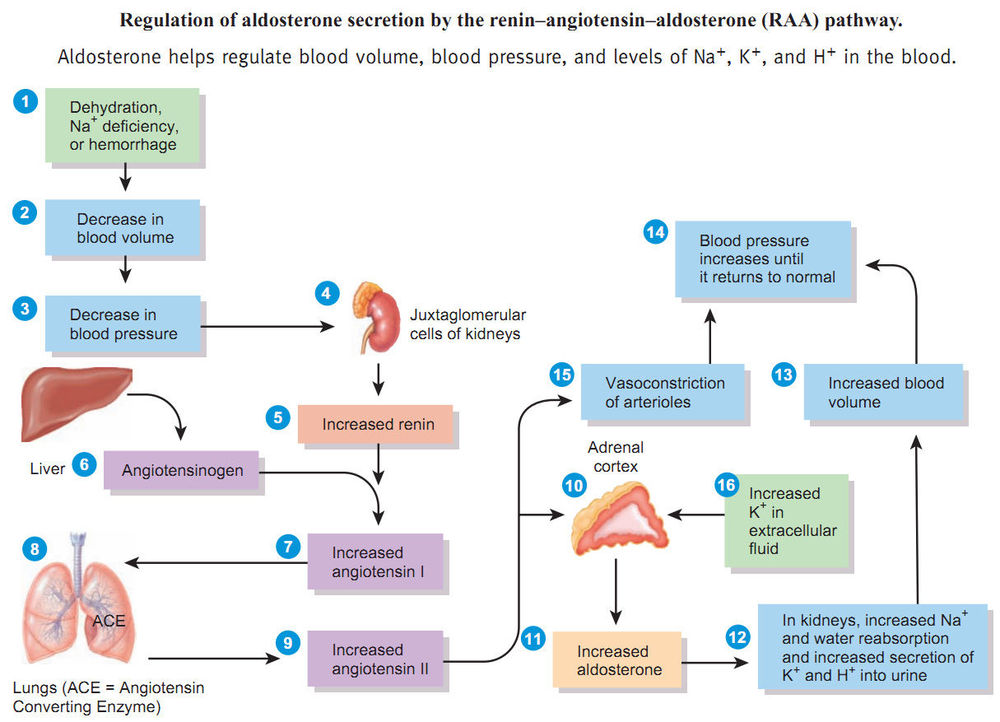
                                                                      1. body fluid regulated by renin-angiotensin-aldosterone system
                                                                        1. ALDOSTERONE- produced in ADRENAL CORTEX
                                                                          1. stimulates Na+ reabsorption in distal parts of nephron
                                                                            1. promotes H+ and K+ secretion (via H+K+ATPase)
                                                                              1. promotes Na+ reabsorption from colon, gastric glands and sweat glands
                                                                                1. i.e. increases net Na+ reabsorption so increases body fluid volume via osmolarity changes and hence osmosis
                                                                              2. Aldosterone- nephron and adrenal cortex
                                                                                1. Nephron
                                                                                  1. increased Na+ reabsorption in DISTAL TUBULE and COLLECTING DUCT
                                                                                    1. up regulation of : Na channels and Na/K pump activity
                                                                                      1. K+ secretion
                                                                                      2. Adrenal cortex
                                                                                        1. Acts on distal tubule = increased K+ secretion in urine
                                                                                          1. Allosteric, negative feedback loop - increased pottassium secretion inhibits aldosterone release vice versa
                                                                                        2. Renin-angiotension system
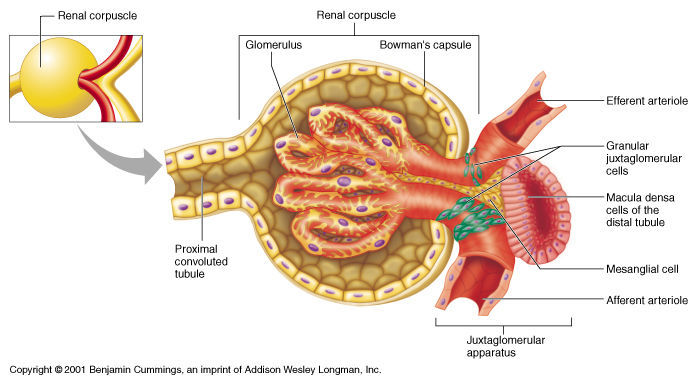
                                                                                          1. renin - an enzyme - produced by JUXTAGLOMERULAR APPARATUS
                                                                                            1. Released into plasma when body Na+ is reduced
                                                                                              1. Stimulus for release is NOT Na+ itself
                                                                                                1. via effective circulating volume ECV - as Na+ determine this
                                                                                                2. low Na+ causes renin release
                                                                                                  1. increased sympathetic release causes renin release
                                                                                                    1. granulosa cells produce renin
                                                                                                  2. Decrease in sodium -> decrease in ECF
                                                                                                    1. sympathetic activity
                                                                                                      1. afferent arteriolar pressure
                                                                                                        1. RENIN RELEASE
                                                                                                        2. Na+ at macula densa
                                                                                                      2. Activation of R-A-S
                                                                                                        1. Decrease in Na content -> Decrease in ECV
                                                                                                          1. increased sympathetic activity
                                                                                                            1. Lower Na+ at macula densa
                                                                                                              1. collection specialised epithelial cells in distal convoluted tubule, detect sodium concentration
                                                                                                              2. decreased afferent arteriolar pressure
                                                                                                              3. RENIN RELEASE
                                                                                                                1. 1. renin acts on angiotensin acts on angiotensiongen in blood to split off angiotensin 1
                                                                                                                  1. 2. ACE enzyme in lungs converts angiotensin 1 - angiotensin 2
                                                                                                                    1. 3. Angiotensin 2 has many effects that lead to ECV increase
                                                                                                              4. Angiotensinogen
                                                                                                                1. combines with renin to form angiotensin 1
                                                                                                                  1. ACE converting enzyme converts angiotensin 1 --> angiotensin 2
                                                                                                                  2. Angiotensin 2 causes:
                                                                                                                    1. vasoconstriction
                                                                                                                      1. increased adolsterone
                                                                                                                        1. increased ADH = increased thirst
                                                                                                                          1. increased Na+ reabsorption
                                                                                                                            1. decreased GFR
                                                                                                                              1. increase fluid volume - increases blood pressure till stabilised to normal levels

                                                                                                                            Semelhante

                                                                                                                            Epithelial tissue
                                                                                                                            Morgan Morgan
                                                                                                                            Renal System A&P
                                                                                                                            Kirsty Jayne Buckley
                                                                                                                            Physiology / Intro psychology
                                                                                                                            Molly Macgregor
                                                                                                                            Introduction to Therapeutic Physical Agents
                                                                                                                            natalia m zameri
                                                                                                                            Malignancies
                                                                                                                            Mark George
                                                                                                                            General Physiology of the Nervous System Physiology PMU 2nd Year
                                                                                                                            Med Student
                                                                                                                            Blood MCQs Physiology PMU 2nd Year
                                                                                                                            Med Student
                                                                                                                            Muscles- Physiology MCQs PMU- 2nd Year
                                                                                                                            Med Student
                                                                                                                            The Gastrointestinal System- Physiology- PMU
                                                                                                                            Med Student
                                                                                                                            Cardiovascular System- Physiology PMU- 2nd Year 2nd Sem
                                                                                                                            Med Student
                                                                                                                            Respiratory System
                                                                                                                            Addeana