
Mapa mental
Improving Organisational structures
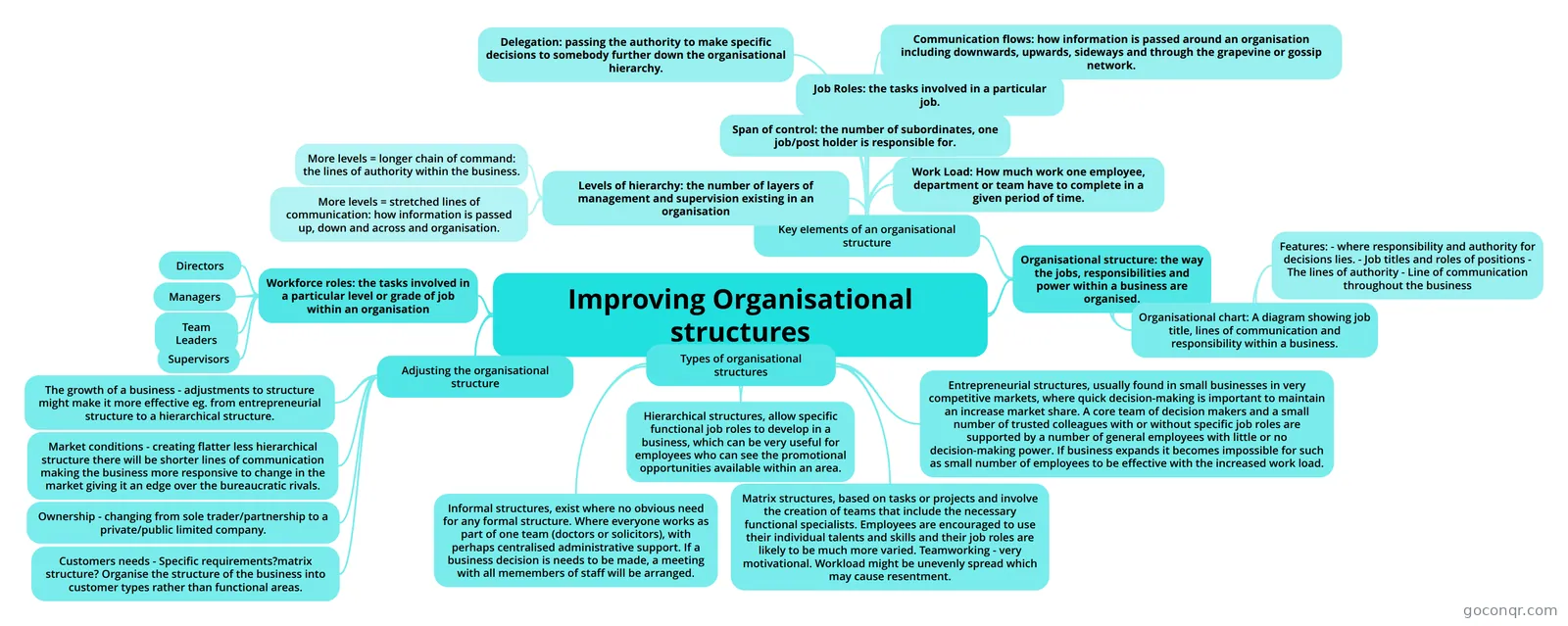
Mind map: Improving organisational structures
Conteúdo do mapa
Improving Organisational structures
Organisational structure: the way the jobs, responsibilities and power within a business are organised.
- Organisational chart: A diagram showing job title, lines of communication and responsibility within a business.
- Features: - where responsibility and authority for decisions lies. - Job titles and roles of positions - The lines of authority - Line of communication throughout the business
- Key elements of an organisational structure
- Levels of hierarchy: the number of layers of management and supervision existing in an organisation
- More levels = longer chain of command: the lines of authority within the business.
- More levels = stretched lines of communication: how information is passed up, down and across and organisation.
- Span of control: the number of subordinates, one job/post holder is responsible for.
- Work Load: How much work one employee, department or team have to complete in a given period of time.
- Job Roles: the tasks involved in a particular job.
- Delegation: passing the authority to make specific decisions to somebody further down the organisational hierarchy.
- Communication flows: how information is passed around an organisation including downwards, upwards, sideways and through the grapevine or gossip network.
- Levels of hierarchy: the number of layers of management and supervision existing in an organisation
- Organisational chart: A diagram showing job title, lines of communication and responsibility within a business.
Types of organisational structures
- Hierarchical structures, allow specific functional job roles to develop in a business, which can be very useful for employees who can see the promotional opportunities available within an area.
- Matrix structures, based on tasks or projects and involve the creation of teams that include the necessary functional specialists. Employees are encouraged to use their individual talents and skills and their job roles are likely to be much more varied. Teamworking - very motivational. Workload might be unevenly spread which may cause resentment.
- Entrepreneurial structures, usually found in small businesses in very competitive markets, where quick decision-making is important to maintain an increase market share. A core team of decision makers and a small number of trusted colleagues with or without specific job roles are supported by a number of general employees with little or no decision-making power. If business expands it becomes impossible for such as small number of employees to be effective with the increased work load.
- Informal structures, exist where no obvious need for any formal structure. Where everyone works as part of one team (doctors or solicitors), with perhaps centralised administrative support. If a business decision is needs to be made, a meeting with all memembers of staff will be arranged.
Workforce roles: the tasks involved in a particular level or grade of job within an organisation
- Directors
- Managers
- Team Leaders
- Supervisors
Adjusting the organisational structure
- The growth of a business - adjustments to structure might make it more effective eg. from entrepreneurial structure to a hierarchical structure.
- Market conditions - creating flatter less hierarchical structure there will be shorter lines of communication making the business more responsive to change in the market giving it an edge over the bureaucratic rivals.
- Ownership - changing from sole trader/partnership to a private/public limited company.
- Customers needs - Specific requirements?matrix structure? Organise the structure of the business into customer types rather than functional areas.
Informações
- Descrição
- Mapa Mental sobre Improving Organisational structures, criado por holtill em 31-05-2014.
- Criado por
- holtill
- Visualizações
- 15
- Avaliação