
Mapa mental
Chapters 3 & 4 Concept Map
Conteúdo do mapa
Chapters 3 & 4 Concept Map
Chapter 3
- Section 3.1
- Exponential Growth
- Modeled by: f(x)=Ca^x
- x= # of time periods
- a= the growth factor
- C is the initial value
- a= the growth factor
- x= # of time periods
- Modeled by: f(x)=Ca^x
- Exponential Decay
- Modeled by: f(x)=Ca^x
- Where 0 < a < 1
- x= # of time periods
- a= the decay factor
- Decay rate (r) satisfies a=1+r, so the rate is NEGATIVE
- a= the decay factor
- Modeled by: f(x)=Ca^x
- Exponential Growth
- Section 3.2
- Changing the Time Period
- ex: Jenny had 2 cats. Today (five years later), she has 20 cats.
- Find the 5 years growth factor
- later/initial
- 20/2
- =10
- =1000%
- =10
- 20/2
- Find one-year growth factor, round to three decimal places
- 10^1/5
- 1.585
- Find an exponential function c(t) for the # of cats Jenny has per year starting 5 years ago
- y=Ca^x
- y=2(1.585)^t
- y=Ca^x
- 10^1/5
- later/initial
- Find the 5 years growth factor
- ex: Jenny had 2 cats. Today (five years later), she has 20 cats.
- Half-Life
- The time it takes for half the atoms to decay
- a=1/2
- ex: A bacteria starts with 20,000 bacteria. The half-life is 20 years
- Find the model, b(t), for a 20 year decay rate
- How many bacteria are left after 240 years?
- 240/20=12
- b(t)=200,000(1/2)^12
- 4.88 bacteria
- b(t)=200,000(1/2)^12
- 240/20=12
- a=1/2
- b(t)=200,000(1/2)^t
- t=# of 20 year half-lives
- b(t)=200,000(1/2)^t
- How many bacteria are left after 240 years?
- Find the model, b(t), for a 20 year decay rate
- The time it takes for half the atoms to decay
- Compounding Interest
- A = P(1+(r/n))^nt
- Ex: $30,000 is invested in a savings account that pays 4% annual interest COMPOUNDED DAILY, what will the account balance be after 6 years?
- A= ?
- P=30,000
- r=.04
- n=365
- t= 6
- A= 30,000(1+(.04/365))^365*6
- =$38,136.97
- Ex: $30,000 is invested in a savings account that pays 4% annual interest COMPOUNDED DAILY, what will the account balance be after 6 years?
- A = P(1+(r/n))^nt
- Compounding Continuously
- Definition: THE NUMBER e: an irrational number represented by the letter 'e'
- A=Pe^rt
- Annual Percentage Yield (APY)
- The annual growth rate of an investment, given by:
- (1+(r/n))^nt -1
- EX: what is the annual percentage yield of an investment that is compounded quarterly at 7.75%?
- (1+(0.0775/4))^ 4*1
- =1.0798-1
- =.0798
- 7.98%
- =.0798
- =1.0798-1
- (1+(0.0775/4))^ 4*1
- The annual growth rate of an investment, given by:
- Changing the Time Period
- Section 3.3
- Rate of Change
- f(x+1) - f(x)
- If the AVERAGE RATE OF CHANGE for a consecutive outputs is constant, then there is a LINEAR model that fits the data exactly
- Adding or subtracting
- Growth or decay factor
- Percentage Rate of Change
- For growth or decay models, growth or decay rate (r) is:
- r = a - 1
- If the PERCENTAGE RATE OF CHANGE for a consecutive outputs is constant, then there is an EXPONENTIAL MODEL that fits the data exactly
- Multiplying and dividing
- For growth or decay models, growth or decay rate (r) is:
- Rate of Change
- Section 3.4
- Graphs of Exponential Functions
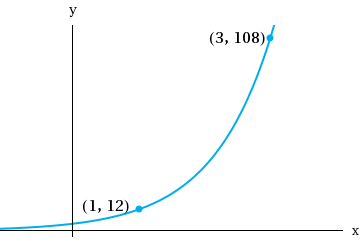
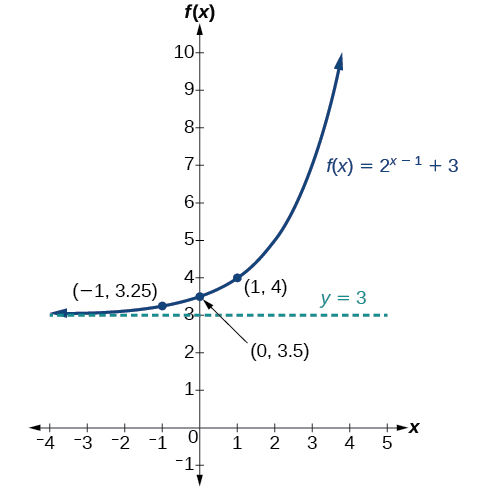
- f(x) = a^x FOR a > 1
- Moving AWAY from the x-axis
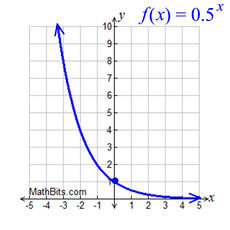
- f(x) = a^x FOR 0 < a < 1
- Moving TOWARDS the x-axis
- The line y=0 (the x-axis) is a horizontal asymptote of (f)
- f(x) = a^x FOR a > 1
- Graphs of Exponential Functions
- Toolkits A.3 & A.4
- Exponential Notation
- 2^4
- 2*2*2*2
- =16
- 2*2*2*2
- 2^4
- Rules for Working with Exponents
- Product Rule
- To MULTIPLY two powers of the same #, ADD the exponents
- 2^3*2^6
- 2*2*2 * 2*2*2*2*2*2
- =2^9
- 2*2*2 * 2*2*2*2*2*2
- 2^3*2^6
- To MULTIPLY two powers of the same #, ADD the exponents
- Quotient Rule
- To DIVIDE two powers of the same #, SUBTRACT the exponents
- 5^5/5^2
- 5*5*5*5*5 / 5*5
- Two 5's cancel out from top & bottom
- 5*5*5
- OR 5^5-2
- =5^3
- Two 5's cancel out from top & bottom
- 5*5*5*5*5 / 5*5
- 5^5/5^2
- To DIVIDE two powers of the same #, SUBTRACT the exponents
- Power Rule
- To raise a power to ANOTHER power, MULTIPLY the exponents
- (6^3)^2
- Two times
- 6^3 * 6^3
- = 6^6
- (6^3)^2
- To raise a power to ANOTHER power, MULTIPLY the exponents
- Product Rule
- Powers of Products/Quotient Rules for Exponents
- To raise a product to a power, raise each factor to the power
- (7x)^3
- 7^3 x^3
- =343x^3
- Both are in the parenthesis, so they both get the exponent
- =343x^3
- 7^3 x^3
- (7x)^3
- To raise a quotient to a power, raise both numerator and denominator to the power
- (3/8)^4
- 3^4/8^4
- 81/4096
- Won't reduce because 3 can't go into 8
- 81/4096
- 3^4/8^4
- (3/8)^4
- To raise a product to a power, raise each factor to the power
- Special Relations
- If 'a' is any nonzero real number and 'n' is a positive integer, then:
- a^0=1
- a^-n= 1/a^n
- If 'a' is any nonzero real number and 'n' is a positive integer, then:
- Rational Exponents
- Radicals:
- 2^1/3
- 3√2
- 2^1/3
- Exponential Notation:
- 4√6
- 6^1/4
- 4√6
- Radicals:
- Exponential Notation
- Section 3.1
Chapter 4
- Section 4.1
- Determining the Base
- log5 (625)= c
- Base: 5
- log5 (625)= c
- Rewrite in Exponential Form
- log6 (36) = a
- Exponential form: 6^a = 36
- Solution: a=2
- Exponential form: 6^a = 36
- log6 (36) = a
- Chase of base formula
- logbX = logaX/logaB
- log11 (355)
- 11^x=355
- On calculator: log(355)/log(11)
- =2.449
- On calculator: log(355)/log(11)
- 11^x=355
- log11 (355)
- logbX = logaX/logaB
- Determining the Base
- Section 4.2
- Laws of Logarithms
- logb(mn)= logb(m)+logb(n)
- The logarithm of a product is the sum of the logarithms
- logb(m/n)= logb(m)-logb(n)
- The logarithm of a quotient is the difference of the logarithms
- logb(m^n)= n*logb(m)
- The logarithm of a power is the exponent times the logarithm of the base
- logb(mn)= logb(m)+logb(n)
- Laws of Logarithms
- Section 4.3
- Linear Scale
- Each mark on the scale corresponds to adding a fixed #
- Logarithmic Scale
- Each mark on the scale corresponds to multiplying by a fixed FACTOR
- The pH Scale
- Measures how acidic or basic a substance is
- Ranges from 0-14
- A pH of 7 is neutral
- Ranges from 0-14
- pH = -log [H+]
- Measures how acidic or basic a substance is
- The Decibel Scale
- S= k * log (I / I^0)
- B= 10 * log (I / I^0), where I^0= 10^ -12
- Linear Scale
- Section 4.4
- Natural Exponential function
- f(x) = e^x
- Natural Logarithm function
- f(x) = ln(x) = loge^x
- ln(x)=y IF AND ONLY IF e^y=x
- Exponential Growth and Decay
- The exponential function: f(t)= Ce^rt
- t represents time
- r is the INSTANTANEOUS growth rate
- C is the initial value of f
- The exponential function: f(t)= Ce^rt
- Expressing an Exponential Model in Terms of e
- The exponential growth or decay model...
- f(x)= Ca^x
- (growth or decay factor 'a' time period)
- f(x)= Ca^x
- ...is equivalent to the exponential model...
- f(x)= Ce^rx
- (instantaneous growth or decay rate 'r' per time period)
- f(x)= Ce^rx
- ...where the instaneous growth or decay rate is...
- r = ln(a)
- The exponential growth or decay model...
- How to find the INSTANTANEOUS growth rate for a culture that starts with 100 bacteria
- Set the models equal
- Divide by 100
- Take the natural logs of each side
- Power property of logs
- Divide by x
- Power property of logs
- Take the natural logs of each side
- Divide by 100
- Ca^x
- 100*2^x
- 2^x
- ln(2^x)
- (inverse of e)
- x*ln(2)
- ln(2)
- ln(2^x)
- 2^x
- 100*2^x
- Ce^rx
- 100e^rx
- e^rx
- ln(e^rx)
- (undoes the exponent)
- rx
- r
- Instantaneous
- r
- ln(e^rx)
- e^rx
- 100e^rx
- =
- MAIN IDEA:
- If the growth factor for a population is 'a', then the instantaneous growth rate is ln(a)
- MAIN IDEA:
- Set the models equal
- Natural Exponential function
- Section 4.5
- ex: Convert exponentials to logs
- 2^x=16
- log2(16)=x
- log(16)/log(2)
- 4=x
- log(16)/log(2)
- log2(16)=x
- 2^x=16
- ex: Get exponents to the same side
- 3^x= 15*7^x
- Divide by 7x on both sides
- (3/7)^x = 15
- log(3/7)(15)=x
- log(15)/log(3/7)
- x= 3.20
- log(15)/log(3/7)
- log(3/7)(15)=x
- (3/7)^x = 15
- Divide by 7x on both sides
- 3^x= 15*7^x
- ex: Isolate the log first
- Convert log to an exponent
- 2logx=3
- Divide by 2 on both sides
- log10(x)= 3/2
- Make 10 the base of the exponent
- 10^(3/2)
- x=31.62
- 10^(3/2)
- Make 10 the base of the exponent
- log10(x)= 3/2
- Divide by 2 on both sides
- 2logx=3
- Convert log to an exponent
- Applying what we learned from other sections to this section
- ex: Convert exponentials to logs
- Section 4.1
Imagens e arquivos do mapa
Informações
- Descrição
- Education Mapa Mental sobre Chapters 3 & 4 Concept Map, criado por Kenzie Ciardo em 23-10-2017.
- Criado por
- Kenzie Ciardo
- Visualizações
- 2
- Avaliação