
Mapa mental
Operations managment
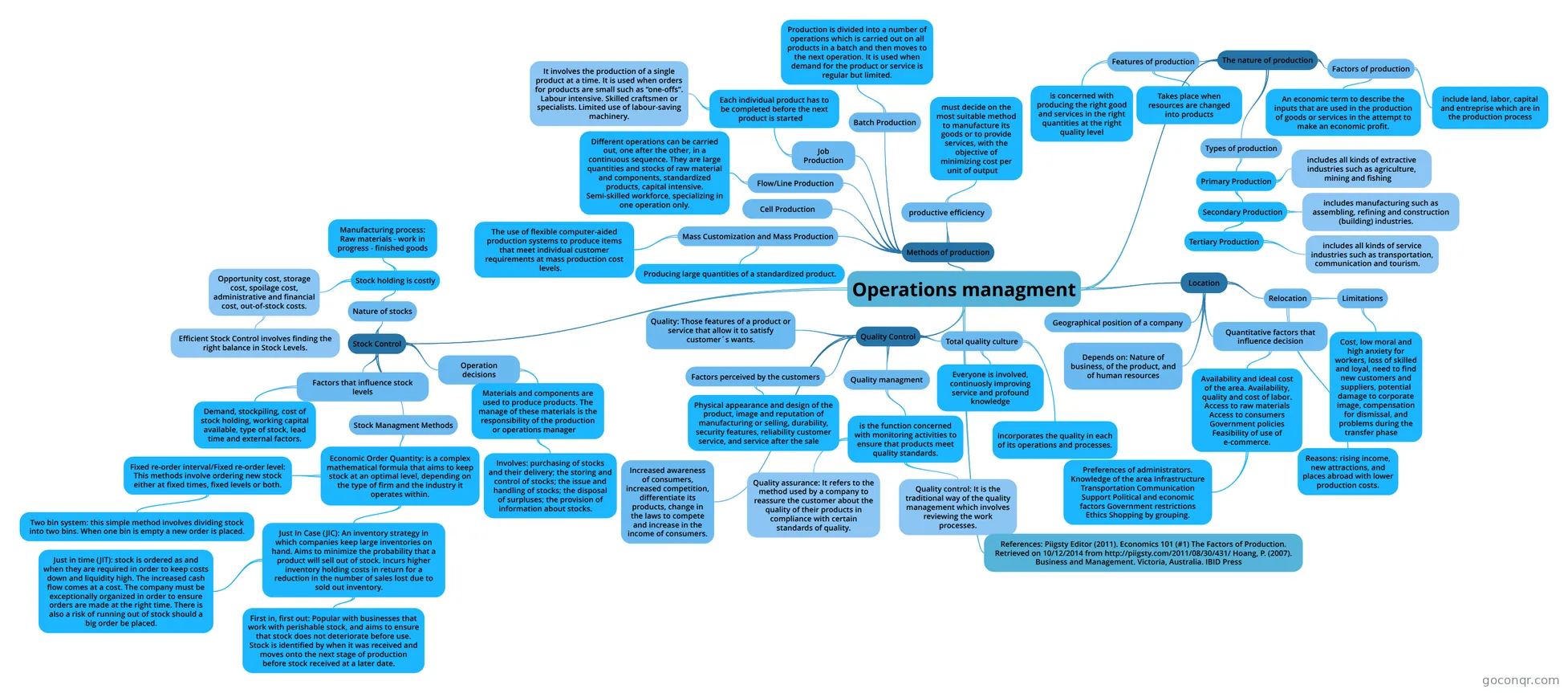
Mind map: Operations management
Conteúdo do mapa
Operations managment
The nature of production
- Features of production
- is concerned with producing the right good and services in the right quantities at the right quality level
- Takes place when resources are changed into products
- Factors of production
- An economic term to describe the inputs that are used in the production of goods or services in the attempt to make an economic profit.
- include land, labor, capital and entreprise which are in the production process
- Types of production
- Primary Production
- Secondary Production
- Tertiary Production
- includes all kinds of service industries such as transportation, communication and tourism.
- includes manufacturing such as assembling, refining and construction (building) industries.
- Tertiary Production
- includes all kinds of extractive industries such as agriculture, mining and fishing
- Secondary Production
- Primary Production
- Features of production
Methods of production
- productive efficiency
- must decide on the most suitable method to manufacture its goods or to provide services, with the objective of minimizing cost per unit of output
- Cell Production
- Job Production
- Each individual product has to be completed before the next product is started
- It involves the production of a single product at a time. It is used when orders for products are small such as “one-offs”. Labour intensive. Skilled craftsmen or specialists. Limited use of labour-saving machinery.
- Each individual product has to be completed before the next product is started
- Batch Production
- Production is divided into a number of operations which is carried out on all products in a batch and then moves to the next operation. It is used when demand for the product or service is regular but limited.
- Flow/Line Production
- Different operations can be carried out, one after the other, in a continuous sequence. They are large quantities and stocks of raw material and components, standardized products, capital intensive. Semi-skilled workforce, specializing in one operation only.
- Mass Customization and Mass Production
- The use of flexible computer-aided production systems to produce items that meet individual customer requirements at mass production cost levels.
- Producing large quantities of a standardized product.
- productive efficiency
Stock Control
- Operation decisions
- Materials and components are used to produce products. The manage of these materials is the responsibility of the production or operations manager
- Involves: purchasing of stocks and their delivery; the storing and control of stocks; the issue and handling of stocks; the disposal of surpluses; the provision of information about stocks.
- Materials and components are used to produce products. The manage of these materials is the responsibility of the production or operations manager
- Nature of stocks
- Stock holding is costly
- Manufacturing process: Raw materials - work in progress - finished goods
- Opportunity cost, storage cost, spoilage cost, administrative and financial cost, out-of-stock costs.
- Efficient Stock Control involves finding the right balance in Stock Levels.
- Stock holding is costly
- Factors that influence stock levels
- Demand, stockpiling, cost of stock holding, working capital available, type of stock, lead time and external factors.
- Stock Managment Methods
- Economic Order Quantity: is a complex mathematical formula that aims to keep stock at an optimal level, depending on the type of firm and the industry it operates within.
- Fixed re-order interval/Fixed re-order level: This methods involve ordering new stock either at fixed times, fixed levels or both.
- Two bin system: this simple method involves dividing stock into two bins. When one bin is empty a new order is placed.
- Just In Case (JIC): An inventory strategy in which companies keep large inventories on hand. Aims to minimize the probability that a product will sell out of stock. Incurs higher inventory holding costs in return for a reduction in the number of sales lost due to sold out inventory.
- Just in time (JIT): stock is ordered as and when they are required in order to keep costs down and liquidity high. The increased cash flow comes at a cost. The company must be exceptionally organized in order to ensure orders are made at the right time. There is also a risk of running out of stock should a big order be placed.
- First in, first out: Popular with businesses that work with perishable stock, and aims to ensure that stock does not deteriorate before use. Stock is identified by when it was received and moves onto the next stage of production before stock received at a later date.
- Fixed re-order interval/Fixed re-order level: This methods involve ordering new stock either at fixed times, fixed levels or both.
- Economic Order Quantity: is a complex mathematical formula that aims to keep stock at an optimal level, depending on the type of firm and the industry it operates within.
- Operation decisions
Quality Control
- Quality: Those features of a product or service that allow it to satisfy customer´s wants.
- Increased awareness of consumers, increased competition, differentiate its products, change in the laws to compete and increase in the income of consumers.
- Factors perceived by the customers
- Physical appearance and design of the product, image and reputation of manufacturing or selling, durability, security features, reliability customer service, and service after the sale
- Quality managment
- is the function concerned with monitoring activities to ensure that products meet quality standards.
- Quality assurance: It refers to the method used by a company to reassure the customer about the quality of their products in compliance with certain standards of quality.
- Quality control: It is the traditional way of the quality management which involves reviewing the work processes.
- is the function concerned with monitoring activities to ensure that products meet quality standards.
- Total quality culture
- Everyone is involved, continuosly improving service and profound knowledge
- incorporates the quality in each of its operations and processes.
Location
- Geographical position of a company
- Depends on: Nature of business, of the product, and of human resources
- Quantitative factors that influence decision
- Availability and ideal cost of the area. Availability, quality and cost of labor. Access to raw materials Access to consumers Government policies Feasibility of use of e-commerce.
- Preferences of administrators. Knowledge of the area Infrastructure Transportation Communication Support Political and economic factors Government restrictions Ethics Shopping by grouping.
- Availability and ideal cost of the area. Availability, quality and cost of labor. Access to raw materials Access to consumers Government policies Feasibility of use of e-commerce.
- Relocation
- Reasons: rising income, new attractions, and places abroad with lower production costs.
- Limitations
- Cost, low moral and high anxiety for workers, loss of skilled and loyal, need to find new customers and suppliers, potential damage to corporate image, compensation for dismissal, and problems during the transfer phase
References: Piigsty Editor (2011). Economics 101 (#1) The Factors of Production. Retrieved on 10/12/2014 from http://piigsty.com/2011/08/30/431/ Hoang, P. (2007). Business and Management. Victoria, Australia. IBID Press
Informações
- Descrição
- Mapa Mental sobre Operations managment, criado por patricia martinez em 20-02-2018.
- Criado por
- patricia martinez
- Visualizações
- 0
- Avaliação