
Mapa mental
Implementing HR Policies and practices
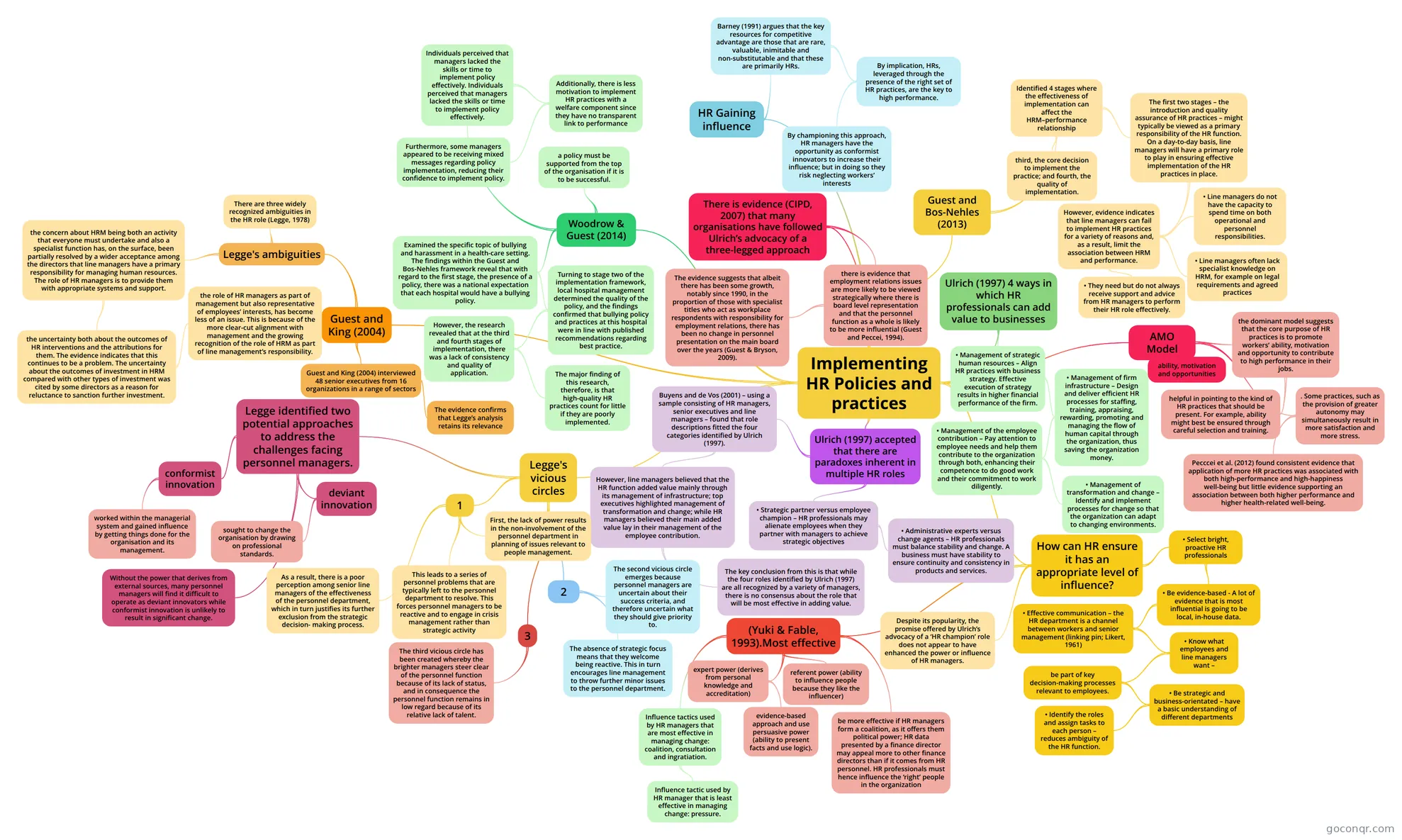
Mind map: Implementing HR policies and practices
Conteúdo do mapa
Implementing HR Policies and practices
Ulrich (1997) 4 ways in which HR professionals can add value to businesses
- • Management of strategic human resources – Align HR practices with business strategy. Effective execution of strategy results in higher financial performance of the firm.
- • Management of firm infrastructure – Design and deliver efficient HR processes for staffing, training, appraising, rewarding, promoting and managing the flow of human capital through the organization, thus saving the organization money.
- • Management of the employee contribution – Pay attention to employee needs and help them contribute to the organization through both, enhancing their competence to do good work and their commitment to work diligently.
- • Management of transformation and change – Identify and implement processes for change so that the organization can adapt to changing environments.
- • Management of the employee contribution – Pay attention to employee needs and help them contribute to the organization through both, enhancing their competence to do good work and their commitment to work diligently.
- • Management of firm infrastructure – Design and deliver efficient HR processes for staffing, training, appraising, rewarding, promoting and managing the flow of human capital through the organization, thus saving the organization money.
- • Management of strategic human resources – Align HR practices with business strategy. Effective execution of strategy results in higher financial performance of the firm.
Ulrich (1997) accepted that there are paradoxes inherent in multiple HR roles
- • Strategic partner versus employee champion – HR professionals may alienate employees when they partner with managers to achieve strategic objectives
- • Administrative experts versus change agents – HR professionals must balance stability and change. A business must have stability to ensure continuity and consistency in products and services.
- Buyens and de Vos (2001) – using a sample consisting of HR managers, senior executives and line managers – found that role descriptions fitted the four categories identified by Ulrich (1997).
- However, line managers believed that the HR function added value mainly through its management of infrastructure; top executives highlighted management of transformation and change; while HR managers believed their main added value lay in their management of the employee contribution.
- The key conclusion from this is that while the four roles identified by Ulrich (1997) are all recognized by a variety of managers, there is no consensus about the role that will be most effective in adding value.
- However, line managers believed that the HR function added value mainly through its management of infrastructure; top executives highlighted management of transformation and change; while HR managers believed their main added value lay in their management of the employee contribution.
- • Strategic partner versus employee champion – HR professionals may alienate employees when they partner with managers to achieve strategic objectives
There is evidence (CIPD, 2007) that many organisations have followed Ulrich’s advocacy of a three-legged approach
- there is evidence that employment relations issues are more likely to be viewed strategically where there is board level representation and that the personnel function as a whole is likely to be more influential (Guest and Peccei, 1994).
- The evidence suggests that albeit there has been some growth, notably since 1990, in the proportion of those with specialist titles who act as workplace respondents with responsibility for employment relations, there has been no change in personnel presentation on the main board over the years (Guest & Bryson, 2009).
- there is evidence that employment relations issues are more likely to be viewed strategically where there is board level representation and that the personnel function as a whole is likely to be more influential (Guest and Peccei, 1994).
Guest and Bos-Nehles (2013)
- Identified 4 stages where the effectiveness of implementation can affect the HRM–performance relationship
- The first two stages – the introduction and quality assurance of HR practices – might typically be viewed as a primary responsibility of the HR function. On a day-to-day basis, line managers will have a primary role to play in ensuring effective implementation of the HR practices in place.
- However, evidence indicates that line managers can fail to implement HR practices for a variety of reasons and, as a result, limit the association between HRM and performance.
- • Line managers do not have the capacity to spend time on both operational and personnel responsibilities.
- • Line managers often lack specialist knowledge on HRM, for example on legal requirements and agreed practices
- • They need but do not always receive support and advice from HR managers to perform their HR role effectively.
- However, evidence indicates that line managers can fail to implement HR practices for a variety of reasons and, as a result, limit the association between HRM and performance.
- third, the core decision to implement the practice; and fourth, the quality of implementation.
- The first two stages – the introduction and quality assurance of HR practices – might typically be viewed as a primary responsibility of the HR function. On a day-to-day basis, line managers will have a primary role to play in ensuring effective implementation of the HR practices in place.
- Identified 4 stages where the effectiveness of implementation can affect the HRM–performance relationship
Woodrow & Guest (2014)
- Examined the specific topic of bullying and harassment in a health-care setting. The findings within the Guest and Bos-Nehles framework reveal that with regard to the first stage, the presence of a policy, there was a national expectation that each hospital would have a bullying policy.
- Turning to stage two of the implementation framework, local hospital management determined the quality of the policy, and the findings confirmed that bullying policy and practices at this hospital were in line with published recommendations regarding best practice.
- However, the research revealed that at the third and fourth stages of implementation, there was a lack of consistency and quality of application.
- The major finding of this research, therefore, is that high-quality HR practices count for little if they are poorly implemented.
- However, the research revealed that at the third and fourth stages of implementation, there was a lack of consistency and quality of application.
- Turning to stage two of the implementation framework, local hospital management determined the quality of the policy, and the findings confirmed that bullying policy and practices at this hospital were in line with published recommendations regarding best practice.
- Individuals perceived that managers lacked the skills or time to implement policy effectively. Individuals perceived that managers lacked the skills or time to implement policy effectively.
- Additionally, there is less motivation to implement HR practices with a welfare component since they have no transparent link to performance
- Furthermore, some managers appeared to be receiving mixed messages regarding policy implementation, reducing their confidence to implement policy.
- Additionally, there is less motivation to implement HR practices with a welfare component since they have no transparent link to performance
- a policy must be supported from the top of the organisation if it is to be successful.
- Examined the specific topic of bullying and harassment in a health-care setting. The findings within the Guest and Bos-Nehles framework reveal that with regard to the first stage, the presence of a policy, there was a national expectation that each hospital would have a bullying policy.
Guest and King (2004)
- Guest and King (2004) interviewed 48 senior executives from 16 organizations in a range of sectors
- The evidence confirms that Legge’s analysis retains its relevance
- Legge's ambiguities
- There are three widely recognized ambiguities in the HR role (Legge, 1978)
- the concern about HRM being both an activity that everyone must undertake and also a specialist function has, on the surface, been partially resolved by a wider acceptance among the directors that line managers have a primary responsibility for managing human resources. The role of HR managers is to provide them with appropriate systems and support.
- the uncertainty both about the outcomes of HR interventions and the attributions for them. The evidence indicates that this continues to be a problem. The uncertainty about the outcomes of investment in HRM compared with other types of investment was cited by some directors as a reason for reluctance to sanction further investment.
- the role of HR managers as part of management but also representative of employees’ interests, has become less of an issue. This is because of the more clear-cut alignment with management and the growing recognition of the role of HRM as part of line management’s responsibility.
- the uncertainty both about the outcomes of HR interventions and the attributions for them. The evidence indicates that this continues to be a problem. The uncertainty about the outcomes of investment in HRM compared with other types of investment was cited by some directors as a reason for reluctance to sanction further investment.
- Guest and King (2004) interviewed 48 senior executives from 16 organizations in a range of sectors
Legge's vicious circles
- 1
- First, the lack of power results in the non-involvement of the personnel department in planning of issues relevant to people management.
- This leads to a series of personnel problems that are typically left to the personnel department to resolve. This forces personnel managers to be reactive and to engage in crisis management rather than strategic activity
- As a result, there is a poor perception among senior line managers of the effectiveness of the personnel department, which in turn justifies its further exclusion from the strategic decision- making process.
- 2
- The second vicious circle emerges because personnel managers are uncertain about their success criteria, and therefore uncertain what they should give priority to.
- The absence of strategic focus means that they welcome being reactive. This in turn encourages line management to throw further minor issues to the personnel department.
- 3
- The third vicious circle has been created whereby the brighter managers steer clear of the personnel function because of its lack of status, and in consequence the personnel function remains in low regard because of its relative lack of talent.
- Legge identified two potential approaches to address the challenges facing personnel managers.
- conformist innovation
- worked within the managerial system and gained influence by getting things done for the organisation and its management.
- deviant innovation
- sought to change the organisation by drawing on professional standards.
- Without the power that derives from external sources, many personnel managers will find it difficult to operate as deviant innovators while conformist innovation is unlikely to result in significant change.
- conformist innovation
- 1
HR Gaining influence
- Barney (1991) argues that the key resources for competitive advantage are those that are rare, valuable, inimitable and non-substitutable and that these are primarily HRs.
- By implication, HRs, leveraged through the presence of the right set of HR practices, are the key to high performance.
- By championing this approach, HR managers have the opportunity as conformist innovators to increase their influence; but in doing so they risk neglecting workers’ interests
- By implication, HRs, leveraged through the presence of the right set of HR practices, are the key to high performance.
- Barney (1991) argues that the key resources for competitive advantage are those that are rare, valuable, inimitable and non-substitutable and that these are primarily HRs.
AMO Model
- the dominant model suggests that the core purpose of HR practices is to promote workers’ ability, motivation and opportunity to contribute to high performance in their jobs.
- helpful in pointing to the kind of HR practices that should be present. For example, ability might best be ensured through careful selection and training.
- ability, motivation and opportunities
- . Some practices, such as the provision of greater autonomy may simultaneously result in more satisfaction and more stress.
- Pecccei et al. (2012) found consistent evidence that application of more HR practices was associated with both high-performance and high-happiness well-being but little evidence supporting an association between both higher performance and higher health-related well-being.
- the dominant model suggests that the core purpose of HR practices is to promote workers’ ability, motivation and opportunity to contribute to high performance in their jobs.
How can HR ensure it has an appropriate level of influence?
- • Select bright, proactive HR professionals
- • Be evidence-based - A lot of evidence that is most influential is going to be local, in-house data.
- • Effective communication – the HR department is a channel between workers and senior management (linking pin; Likert, 1961)
- • Know what employees and line managers want –
- be part of key decision-making processes relevant to employees.
- • Be strategic and business-orientated – have a basic understanding of different departments
- • Identify the roles and assign tasks to each person – reduces ambiguity of the HR function.
- • Be strategic and business-orientated – have a basic understanding of different departments
- be part of key decision-making processes relevant to employees.
- • Know what employees and line managers want –
- • Effective communication – the HR department is a channel between workers and senior management (linking pin; Likert, 1961)
- • Be evidence-based - A lot of evidence that is most influential is going to be local, in-house data.
- Despite its popularity, the promise offered by Ulrich’s advocacy of a ‘HR champion’ role does not appear to have enhanced the power or influence of HR managers.
- (Yuki & Fable, 1993).Most effective
- expert power (derives from personal knowledge and accreditation)
- evidence-based approach and use persuasive power (ability to present facts and use logic).
- referent power (ability to influence people because they like the influencer)
- be more effective if HR managers form a coalition, as it offers them political power; HR data presented by a finance director may appeal more to other finance directors than if it comes from HR personnel. HR professionals must hence influence the ‘right’ people in the organization
- Influence tactics used by HR managers that are most effective in managing change: coalition, consultation and ingratiation.
- Influence tactic used by HR manager that is least effective in managing change: pressure.
- expert power (derives from personal knowledge and accreditation)
- • Select bright, proactive HR professionals
Informações
- Descrição
- Mapa Mental sobre Implementing HR Policies and practices, criado por Tiffany Afia em 23-08-2018.
- Criado por
- Tiffany Afia
- Visualizações
- 0
- Avaliação